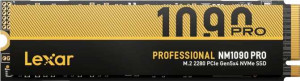
Lexar NM1090 Pro 2TB
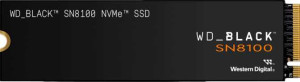
Western Digital WD Black SN8100 1TB

Lexar NM1090 Pro 2TB Western Digital WD Black SN8100 1TB

Overview

Welcome to our in-depth specification comparison between the Lexar NM1090 Pro 2TB and the Western Digital WD Black SN8100 1TB. Both drives share a remarkably similar foundation — PCIe 5.0, NVMe 2.0, the Silicon Motion SM2508 controller, and TLC NAND with a DRAM cache — making this a particularly nuanced head-to-head. The key battlegrounds come down to sequential and random performance, storage capacity, endurance ratings, and benchmark results, where each drive stakes out its own competitive advantage.

Common Features

  • Both drives use the M.2 form factor.
  • Both drives include a DRAM cache.
  • Both drives are NVMe SSDs.
  • Both drives use NVMe version 2.
  • Both drives are powered by the Silicon Motion SM2508 controller.
  • Both drives use TLC NAND flash storage.
  • Both drives connect via PCIe version 5.
  • Both drives feature an 8-channel controller.
  • Sequential write speed is 11000 MB/s on both drives.

Main Differences

  • Sequential read speed is 12000 MB/s on Lexar NM1090 Pro 2TB and 14900 MB/s on Western Digital WD Black SN8100 1TB.
  • Random read speed is 2100000 IOPS on Lexar NM1090 Pro 2TB and 1600000 IOPS on Western Digital WD Black SN8100 1TB.
  • Random write speed is 1800000 IOPS on Lexar NM1090 Pro 2TB and 2400000 IOPS on Western Digital WD Black SN8100 1TB.
  • PassMark score is 72554 on Lexar NM1090 Pro 2TB and 79571 on Western Digital WD Black SN8100 1TB.
  • Storage capacity is 2000GB on Lexar NM1090 Pro 2TB and 1000GB on Western Digital WD Black SN8100 1TB.
  • Terabytes Written (TBW) endurance rating is 1400 TBW on Lexar NM1090 Pro 2TB and 600 TBW on Western Digital WD Black SN8100 1TB.
  • MTBF is 1.5 million hours on Lexar NM1090 Pro 2TB and 1.8 million hours on Western Digital WD Black SN8100 1TB.
Specs Comparison
Lexar NM1090 Pro 2TB

Lexar NM1090 Pro 2TB

Western Digital WD Black SN8100 1TB

Western Digital WD Black SN8100 1TB

Read speed:
sequential read speed 12000 MB/s 14900 MB/s
random read speed 2100000 IOPS 1600000 IOPS

When it comes to read performance, both drives represent the upper tier of consumer NVMe storage, but they each lead in a different dimension. The WD Black SN8100 1TB holds a commanding advantage in sequential read speed at 14,900 MB/s, versus 12,000 MB/s for the Lexar NM1090 Pro 2TB — a roughly 24% gap that is meaningful for large, sustained data transfers such as loading massive game world assets, moving large video files, or reading full OS images.

The picture flips entirely for random reads, where the Lexar NM1090 Pro pulls ahead with 2,100,000 IOPS compared to the SN8100's 1,600,000 IOPS — a 31% lead. Random IOPS governs how quickly a drive handles the constant stream of small, scattered read requests typical of multitasking, application launches, database queries, and boot sequences. In day-to-day desktop use, this metric often has a more perceptible impact on system responsiveness than peak sequential throughput.

Neither drive is a clean winner here — the edge depends entirely on the workload. Users who frequently move large files or work with sequential-heavy pipelines (video editing, backups) will benefit more from the SN8100's sequential lead, while those prioritizing snappy system response under mixed or random I/O loads — the more common real-world scenario — will find the NM1090 Pro's IOPS advantage more tangible. For general-purpose use, the Lexar holds a practical edge; for pure throughput, the WD wins.
Write speed:
sequential write speed 11000 MB/s 11000 MB/s
random write speed 1800000 IOPS 2400000 IOPS

Sequential write speed is a dead heat: both the Lexar NM1090 Pro 2TB and the WD Black SN8100 1TB top out at an identical 11,000 MB/s. For sustained write workloads — exporting large video projects, writing system images, or copying bulk data — neither drive has any meaningful advantage over the other.

The real separation emerges in random write IOPS, and here the SN8100 pulls decisively ahead at 2,400,000 IOPS versus the NM1090 Pro's 1,800,000 IOPS — a 33% gap. Random write performance governs how efficiently a drive handles fragmented, non-sequential data being written simultaneously, which is the dominant pattern during OS operation, application installs, game patch updates, and any workload involving many small concurrent file writes. A drive with higher random write IOPS will feel more fluid under these conditions and is less likely to create bottlenecks in write-intensive multitasking scenarios.

Overall, the SN8100 holds the edge in write performance. The sequential tie means neither drive has the upper hand for bulk transfers, but the SN8100's substantial random write advantage makes it the stronger performer for the varied, real-world write patterns that most users actually encounter. The NM1090 Pro is by no means slow here — 1.8 million write IOPS is still exceptional — but the SN8100 is simply more capable under pressure.

Benchmarks:
PassMark result 72554 79571

PassMark's storage benchmark synthesizes a broad range of read, write, and mixed I/O workloads into a single composite score, making it a useful holistic indicator of real-world drive performance. The WD Black SN8100 1TB scores 79,571 against the Lexar NM1090 Pro 2TB's 72,554 — a roughly 9.7% advantage that aligns with what the individual speed specs already suggested.

A gap of this magnitude in PassMark is meaningful rather than marginal. It indicates the SN8100 consistently outperforms the NM1090 Pro across the variety of mixed workloads the benchmark exercises — not just in one isolated metric. For users who want a single data point to gauge overall drive responsiveness, the SN8100's score reflects a tangibly faster drive in aggregate.

The SN8100 holds a clear benchmark edge. While the NM1090 Pro's score of 72,554 is still firmly high-end, the SN8100 pulls ahead by a consistent margin that mirrors its random write and sequential read leads seen in the raw specs. Users prioritizing peak all-round performance will find the SN8100 the stronger choice based on this data.

General info:
type M2 M2
SSD cache DRAM cache DRAM cache
Is an NVMe SSD
NVMe version 2 2
internal storage 2000GB 1000GB
release date April 2025 May 2025
controller Silicon Motion SM2508 Silicon Motion SM2508
SSD storage type TLC TLC
PCI Express (PCIe) version 5 5
Controller channels 8 8
Terabytes Written (TBW) 1400 600
MTBF 1.5million hours 1.8million hours
warranty period 5 years 5 years
Has an integrated heatsink
has RGB lighting

At the platform level, these two drives are strikingly similar: both use the same Silicon Motion SM2508 controller with 8 channels, the same PCIe 5.0 / NVMe 2.0 interface, TLC NAND with a DRAM cache, and an identical 5-year warranty. This shared foundation explains why their performance profiles are competitive rather than generational — they are built on the same underlying architecture.

The most consequential differences are capacity and endurance. The Lexar NM1090 Pro offers 2TB of storage with a 1,400 TBW endurance rating, while the SN8100 provides 1TB with 600 TBW. The Lexar's endurance advantage is proportional to its larger capacity — more NAND cells mean more write cycles distributed across a bigger pool — so neither drive is unusually aggressive or conservative in its endurance tuning. The SN8100 counters with a slightly higher MTBF of 1.8 million hours versus 1.5 million for the Lexar, suggesting a marginal reliability edge in terms of component longevity, though both figures are well beyond what typical consumer use would ever test.

For general info, there is no single winner — the right choice hinges on the user's priority. Those needing more storage and long-term write headroom lean toward the NM1090 Pro's capacity and TBW advantage, while users satisfied with 1TB who place a premium on the SN8100's slightly higher rated reliability will find it a well-matched alternative. The shared platform means neither choice involves a meaningful architectural trade-off.

Comparison Summary & Verdict

After examining all available specifications, both drives prove to be high-calibre PCIe 5.0 SSDs that share the same core architecture. The Western Digital WD Black SN8100 1TB pulls ahead in raw sequential read speed at 14900 MB/s, random write performance at 2400000 IOPS, and achieves a higher PassMark score of 79571, along with a superior MTBF of 1.8 million hours — making it the stronger choice for users who demand peak throughput and reliability in a 1TB form. The Lexar NM1090 Pro 2TB, on the other hand, offers double the storage capacity, a significantly higher TBW endurance rating of 1400, and superior random read speeds at 2100000 IOPS, making it ideal for power users and content creators who need ample, long-lasting storage above all else.

Lexar NM1090 Pro 2TB
Buy Lexar NM1090 Pro 2TB if...

Buy the Lexar NM1090 Pro 2TB if you need maximum storage capacity and long-term endurance, with its 2TB capacity, 1400 TBW rating, and superior random read speed making it ideal for heavy workloads and large data storage.

Western Digital WD Black SN8100 1TB
Buy Western Digital WD Black SN8100 1TB if...

Buy the Western Digital WD Black SN8100 1TB if you prioritize peak sequential read performance and faster random write speeds, backed by a higher benchmark score and a best-in-class MTBF reliability rating.