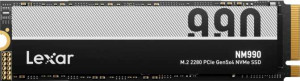
Lexar NM990 2TB
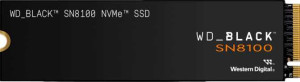
Western Digital WD Black SN8100 4TB

Lexar NM990 2TB Western Digital WD Black SN8100 4TB

Overview

Welcome to our detailed specification comparison between the Lexar NM990 2TB and the Western Digital WD Black SN8100 4TB, two high-performance PCIe 5.0 NVMe SSDs competing at the cutting edge of consumer storage. Both drives share a strong foundation — M.2 form factor, DRAM cache, and a 5-year warranty — but key battlegrounds emerge around read and write speeds, endurance ratings, and overall benchmark performance. Read on to see how these two drives stack up across every major specification.

Common Features

  • Both drives use the M.2 form factor.
  • Both drives feature a DRAM cache.
  • Both drives are NVMe SSDs.
  • Both drives use PCIe version 5.
  • Both drives have 8 controller channels.
  • Both drives come with a 5-year warranty.
  • Neither drive has an integrated heatsink.
  • Neither drive has RGB lighting.

Main Differences

  • Sequential read speed is 14000 MB/s on Lexar NM990 2TB and 14900 MB/s on Western Digital WD Black SN8100 4TB.
  • Random read speed is 2000000 IOPS on Lexar NM990 2TB and 2300000 IOPS on Western Digital WD Black SN8100 4TB.
  • Sequential write speed is 10000 MB/s on Lexar NM990 2TB and 14000 MB/s on Western Digital WD Black SN8100 4TB.
  • Random write speed is 1400000 IOPS on Lexar NM990 2TB and 2400000 IOPS on Western Digital WD Black SN8100 4TB.
  • PassMark score is 72310 on Lexar NM990 2TB and 90689 on Western Digital WD Black SN8100 4TB.
  • Internal storage capacity is 2000GB on Lexar NM990 2TB and 4000GB on Western Digital WD Black SN8100 4TB.
  • Terabytes Written (TBW) endurance rating is 1500 TBW on Lexar NM990 2TB and 2400 TBW on Western Digital WD Black SN8100 4TB.
Specs Comparison
Lexar NM990 2TB

Lexar NM990 2TB

Western Digital WD Black SN8100 4TB

Western Digital WD Black SN8100 4TB

Read speed:
sequential read speed 14000 MB/s 14900 MB/s
random read speed 2000000 IOPS 2300000 IOPS

Both drives operate at the very top tier of consumer NVMe performance, but the WD Black SN8100 4TB holds a measurable edge across both read metrics. Its sequential read speed of 14900 MB/s edges out the Lexar NM990's 14000 MB/s — a roughly 6.4% difference that translates to faster large-file transfers, such as moving multi-gigabyte video projects or game installs.

The more meaningful gap appears in random read performance: the SN8100 reaches 2,300,000 IOPS versus the NM990's 2,000,000 IOPS — a 15% advantage. Random IOPS governs how quickly a drive handles the thousands of small, scattered read requests typical of OS boot times, application launches, and database queries. In everyday use, this gap is more likely to be felt than the sequential difference.

Both drives are genuinely elite performers, and neither will feel slow in any real-world scenario. However, based strictly on the provided specs, the WD Black SN8100 has a clear read-speed advantage — particularly in random workloads where its lead is substantial enough to matter in latency-sensitive tasks.

Write speed:
sequential write speed 10000 MB/s 14000 MB/s
random write speed 1400000 IOPS 2400000 IOPS

Write performance is where the gap between these two drives widens considerably. The SN8100 achieves a sequential write speed of 14000 MB/s — 40% faster than the NM990's 10000 MB/s. That kind of difference is directly felt when capturing high-bitrate video straight to the drive, writing large backups, or transferring entire game libraries between storage devices.

The random write disparity is even more striking: 2,400,000 IOPS on the SN8100 versus 1,400,000 IOPS on the NM990 — a 71% lead. Random write IOPS determine how efficiently a drive handles fragmented, concurrent write operations, which are common in creative workflows involving simultaneous file saving, compilation tasks, and virtual machine activity. A gap of this magnitude puts the two drives in practically different performance tiers for write-intensive workloads.

The verdict here is unambiguous: the WD Black SN8100 holds a dominant write-speed advantage across both sequential and random metrics. The NM990 remains a strong performer in absolute terms, but users whose workloads lean heavily on sustained or parallel writes will find the SN8100 meaningfully faster in practice.

Benchmarks:
PassMark result 72310 90689

PassMark scores synthesize a range of read, write, and seek operations into a single composite figure, making them a useful cross-check against raw spec claims. The SN8100 scores 90,689 compared to the NM990's 72,310 — a margin of roughly 25%. This aligns closely with the pattern seen in the raw specs: the SN8100 consistently outperforms across the board, and the benchmark confirms that advantage isn't limited to any single metric.

A 25% lead in PassMark is significant. Drives that score in the 70,000–75,000 range are already exceptional, but crossing the 90,000 threshold puts the SN8100 among the fastest consumer NVMe drives available. For users who rely on benchmark scores as a purchasing shorthand, this gap is large enough to be meaningful rather than a statistical footnote.

Based on the provided benchmark data, the WD Black SN8100 holds a clear and consistent advantage. The Lexar NM990 is by no means a weak performer — a score above 72,000 is firmly elite — but the SN8100's lead is substantial enough to be the objective choice for anyone prioritizing peak overall drive performance.

General info:
type M2 M2
SSD cache DRAM cache DRAM cache
Is an NVMe SSD
internal storage 2000GB 4000GB
release date June 2025 May 2025
PCI Express (PCIe) version 5 5
Controller channels 8 8
Terabytes Written (TBW) 1500 2400
warranty period 5 years 5 years
Has an integrated heatsink
has RGB lighting

At the foundational level, these two drives share a remarkably similar profile: both are M.2 NVMe SSDs with DRAM cache, PCIe 5.0 interfaces, 8 controller channels, and identical 5-year warranties. The shared PCIe 5.0 interface is what enables the extreme speeds seen in both drives, and the DRAM cache ensures consistent low-latency access under sustained workloads — neither drive cuts corners on the core architecture.

The two meaningful differentiators in this group are capacity and endurance. The SN8100 doubles the storage at 4TB versus 2TB on the NM990, and its TBW rating of 2,400 significantly outpaces the NM990's 1,500 TBW. TBW — terabytes written — is a manufacturer's rated lifespan figure; the SN8100's 60% higher rating means it is rated to handle substantially more cumulative write activity before wear becomes a concern, making it a stronger fit for write-heavy professional environments over the long term.

Since form factor, cache type, interface, channel count, and warranty are all identical, the SN8100 holds the clear edge in this group purely on capacity and longevity. For users who need more storage headroom or expect heavy sustained use over many years, that combination is a tangible advantage. The NM990's specs are entirely competitive for moderate workloads — the gap simply comes down to scale.

Comparison Summary & Verdict

After examining all the evidence, both drives are premium PCIe 5.0 NVMe SSDs that share important qualities: M.2 form factor, DRAM cache, 8 controller channels, and a solid 5-year warranty. However, the Western Digital WD Black SN8100 4TB holds a consistent performance edge, delivering higher sequential read (14900 MB/s) and sequential write (14000 MB/s) speeds, superior random IOPS, a significantly better PassMark score of 90689, and a higher TBW endurance rating of 2400. The Lexar NM990 2TB remains a compelling option for users who need a capable, fast PCIe 5.0 drive with a smaller capacity footprint. The WD Black SN8100 4TB is the stronger all-round performer and suits those who demand maximum throughput and long-term endurance.

Lexar NM990 2TB
Buy Lexar NM990 2TB if...

Buy the Lexar NM990 2TB if you need a fast PCIe 5.0 NVMe SSD with a 2TB capacity and strong sequential performance at what is likely a more accessible price point.

Western Digital WD Black SN8100 4TB
Buy Western Digital WD Black SN8100 4TB if...

Buy the Western Digital WD Black SN8100 4TB if you want the best possible sequential and random performance, a higher endurance rating of 2400 TBW, and double the storage capacity.