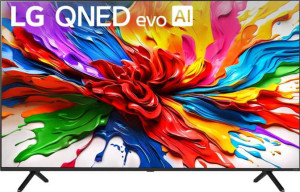
LG 85QNED92AUA 85"
Panasonic TV-65W93BE9 65"

LG 85QNED92AUA 85" Panasonic TV-65W93BE9 65"

Overview

Welcome to our in-depth spec comparison between the LG 85QNED92AUA 85″ and the Panasonic TV-65W93BE9 65″. These two 4K TVs share a strong common foundation, yet diverge in meaningful ways across display technology, refresh rate, audio hardware, and connectivity. Whether screen real estate or sharper pixel density matters more to you, this breakdown will help you weigh each set's strengths before making your decision.

Common Features

  • Both TVs have a 4K (UHD) display resolution.
  • Both TVs share a resolution of 3840 x 2160 px.
  • Both TVs are capable of displaying 1070 million colors.
  • Both TVs have a 10-bit color bit depth.
  • HDR10 support is available on both TVs.
  • Dolby Vision support is available on both TVs.
  • HLG support is available on both TVs.
  • Both TVs support AMD FreeSync and AMD FreeSync Premium adaptive synchronization.
  • Both TVs have Bluetooth connectivity.
  • Both TVs are equipped with HDMI 2.1 ports.
  • Both TVs have 4 HDMI ports.
  • Both TVs support Wi-Fi.
  • Both TVs have 2 USB ports.
  • Both TVs have 1 RJ45 port.
  • Miracast support is available on both TVs.
  • Neither TV has an external memory slot.
  • Dolby Digital support is available on both TVs.
  • Digital Out support is available on both TVs.
  • Dolby Digital Plus support is available on both TVs.
  • SRS TheaterSound HD is not available on either TV.
  • Both TVs have stereo speakers.
  • Dolby Atmos support is available on both TVs.
  • Dolby Audio support is available on both TVs.
  • Dolby Virtual support is not available on either TV.
  • Both TVs support VESA mounting.
  • AirPlay support is available on both TVs.
  • Both TVs have a built-in smart TV platform.
  • Both TVs are compatible with Google Assistant.
  • Both TVs work with Alexa.
  • Siri and Apple HomeKit support is not available on either TV.
  • Both TVs support remote control via smartphone.
  • Neither TV has a rechargeable remote control.
  • USB recording is supported on both TVs.

Main Differences

  • The display type is Mini-LED, LCD, LED-backlit on LG 85QNED92AUA 85″ and LED-backlit, LCD on Panasonic TV-65W93BE9 65″.
  • The screen size is 84.5″ on LG 85QNED92AUA 85″ and 65″ on Panasonic TV-65W93BE9 65″.
  • The pixel density is 52 ppi on LG 85QNED92AUA 85″ and 68 ppi on Panasonic TV-65W93BE9 65″.
  • The refresh rate is 120Hz on LG 85QNED92AUA 85″ and 144Hz on Panasonic TV-65W93BE9 65″.
  • HDR10+ support is present on Panasonic TV-65W93BE9 65″ but not available on LG 85QNED92AUA 85″.
  • The Wi-Fi versions supported are Wi-Fi 4, Wi-Fi 5, Wi-Fi 6, and Wi-Fi 6E on LG 85QNED92AUA 85″, while Panasonic TV-65W93BE9 65″ supports only Wi-Fi 4 and Wi-Fi 5.
  • A 3.5 mm audio jack socket is present on Panasonic TV-65W93BE9 65″ but not available on LG 85QNED92AUA 85″.
  • A built-in subwoofer is present on LG 85QNED92AUA 85″ but not available on Panasonic TV-65W93BE9 65″.
  • The width is 1889.8 mm on LG 85QNED92AUA 85″ and 1453 mm on Panasonic TV-65W93BE9 65″.
  • The weight is 35199 g on LG 85QNED92AUA 85″ and 25500 g on Panasonic TV-65W93BE9 65″.
  • The thickness is 60.9 mm on LG 85QNED92AUA 85″ and 83 mm on Panasonic TV-65W93BE9 65″.
  • The height is 1082 mm on LG 85QNED92AUA 85″ and 840 mm on Panasonic TV-65W93BE9 65″.
  • The volume is 124526.10324 cm³ on LG 85QNED92AUA 85″ and 101303.16 cm³ on Panasonic TV-65W93BE9 65″.
Specs Comparison
LG 85QNED92AUA 85"

LG 85QNED92AUA 85"

Panasonic TV-65W93BE9 65"

Panasonic TV-65W93BE9 65"

Display:
display resolution 4K (UHD) 4K (UHD)
Display type Mini-LED, LCD, LED-backlit LED-backlit, LCD
screen size 84.5" 65"
resolution 3840 x 2160 px 3840 x 2160 px
pixel density 52 ppi 68 ppi
display colors 1070 million 1070 million
bit depth 10-bit 10-bit
refresh rate 120Hz 144Hz
supports HDR10
supports HDR10+
supports Dolby Vision
supports HLG
Adaptive synchronization AMD FreeSync, AMD FreeSync Premium AMD FreeSync, AMD FreeSync Premium
has anti-reflection coating
has an ambient light sensor
maximum horizontal viewing angle 178º 178º
maximum vertical viewing angle 178º 178º

Both the LG 85QNED92AUA and the Panasonic TV-65W93BE9 share a strong display foundation: native 4K (3840 x 2160) resolution, a 10-bit panel capable of rendering 1.07 billion colors, and identical viewing angles of 178° horizontally and vertically. They also both carry anti-reflection coatings and ambient light sensors, and support the same adaptive sync stack — AMD FreeSync and FreeSync Premium — which matters for gamers connecting a compatible GPU or console.

The more meaningful differences emerge in three areas. First, the LG uses a Mini-LED backlighting layer on top of standard LCD, which typically enables finer local dimming zones and improved contrast versus a conventional LED-backlit LCD like the Panasonic — though neither spec table confirms peak brightness or dimming zone counts directly. Second, the Panasonic edges ahead on motion with a 144Hz native refresh rate versus the LG's 120Hz, a practical advantage in fast-motion content and gaming. Third, on HDR format coverage, the Panasonic supports HDR10+ in addition to HDR10, Dolby Vision, and HLG — giving it the complete set of major HDR standards, whereas the LG is missing HDR10+. For users whose streaming services or disc libraries lean on HDR10+ content (common on Amazon Prime Video and select 4K Blu-rays), this is a real-world gap. The LG's 84.5″ panel versus the Panasonic's 65″ makes pixel density run in the opposite direction: the Panasonic achieves 68 ppi versus the LG's 52 ppi, meaning the image will appear slightly sharper up close despite identical resolution — a natural consequence of fitting the same pixel count into a smaller screen.

On balance, the Panasonic TV-65W93BE9 holds a modest but clear display advantage in specs alone: it covers all four major HDR formats, refreshes faster at 144Hz, and delivers a higher pixel density. The LG's Mini-LED architecture is a potential counterweight on the contrast front, but that advantage is inferential from the panel type rather than confirmed by the provided data. If HDR format completeness and refresh rate matter most, the Panasonic leads; if sheer screen real estate is the priority, the LG's 85-inch footprint is in a different category entirely.
Connectivity:
Has Bluetooth
HDMI version HDMI 2.1 HDMI 2.1
HDMI ports 4 4
supports Wi-Fi
Wi-Fi version Wi-Fi 4 (802.11n), Wi-Fi 5 (802.11ac), Wi-Fi 6 (802.11ax), Wi-Fi 6E (802.11ax) Wi-Fi 4 (802.11n), Wi-Fi 5 (802.11ac)
USB ports 2 2
RJ45 ports 1 1
supports Miracast
has a socket for a 3.5 mm audio jack
has an external memory slot
has a VGA connector
has a DVI connector

At the wired level, these two TVs are effectively identical: both offer 4 HDMI 2.1 ports, 2 USB ports, and a single RJ45 ethernet jack. HDMI 2.1 is the current gold standard for home theater connectivity, supporting 4K at 120Hz and 8K signals, uncompressed audio passthrough, and gaming features like VRR — so neither TV is leaving bandwidth on the table for external devices.

Wireless connectivity is where a meaningful gap opens. The LG 85QNED92AUA supports Wi-Fi 6E (802.11ax) in addition to Wi-Fi 6, 5, and 4, while the Panasonic TV-65W93BE9 tops out at Wi-Fi 5 (802.11ac). In practice, Wi-Fi 6E unlocks access to the 6GHz band — a less congested spectrum that delivers faster throughput and lower latency, particularly valuable in dense apartment environments or households with many connected devices. For 4K HDR streaming and future-proofing, this is a tangible LG advantage. Both support Miracast for wireless screen mirroring, and both have Bluetooth, though neither spec entry confirms the Bluetooth version, limiting deeper analysis there.

One counterpoint in the Panasonic's favor: it includes a 3.5mm audio jack, which the LG omits entirely. For users who want to plug in wired headphones directly to the TV — useful for late-night viewing without disturbing others — this is a small but genuinely practical differentiator. Overall though, the LG 85QNED92AUA holds the connectivity edge, primarily driven by its superior Wi-Fi 6E support, which the Panasonic cannot match.

Audio:
supports Dolby Digital
supports Digital Out
supports Dolby Digital Plus
has SRS TheaterSound HD
has stereo speakers
has Dolby Atmos
has Dolby Audio
supports Dolby Virtual
has a subwoofer
HDMI ARC / eARC HDMI ARC, HDMI eARC HDMI ARC, HDMI eARC

Across the audio format landscape, these two TVs are a near-perfect match. Both decode Dolby Atmos, Dolby Digital Plus, and carry full HDMI ARC and eARC support — meaning either set can pass lossless, object-based surround sound from a compatible soundbar or AV receiver without any signal degradation. For users who rely on an external audio setup, this shared foundation ensures neither TV creates a bottleneck in the audio chain.

The sole hardware differentiator is that the LG 85QNED92AUA includes a built-in subwoofer, while the Panasonic TV-65W93BE9 does not. A dedicated subwoofer handles low-frequency reproduction — the deep bass that gives explosions weight and music body — which a standard stereo speaker array struggles to reproduce convincingly. For viewers who plan to use the TV's internal speakers without an external audio system, this gives the LG a meaningful advantage in perceived audio fullness and cinematic impact.

The verdict here depends entirely on the user's audio setup. Anyone connecting a soundbar or home theater system will find both TVs equally capable, with eARC ensuring the cleanest possible signal transfer. For those watching in speaker-only mode, the LG's integrated subwoofer delivers a more complete out-of-the-box experience — making it the stronger choice for standalone audio performance based on the provided specs.

Design:
width 1889.8 mm 1453 mm
weight 35199 g 25500 g
thickness 60.9 mm 83 mm
height 1082 mm 840 mm
volume 124526.10324 cm³ 101303.16 cm³
Supports VESA mount

Comparing the physical design of these two TVs requires acknowledging upfront that they occupy fundamentally different size categories — 84.5″ versus 65″ — so raw dimension differences are largely expected rather than meaningful design trade-offs. The LG's width of 1889.8 mm versus the Panasonic's 1453 mm is a direct consequence of that screen size gap, and the same logic applies to height and overall volume. Both support VESA mounting, so wall installation is an option for either set.

Where a genuine design distinction exists is in thickness. Despite being the larger TV, the LG 85QNED92AUA is notably slimmer at 60.9 mm deep, compared to the Panasonic TV-65W93BE9's 83 mm. That roughly 22 mm difference is perceptible in practice — particularly for wall-mount installations where a shallower profile sits closer to the wall and looks cleaner. Weight follows the expected pattern: the LG comes in at 35.2 kg versus the Panasonic's 25.5 kg, which matters during installation; both TVs will typically require two people to handle safely, but the LG's additional mass makes careful wall-mount planning more critical.

There is no clear overall design winner here since the size classes are mismatched, but the LG does earn a specific edge for its slimmer profile relative to its footprint — an impressive engineering outcome for an 85-inch panel. Users prioritizing a low-profile wall installation will find the LG's thinner chassis more accommodating, while those working within tighter room constraints will naturally gravitate toward the more compact Panasonic.

Features:
release date April 2025 May 2025
has AirPlay
has built-in smart TV
compatible with Google Assistant
works with Alexa
works with Siri/Apple HomeKit
supports a remote smartphone
has a rechargeable remote control
supports USB recording
standby power consumption 0.5W 0.5W
has a search browser
has a sleep timer
has a child lock
has voice commands

Rarely does a spec group land as a perfect tie, but the Features category here is exactly that — every single data point is identical between the LG 85QNED92AUA and the Panasonic TV-65W93BE9. Both carry built-in smart TV platforms, support AirPlay, respond to Google Assistant and Alexa voice commands, and allow smartphone remote control. Neither supports Apple HomeKit or Siri, which is worth noting for households deeply embedded in the Apple ecosystem.

A few shared features deserve particular attention for their practical value. USB recording — the ability to record live broadcast content directly to an attached USB drive — is a genuinely useful feature that not all smart TVs include, and both sets offer it. Standby power consumption of 0.5W on both is impressively low and will have a negligible impact on electricity bills even over years of use. The absence of a rechargeable remote control on both means users will need to keep disposable or rechargeable AA/AAA batteries on hand, a minor but recurring inconvenience.

With zero differentiation across all provided feature specs, this group is an unambiguous tie. Neither TV offers a feature advantage over the other, and a buyer's decision should rest entirely on the distinctions uncovered in other spec groups — display technology, connectivity, and audio — rather than anything in the features category.

Comparison Summary & Verdict

Both the LG 85QNED92AUA 85″ and the Panasonic TV-65W93BE9 65″ are capable 4K displays with solid shared credentials, including Dolby Vision, Dolby Atmos, four HDMI 2.1 ports, and full smart TV platforms. Where they diverge is telling: the LG brings a larger 84.5″ Mini-LED panel with a built-in subwoofer and newer Wi-Fi 6E support, making it the stronger choice for home cinema enthusiasts who want a commanding screen and richer out-of-the-box sound. The Panasonic counters with a 144Hz refresh rate, higher 68 ppi pixel density, HDR10+ support, and a 3.5 mm audio jack, giving it an edge for gamers and those who value picture precision on a more compact 65″ footprint. Choose accordingly based on your room size and primary use case.

LG 85QNED92AUA 85
Buy LG 85QNED92AUA 85" if...

Buy the LG 85QNED92AUA 85″ if you want a massive Mini-LED screen with a built-in subwoofer, cutting-edge Wi-Fi 6E connectivity, and an immersive home cinema experience.

Panasonic TV-65W93BE9 65
Buy Panasonic TV-65W93BE9 65" if...

Buy the Panasonic TV-65W93BE9 65″ if you prioritize a higher 144Hz refresh rate, HDR10+ support, and a sharper pixel density in a more compact and lighter form factor.