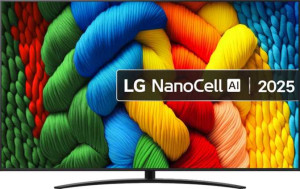
LG 86NANO81A6A 86"
TCL 75C6KS 75"

LG 86NANO81A6A 86" TCL 75C6KS 75"

Overview

Welcome to our detailed spec comparison between the LG 86NANO81A6A 86″ and the TCL 75C6KS 75″. These two large-screen 4K TVs share a surprising number of features, yet diverge significantly in areas that matter most to discerning buyers. From display technology and refresh rate to overall size, weight, and audio performance, this head-to-head breakdown will help you determine which television best suits your living room and viewing habits.

Common Features

  • Both TVs offer 4K (UHD) display resolution at 3840 x 2160 px.
  • Both TVs display 1070 million colors with a 10-bit bit depth.
  • HDR10 support is available on both products.
  • HDR10+ support is available on both products.
  • Dolby Vision support is available on both products.
  • HLG support is available on both products.
  • Bluetooth connectivity is available on both products.
  • Both TVs feature HDMI 2.1 ports.
  • Wi-Fi is supported on both products, with Wi-Fi 4 (802.11n) and Wi-Fi 5 (802.11ac).
  • Both TVs include 2 USB ports and 1 RJ45 port.
  • Miracast support is available on both products.
  • A 3.5 mm audio jack socket is present on both products.
  • Dolby Digital support is available on both products.
  • Both TVs deliver an audio output power of 2 x 10W.
  • Digital Out support is available on both products.
  • Dolby Digital Plus support is available on both products.
  • SRS TheaterSound HD is not available on either product.
  • Both TVs feature stereo speakers.
  • Dolby Atmos and Dolby Audio are available on both products.
  • Both TVs support VESA mounting.
  • AirPlay is available on both products.
  • Both TVs have a built-in smart TV platform.
  • Google Assistant compatibility is available on both products.
  • Siri and Apple HomeKit support is not available on either product.
  • Remote smartphone control is supported on both products.
  • Neither TV includes a rechargeable remote control.
  • USB recording is supported on both products.
  • Both TVs have a standby power consumption of 0.5W.

Main Differences

  • The display technology is LED-backlit LCD on LG 86NANO81A6A 86″ and QLED LED-backlit LCD with Mini-LED on TCL 75C6KS 75″.
  • Screen size is 86″ on LG 86NANO81A6A 86″ and 74.5″ on TCL 75C6KS 75″.
  • Pixel density is 51 ppi on LG 86NANO81A6A 86″ and 59 ppi on TCL 75C6KS 75″.
  • Refresh rate is 60Hz on LG 86NANO81A6A 86″ and 120Hz on TCL 75C6KS 75″.
  • HDMI port count is 3 on LG 86NANO81A6A 86″ and 4 on TCL 75C6KS 75″.
  • Bluetooth version is 5.1 on LG 86NANO81A6A 86″ and 5.4 on TCL 75C6KS 75″.
  • A built-in subwoofer is not present on LG 86NANO81A6A 86″ but is included on TCL 75C6KS 75″.
  • Width is 1927 mm on LG 86NANO81A6A 86″ and 1670 mm on TCL 75C6KS 75″.
  • Weight is 48900 g on LG 86NANO81A6A 86″ and 23500 g on TCL 75C6KS 75″.
  • Thickness is 59.9 mm on LG 86NANO81A6A 86″ and 56.7 mm on TCL 75C6KS 75″.
  • Height is 1104 mm on LG 86NANO81A6A 86″ and 960 mm on TCL 75C6KS 75″.
  • Volume is 127431.74 cm³ on LG 86NANO81A6A 86″ and 90901.44 cm³ on TCL 75C6KS 75″.
  • Maximum operating temperature is 40 °C on LG 86NANO81A6A 86″ and 35 °C on TCL 75C6KS 75″.
  • Lowest potential operating temperature is 0 °C on LG 86NANO81A6A 86″ and 5 °C on TCL 75C6KS 75″.
Specs Comparison
LG 86NANO81A6A 86"

LG 86NANO81A6A 86"

TCL 75C6KS 75"

TCL 75C6KS 75"

Display:
display resolution 4K (UHD) 4K (UHD)
Display type LED-backlit, LCD QLED, LED-backlit, LCD, Mini-LED
screen size 86" 74.5"
resolution 3840 x 2160 px 3840 x 2160 px
pixel density 51 ppi 59 ppi
display colors 1070 million 1070 million
bit depth 10-bit 10-bit
refresh rate 60Hz 120Hz
supports HDR10
supports HDR10+
supports Dolby Vision
supports HLG
has anti-reflection coating
has an ambient light sensor
maximum horizontal viewing angle 178º 178º
maximum vertical viewing angle 178º 178º

Both the LG 86NANO81A6A and the TCL 75C6KS deliver 4K UHD resolution at 3840 x 2160 px, with 10-bit color depth and 1.07 billion displayable colors. They share identical HDR format support — HDR10, HDR10+, Dolby Vision, and HLG — meaning neither has an edge in content compatibility. Anti-reflection coating and an ambient light sensor are also present on both, as are the maximum 178° horizontal and vertical viewing angles, so neither TV will disadvantage off-axis viewers.

Where the panels diverge meaningfully is in technology and motion handling. The TCL uses a QLED Mini-LED panel — a significant step up from the LG's standard LED-backlit LCD (NanoCell). Mini-LED backlighting enables far more precise local dimming zones, translating to deeper blacks, brighter highlights, and better contrast in HDR content. More critically, the TCL's 120Hz refresh rate versus the LG's 60Hz is a major real-world differentiator: fast motion, sports, and gaming all benefit substantially from the higher panel refresh rate, which also enables Variable Refresh Rate and smoother frame interpolation. Despite being the smaller set, the TCL's 59 ppi pixel density also edges out the LG's 51 ppi, meaning images are marginally sharper at equivalent viewing distances.

The LG's 86″ screen size is its strongest counter-argument — for large living rooms where immersive scale matters more than panel precision, the extra 11.5 inches of diagonal is tangible. But on pure display quality metrics, the TCL 75C6KS holds a clear technical edge: its superior panel technology, doubled refresh rate, and higher pixel density make it the more capable display for the majority of viewing scenarios.

Connectivity:
Has Bluetooth
HDMI version HDMI 2.1 HDMI 2.1
HDMI ports 3 4
supports Wi-Fi
Wi-Fi version Wi-Fi 4 (802.11n), Wi-Fi 5 (802.11ac) Wi-Fi 4 (802.11n), Wi-Fi 5 (802.11ac)
Bluetooth version 5.1 5.4
USB ports 2 2
RJ45 ports 1 1
supports Miracast
has a socket for a 3.5 mm audio jack
has an external memory slot
has a VGA connector
DVB standards DVB-T, DVB-T2, DVB-C, DVB-S, DVB-S2 DVB-T, DVB-T2, DVB-C, DVB-S, DVB-S2
has a DVI connector

The connectivity foundations of both TVs are largely identical: HDMI 2.1, dual USB ports, an RJ45 ethernet port, Wi-Fi 5, Miracast, a 3.5mm audio jack, and a matching set of DVB tuner standards. For most users, this common ground covers all the essentials comfortably, and the shared Wi-Fi 5 (802.11ac) support means both will handle 4K streaming without issue on a capable home network.

Two specs separate them, and both favor the TCL. First, it offers 4 HDMI ports versus the LG's 3 — a practically meaningful difference for users running a full entertainment setup (gaming console, soundbar, streaming device, Blu-ray player) who would otherwise need a switch. Second, the TCL's Bluetooth 5.4 is a notable generational step ahead of the LG's Bluetooth 5.1. The newer version brings improved connection stability, lower latency, and better handling of multiple simultaneous Bluetooth devices — relevant for wireless headphones, game controllers, or audio accessories.

Neither TV offers an external memory slot, and both lack legacy connectors like VGA or DVI, which is appropriate for modern sets. Overall, the TCL 75C6KS holds a modest but real connectivity edge — the extra HDMI port and newer Bluetooth standard give it more practical flexibility without any trade-offs elsewhere in this category.

Audio:
supports Dolby Digital
audio output power 2 x 10W 2 x 10W
supports Digital Out
supports Dolby Digital Plus
has SRS TheaterSound HD
has stereo speakers
has Dolby Atmos
has Dolby Audio
supports Dolby Virtual
has a subwoofer
HDMI ARC / eARC HDMI ARC, HDMI eARC HDMI eARC, HDMI ARC

In terms of audio format support, these two TVs are perfectly matched. Both deliver 2 x 10W stereo output with Dolby Atmos, Dolby Audio, Dolby Digital Plus, and Digital Out, alongside both HDMI ARC and eARC — the latter being the more capable standard that supports lossless audio passthrough to a compatible soundbar or AV receiver. For users routing audio externally, eARC on both sets means no compromise there.

The single differentiator in this category is the TCL's inclusion of a built-in subwoofer, which the LG lacks. A dedicated subwoofer handles low-frequency reproduction that stereo drivers alone struggle with, meaning the TCL should deliver more perceptible bass depth straight out of the box — an advantage particularly noticeable during action sequences, music, and cinematic content. At the same total output wattage of 20W, the TCL is simply distributing that power more effectively across the frequency range.

That said, neither TV is designed to replace a dedicated sound system, and the 20W ceiling limits both regardless of speaker configuration. Users planning to connect an external soundbar or AV receiver will largely neutralize this difference. For those relying solely on the TV's built-in audio, however, the TCL 75C6KS holds a clear edge thanks to its subwoofer — the only meaningful distinction in this otherwise identical category.

Design:
width 1927 mm 1670 mm
weight 48900 g 23500 g
thickness 59.9 mm 56.7 mm
height 1104 mm 960 mm
volume 127431.7392 cm³ 90901.44 cm³
Supports VESA mount
maximum operating temperature 40 °C 35 °C
lowest potential operating temperature 0 °C 5 °C

Screen size alone explains much of the physical disparity here, but the numbers are still striking. The LG weighs in at 48.9 kg compared to the TCL's 23.5 kg — more than double — and its footprint is substantially larger at 1927 mm wide versus 1670 mm. For installation, this is a critical practical consideration: the LG will almost certainly require two people and careful wall reinforcement if mounted, while the TCL's relative lightness makes handling and positioning significantly more manageable. Both support VESA mounting, so neither is restricted to stand use.

Thickness is the one dimension where the gap closes considerably — 59.9 mm for the LG versus 56.7 mm for the TCL — a difference that is negligible in real-world placement. The overall volume difference (roughly 127,400 cm³ vs 90,900 cm³) simply reflects the screen size gap and carries no independent design implication.

On operating temperature tolerance, the LG holds a slight edge: it functions between 0–40 °C versus the TCL's 5–35 °C range. This is a minor but real distinction for installations in garages, sunrooms, or poorly climate-controlled spaces where temperatures could drift toward either extreme. Overall, the TCL's dramatically lower weight makes it the more practical set to install and reposition, while the LG's size naturally dominates any room it occupies — a trade-off each buyer must weigh against their space and setup requirements.

Features:
release date April 2025 March 2025
has AirPlay
has built-in smart TV
compatible with Google Assistant
works with Siri/Apple HomeKit
supports a remote smartphone
has a rechargeable remote control
supports USB recording
standby power consumption 0.5W 0.5W
has a search browser
has a sleep timer
has a child lock
has voice commands

This is a rare case of a complete feature draw. Across every single specification in this group, the LG 86NANO81A6A and the TCL 75C6KS are identical — from AirPlay and Google Assistant compatibility to USB recording, smartphone remote support, voice commands, and a matching 0.5W standby power consumption. Neither supports Apple HomeKit or Siri, and neither ships with a rechargeable remote.

The shared feature set is genuinely well-rounded for modern smart TV use. AirPlay allows seamless content mirroring from Apple devices without cables, Google Assistant enables hands-free control and smart home integration, and USB recording lets users capture broadcast content directly to an external drive — a feature increasingly absent on budget-tier sets. The identical standby draw means neither will meaningfully impact energy bills when idle.

With no differentiating data point to separate them, this category is a definitive tie. Buyers prioritizing smart features and ecosystem compatibility will find both TVs equally capable — the decision here comes down entirely to the other specification groups.

Comparison Summary & Verdict

After examining every specification, a clear picture emerges for each buyer type. The LG 86NANO81A6A 86″ is the better fit if sheer screen size is your priority — its 86-inch panel dominates any room and operates across a wider temperature range (0–40 °C), making it slightly more versatile in challenging environments. However, the TCL 75C6KS 75″ punches hard on picture quality thanks to its QLED Mini-LED display and higher pixel density of 59 ppi, and its 120Hz refresh rate makes it a compelling choice for sports fans and gamers. The TCL also benefits from a built-in subwoofer, a fourth HDMI port, newer Bluetooth 5.4, and is dramatically lighter at 23.5 kg versus 48.9 kg, simplifying installation. Both TVs support Dolby Vision, HDR10+, Dolby Atmos, AirPlay, and Google Assistant, so neither compromises on smart features or HDR standards.

LG 86NANO81A6A 86
Buy LG 86NANO81A6A 86" if...

Buy the LG 86NANO81A6A 86″ if you want the largest possible screen and need a TV that operates reliably in environments with lower temperatures or wider thermal ranges.

TCL 75C6KS 75
Buy TCL 75C6KS 75" if...

Buy the TCL 75C6KS 75″ if you prioritize superior picture quality with QLED Mini-LED technology, a smoother 120Hz refresh rate for gaming or sports, better audio with a built-in subwoofer, and a much lighter, easier-to-install design.