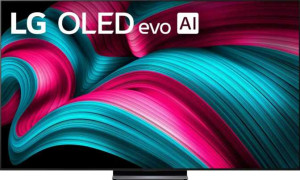
LG OLED55C5PUA 55"
Samsung QA83S95FAEXXY 83"

LG OLED55C5PUA 55" Samsung QA83S95FAEXXY 83"

Overview

Welcome to our in-depth specification comparison between the LG OLED55C5PUA 55″ and the Samsung QA83S95FAEXXY 83″. Both televisions share a premium OLED panel with 4K UHD resolution and a robust feature set, yet they take notably different approaches across key areas including screen size and pixel density, refresh rate, HDR format support, and energy efficiency. Whether you are optimizing for a compact living space or a cinematic large-screen experience, this comparison will help you navigate the specs that matter most.

Common Features

  • Both products have a 4K (UHD) display resolution.
  • Both products use an OLED/AMOLED display type.
  • Both products have a native resolution of 3840 x 2160 px.
  • Both products support 1070 million display colors.
  • Both products have a 10-bit color depth.
  • Both products support HDR10.
  • Both products support HLG.
  • Both products have an anti-reflection coating.
  • Both products have Bluetooth connectivity.
  • Both products use HDMI 2.1.
  • Both products have 4 HDMI ports.
  • Both products support Wi-Fi.
  • Both products have Bluetooth version 5.3.
  • Both products have 1 RJ45 port.
  • Both products support Miracast.
  • Neither product has a 3.5 mm audio jack socket.
  • Both products support Digital Out.
  • Neither product has SRS TheaterSound HD.
  • Both products have stereo speakers.
  • Both products support Dolby Atmos.
  • Both products support Dolby Audio.
  • Neither product supports Dolby Virtual.
  • Both products have a subwoofer.
  • Both products support HDMI ARC and HDMI eARC.
  • Both products support VESA mounting.
  • Both products have AirPlay.
  • Both products have a built-in smart TV platform.
  • Both products are compatible with Google Assistant.
  • Both products work with Alexa.
  • Neither product works with Siri or Apple HomeKit.
  • Both products support remote smartphone control.
  • Both products support USB recording.
  • Both products have a standby power consumption of 0.5W.

Main Differences

  • Screen size is 55.2″ on LG OLED55C5PUA 55″ and 83.5″ on Samsung QA83S95FAEXXY 83″.
  • Pixel density is 80 ppi on LG OLED55C5PUA 55″ and 53 ppi on Samsung QA83S95FAEXXY 83″.
  • Refresh rate is 120Hz on LG OLED55C5PUA 55″ and 165Hz on Samsung QA83S95FAEXXY 83″.
  • HDR10+ support is present on Samsung QA83S95FAEXXY 83″ but not available on LG OLED55C5PUA 55″.
  • Dolby Vision support is present on LG OLED55C5PUA 55″ but not available on Samsung QA83S95FAEXXY 83″.
  • Adaptive synchronization includes Nvidia G-Sync, AMD FreeSync, and AMD FreeSync Premium on LG OLED55C5PUA 55″, while Samsung QA83S95FAEXXY 83″ supports AMD FreeSync, AMD FreeSync Premium, and AMD FreeSync Premium Pro.
  • Wi-Fi support includes Wi-Fi 4, Wi-Fi 5, Wi-Fi 6, and Wi-Fi 6E on LG OLED55C5PUA 55″, whereas Samsung QA83S95FAEXXY 83″ supports only Wi-Fi 4 and Wi-Fi 5.
  • USB ports number 3 on LG OLED55C5PUA 55″ and 4 on Samsung QA83S95FAEXXY 83″.
  • DVB standards include DVB-T, DVB-T2, DVB-C, DVB-S, and DVB-S2 on LG OLED55C5PUA 55″, while Samsung QA83S95FAEXXY 83″ supports only DVB-T and DVB-T2.
  • Width is 1221.7 mm on LG OLED55C5PUA 55″ and 1844.2 mm on Samsung QA83S95FAEXXY 83″.
  • Height is 703.6 mm on LG OLED55C5PUA 55″ and 1056.8 mm on Samsung QA83S95FAEXXY 83″.
  • Thickness is 45.7 mm on LG OLED55C5PUA 55″ and 12.6 mm on Samsung QA83S95FAEXXY 83″.
  • Weight is 16012 g on LG OLED55C5PUA 55″ and 51900 g on Samsung QA83S95FAEXXY 83″.
  • Volume is 39283.177084 cm³ on LG OLED55C5PUA 55″ and 24556.777056 cm³ on Samsung QA83S95FAEXXY 83″.
  • A rechargeable remote control is included with Samsung QA83S95FAEXXY 83″ but not with LG OLED55C5PUA 55″.
  • Operating power consumption is 133.1W on LG OLED55C5PUA 55″ and 248W on Samsung QA83S95FAEXXY 83″.
  • Annual power consumption is 246 kWh on LG OLED55C5PUA 55″ and 908 kWh on Samsung QA83S95FAEXXY 83″.
Specs Comparison
LG OLED55C5PUA 55"

LG OLED55C5PUA 55"

Samsung QA83S95FAEXXY 83"

Samsung QA83S95FAEXXY 83"

Display:
display resolution 4K (UHD) 4K (UHD)
Display type OLED/AMOLED OLED/AMOLED
screen size 55.2" 83.5"
resolution 3840 x 2160 px 3840 x 2160 px
pixel density 80 ppi 53 ppi
display colors 1070 million 1070 million
bit depth 10-bit 10-bit
refresh rate 120Hz 165Hz
supports HDR10
supports HDR10+
supports Dolby Vision
supports HLG
Adaptive synchronization Nvidia G-Sync, AMD FreeSync, AMD FreeSync Premium AMD FreeSync, AMD FreeSync Premium, AMD FreeSync Premium Pro
has anti-reflection coating
has an ambient light sensor
maximum horizontal viewing angle 178º 178º
maximum vertical viewing angle 178º 178º

Both the LG OLED55C5PUA and the Samsung QA83S95FAEXXY share a strong foundation: identical OLED/AMOLED panel technology, 4K (3840 x 2160) resolution, 10-bit color depth rendering 1.07 billion colors, and symmetrical 178° viewing angles in both axes. They also both include anti-reflection coating and an ambient light sensor, meaning neither cuts corners on everyday usability. The critical divergence begins with size and pixel density — the LG's 55.2″ screen achieves a noticeably sharper 80 ppi, while the Samsung's much larger 83.5″ panel drops to 53 ppi. In practical terms, this means fine text and detail will appear crisper on the LG at typical viewing distances, whereas the Samsung's lower pixel density only becomes imperceptible when seated further away, as is common with very large screens.

On motion handling, the Samsung holds a clear advantage with a 165Hz refresh rate versus the LG's 120Hz. The extra headroom matters most for high-frame-rate gaming and fast-paced content, where the Samsung will render motion more smoothly. For HDR format support, the two products diverge in opposite directions: the LG supports Dolby Vision but not HDR10+, while the Samsung supports HDR10+ but not Dolby Vision. This is a meaningful practical split — Dolby Vision dominates streaming platforms like Netflix and Apple TV+, while HDR10+ is more prevalent on Amazon Prime Video and Samsung's own ecosystem. Neither format is universally superior in quality, so the better choice depends on where you primarily consume content.

For adaptive sync, the LG adds Nvidia G-Sync compatibility alongside AMD FreeSync Premium, giving it broader compatibility across both major GPU brands — a genuine edge for PC gamers. The Samsung is limited to AMD FreeSync tiers only. Overall, the Samsung wins on sheer screen real estate and refresh rate, making it the stronger choice for immersive large-room viewing and high-framerate gaming on AMD hardware. The LG, however, has the edge in pixel sharpness, Dolby Vision support, and wider GPU compatibility, making it the more versatile all-rounder for mixed use at a more intimate viewing distance.
Connectivity:
Has Bluetooth
HDMI version HDMI 2.1 HDMI 2.1
HDMI ports 4 4
supports Wi-Fi
Wi-Fi version Wi-Fi 4 (802.11n), Wi-Fi 5 (802.11ac), Wi-Fi 6 (802.11ax), Wi-Fi 6E (802.11ax) Wi-Fi 4 (802.11n), Wi-Fi 5 (802.11ac)
Bluetooth version 5.3 5.3
USB ports 3 4
RJ45 ports 1 1
supports Miracast
has a socket for a 3.5 mm audio jack
has an external memory slot
has a VGA connector
DVB standards DVB-T, DVB-T2, DVB-C, DVB-S, DVB-S2 DVB-T, DVB-T2
has a DVI connector

The wired backbone of both TVs is essentially identical: 4x HDMI 2.1 ports, a single RJ45 ethernet jack, Bluetooth 5.3, and Miracast support — a solid, modern setup that will satisfy most users. Where the two diverge meaningfully is in wireless networking. The LG supports Wi-Fi 6 and Wi-Fi 6E in addition to older standards, while the Samsung tops out at Wi-Fi 5 (802.11ac). In practical terms, Wi-Fi 6E unlocks the 6GHz band, which is less congested and capable of significantly higher throughput — a real advantage in busy households with many connected devices, or when streaming uncompressed 4K content over a network.

The Samsung counters with one extra USB port — 4 vs. 3 on the LG — which is a minor but occasionally useful convenience for simultaneously connecting external drives, keyboards, or other peripherals without needing a hub. On broadcast tuner support, the LG holds a broader hand: it includes DVB-C, DVB-S, and DVB-S2 in addition to the terrestrial DVB-T/T2 standards that the Samsung covers. This matters for users who rely on cable or satellite reception directly through the TV's built-in tuner, as the Samsung would require an external receiver for those signal types.

Connectivity overall gives the LG OLED55C5PUA a clear edge. Its Wi-Fi 6E support is the most impactful differentiator in modern home networking, and its wider DVB tuner range adds genuine versatility for broadcast viewers. The Samsung's extra USB port is a convenience rather than a competitive advantage, making the LG the stronger performer in this category.

Audio:
supports Digital Out
has SRS TheaterSound HD
has stereo speakers
has Dolby Atmos
has Dolby Audio
supports Dolby Virtual
has a subwoofer
HDMI ARC / eARC HDMI ARC, HDMI eARC HDMI ARC, HDMI eARC

Across every audio specification provided, the LG OLED55C5PUA and the Samsung QA83S95FAEXXY are a perfect match. Both feature stereo speakers with a built-in subwoofer, support Dolby Atmos and Dolby Audio, and offer both HDMI ARC and eARC — the latter being the more important of the two, as eARC carries high-bandwidth audio formats like Dolby Atmos TrueHD and DTS:X losslessly to a connected soundbar or AV receiver. Digital audio output is also present on both, ensuring compatibility with older external audio equipment.

This is a straightforward draw. Based strictly on the provided specs, neither TV holds any audio advantage over the other — every feature and format listed is shared equally. Buyers prioritizing audio capability should look beyond this spec group, as the differentiating factors will lie elsewhere.

Design:
width 1221.7 mm 1844.2 mm
weight 16012 g 51900 g
thickness 45.7 mm 12.6 mm
height 703.6 mm 1056.8 mm
volume 39283.177084 cm³ 24556.777056 cm³
Supports VESA mount

Size naturally dominates this category: the Samsung QA83S95FAEXXY is a substantially larger panel, and its physical dimensions reflect that — 1844.2 mm wide and 1056.8 mm tall versus the LG's 1221.7 x 703.6 mm footprint. The weight gap is even more striking, with the Samsung coming in at 51,900 g (roughly 52 kg) compared to the LG's 16,012 g (about 16 kg). For installation, this means the Samsung will almost certainly require two people and potentially wall-reinforcement checks before mounting, while the LG is considerably more manageable to position and reposition.

The most surprising figure is thickness. Despite being a much larger TV, the Samsung is dramatically slimmer at just 12.6 mm — less than a third of the LG's 45.7 mm depth. This makes the Samsung a far more striking wall-mounted installation, sitting almost flush against the surface. The LG, by contrast, will protrude noticeably more when wall-mounted, which may matter in spaces where a sleek, low-profile aesthetic is a priority. Interestingly, the Samsung's extreme thinness results in a lower total volume despite its larger screen area — a testament to how aggressively its chassis has been engineered. Both TVs support VESA mounting, so neither has an advantage on that front.

The verdict here depends entirely on the use case. The Samsung wins decisively on profile aesthetics with its near-borderline 12.6 mm thinness, but its ~52 kg weight makes installation a serious physical undertaking. The LG is far lighter and easier to handle, but its greater depth will be more visually prominent on a wall. Neither is objectively superior — the right choice hinges on room size, installation support available, and how much the slim-profile aesthetic matters to the buyer.

Features:
release date March 2025 March 2025
has AirPlay
has built-in smart TV
compatible with Google Assistant
works with Alexa
works with Siri/Apple HomeKit
supports a remote smartphone
has a rechargeable remote control
supports USB recording
operating power consumption 133.1W 248W
standby power consumption 0.5W 0.5W
has a search browser
has a sleep timer
has a child lock
annual power consumption 246 kWh 908 kWh
warranty period 1 years 1 years
has voice commands

Smart platform parity is nearly total between these two TVs: both run a built-in smart TV OS, support AirPlay, Google Assistant, Alexa, USB recording, voice commands, and smartphone remote control. Neither supports Apple HomeKit, and both share an identical 0.5W standby draw. The one small but practical differentiator here is the Samsung's rechargeable remote control — the LG ships with a conventional battery-powered remote. Over months of use, not having to replace batteries is a minor but genuinely appreciated convenience.

The most consequential numbers in this group are power-related. The LG draws 133.1W during operation versus the Samsung's 248W — nearly double. Projected over a year, that translates to an estimated 246 kWh for the LG against 908 kWh for the Samsung. At typical residential electricity rates, that gap represents a significant real-world cost difference annually. Much of this disparity is attributable to the Samsung's far larger screen area rather than efficiency shortcomings per se, but the outcome for the user's electricity bill is the same regardless of cause.

For this spec group, the LG OLED55C5PUA holds a meaningful advantage on power efficiency — the annual consumption gap is too large to dismiss. The Samsung edges ahead only on the rechargeable remote, which is a convenience rather than a capability. Users who watch several hours of TV daily and are mindful of running costs will find the LG's energy footprint substantially easier to live with.

Comparison Summary & Verdict

After examining all available specifications, these two OLED televisions clearly target different audiences. The LG OLED55C5PUA 55″ is the stronger choice for users who value Dolby Vision support, a sharper 80 ppi pixel density, broader Wi-Fi compatibility including Wi-Fi 6E, and significantly lower power consumption at just 246 kWh annually — making it a practical, space-efficient option. The Samsung QA83S95FAEXXY 83″, on the other hand, dominates in sheer screen presence with its 83.5″ panel, a faster 165Hz refresh rate, HDR10+ support, AMD FreeSync Premium Pro for gaming, and an ultra-slim 12.6 mm profile. Buyers seeking an immersive large-format display for gaming or home cinema will find the Samsung compelling, while those prioritizing a refined, energy-conscious everyday TV in a mid-size form factor will be well served by the LG.

LG OLED55C5PUA 55
Buy LG OLED55C5PUA 55" if...

Buy the LG OLED55C5PUA 55″ if you want Dolby Vision support, superior pixel density, wider Wi-Fi compatibility, and much lower annual energy consumption in a compact, lightweight form factor.

Samsung QA83S95FAEXXY 83
Buy Samsung QA83S95FAEXXY 83" if...

Buy the Samsung QA83S95FAEXXY 83″ if you want a massive 83.5″ screen, a 165Hz refresh rate with AMD FreeSync Premium Pro for gaming, HDR10+ support, and an ultra-slim design.