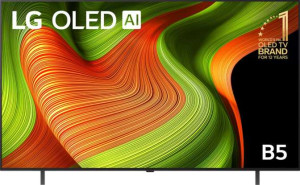
LG OLED83B5PUA 83"
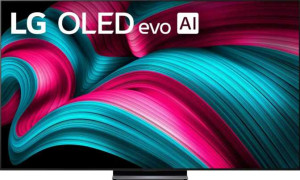
LG OLED83C5PUA 83"

LG OLED83B5PUA 83" LG OLED83C5PUA 83"

Overview

When it comes to large-screen OLED televisions, the LG OLED83B5PUA 83″ and the LG OLED83C5PUA 83″ share a remarkable amount of common ground — yet their differences reveal two distinct personalities. Both deliver breathtaking 4K OLED picture quality at 120Hz with identical dimensions and smart platform features, but they diverge in meaningful ways across audio hardware, USB connectivity, and power efficiency. Read on to find out which 83-inch giant belongs in your living room.

Common Features

  • Both TVs have a 4K UHD OLED display with a screen size of 83.5″.
  • Both TVs share a resolution of 3840 x 2160 px.
  • Both TVs have a pixel density of 53 ppi.
  • Both TVs support 1070 million display colors at a 10-bit depth.
  • Both TVs have a native refresh rate of 120Hz.
  • Both TVs include 4 HDMI 2.1 ports and 1 RJ45 port.
  • Both TVs support Wi-Fi 4, Wi-Fi 5, Wi-Fi 6, and Wi-Fi 6E.
  • Both TVs include Bluetooth 5.3.
  • Miracast is supported on both TVs.
  • Both TVs support Dolby Digital.
  • Both TVs support Digital Out.
  • Dolby Digital Plus is not supported on either TV.
  • SRS TheaterSound HD is not available on either TV.
  • Both TVs have stereo speakers.
  • Both TVs have Dolby Atmos and Dolby Audio.
  • Dolby Virtual is not supported on either TV.
  • Both TVs share the same dimensions: 1841.5 mm wide, 1054.1 mm tall, and 53.3 mm thick.
  • Both TVs support VESA mounting.
  • Both TVs operate within a temperature range of 0 °C to 40 °C.
  • Both TVs have Chromecast built-in, AirPlay, Google Assistant compatibility, and Alexa support.
  • Siri and Apple HomeKit are not supported on either TV.
  • Both TVs support smartphone remote control.
  • Neither TV has a rechargeable remote control.
  • Both TVs have a built-in smart TV platform.

Main Differences

  • USB ports total 2 on LG OLED83B5PUA 83″ and 3 on LG OLED83C5PUA 83″.
  • A subwoofer is included on LG OLED83C5PUA 83″ but not available on LG OLED83B5PUA 83″.
  • Weight is 27714 g on LG OLED83B5PUA 83″ and 33022 g on LG OLED83C5PUA 83″.
  • Operating power consumption is 195.5W on LG OLED83B5PUA 83″ and 223W on LG OLED83C5PUA 83″.
  • Annual power consumption is 360 kWh on LG OLED83B5PUA 83″ and 410 kWh on LG OLED83C5PUA 83″.
Specs Comparison
LG OLED83B5PUA 83"

LG OLED83B5PUA 83"

LG OLED83C5PUA 83"

LG OLED83C5PUA 83"

Display:
display resolution 4K (UHD) 4K (UHD)
Display type OLED/AMOLED OLED/AMOLED
screen size 83.5" 83.5"
resolution 3840 x 2160 px 3840 x 2160 px
pixel density 53 ppi 53 ppi
display colors 1070 million 1070 million
bit depth 10-bit 10-bit
refresh rate 120Hz 120Hz
supports HDR10
supports HDR10+
supports Dolby Vision
supports HLG
Adaptive synchronization Nvidia G-Sync, AMD FreeSync, AMD FreeSync Premium Nvidia G-Sync, AMD FreeSync, AMD FreeSync Premium
response time 0.1 ms 0.1 ms
has anti-reflection coating
has an ambient light sensor
maximum horizontal viewing angle 178º 178º
maximum vertical viewing angle 178º 178º

In the Display category, the LG OLED83B5PUA and the LG OLED83C5PUA are identical across every single specified metric. Both share an 83.5″ OLED/AMOLED panel running at 4K (3840 x 2160) resolution with a pixel density of 53 ppi, a 10-bit color pipeline capable of rendering over a billion colors, and a native 120Hz refresh rate — all of which translate to smooth motion handling and rich, lifelike color depth in daily use.

On the HDR and gaming side, both televisions support Dolby Vision, HDR10, and HLG, while neither supports HDR10+. Both also offer the same adaptive sync suite — Nvidia G-Sync, AMD FreeSync, and AMD FreeSync Premium — paired with a 0.1ms response time, making them equally capable as large-screen gaming displays. Anti-reflection coating and an ambient light sensor are present on both, as are identical 178° horizontal and vertical viewing angles, which is characteristic of OLED technology and ensures consistent image quality from nearly any seat in the room.

The verdict for this category is a complete tie: there is no display-related differentiator between these two models based on the provided specifications. A buyer choosing between the B5 and C5 should look to other spec groups — such as processing, brightness, or smart features — to find meaningful distinctions.

Connectivity:
Has Bluetooth
HDMI version HDMI 2.1 HDMI 2.1
HDMI ports 4 4
supports Wi-Fi
Wi-Fi version Wi-Fi 4 (802.11n), Wi-Fi 5 (802.11ac), Wi-Fi 6 (802.11ax), Wi-Fi 6E (802.11ax) Wi-Fi 4 (802.11n), Wi-Fi 5 (802.11ac), Wi-Fi 6 (802.11ax), Wi-Fi 6E (802.11ax)
Bluetooth version 5.3 5.3
USB ports 2 3
RJ45 ports 1 1
supports Miracast
has a socket for a 3.5 mm audio jack
has an external memory slot
has a VGA connector
DVB standards DVB-T, DVB-T2, DVB-C, DVB-S, DVB-S2 DVB-T, DVB-T2, DVB-C, DVB-S, DVB-S2
has a DVI connector

Across most of the connectivity stack, these two televisions are mirror images of each other. Both feature 4x HDMI 2.1 ports — essential for 4K/120Hz passthrough from modern consoles and PCs — alongside Wi-Fi 6E support, Bluetooth 5.3, a dedicated Ethernet port, and Miracast for wireless screen mirroring. This is a strong and modern connectivity foundation by any measure.

The only tangible difference between the two lies in USB port count: the B5PUA offers 2 USB ports, while the C5PUA provides 3. In practice, that extra port can matter more than it seems — simultaneously connecting a USB storage drive, a wireless dongle, and a third peripheral (like a keyboard or webcam) becomes possible on the C5 without needing a hub, whereas the B5 would require one.

The C5PUA holds a narrow but practical edge in this category solely due to its additional USB port. For users who plan to connect multiple USB devices at once, this is a genuine convenience advantage. Those who rarely use more than one or two USB accessories at a time will find the difference inconsequential in everyday use.

Audio:
supports Dolby Digital
supports Digital Out
supports Dolby Digital Plus
has SRS TheaterSound HD
has stereo speakers
has Dolby Atmos
has Dolby Audio
supports Dolby Virtual
has a subwoofer
has a DTS-HD High Resolution
has DTS:X
HDMI ARC / eARC HDMI ARC, HDMI eARC HDMI ARC, HDMI eARC

Both televisions share a well-rounded audio feature set: Dolby Atmos, Dolby Audio, DTS:X, DTS-HD High Resolution, and full HDMI ARC/eARC support are present on each. eARC in particular is worth highlighting — it allows lossless audio formats to be passed to a compatible soundbar or AV receiver over a single HDMI cable, making it a future-proof connection for high-end home theater setups.

The sole differentiator in this category is that the C5PUA includes a built-in subwoofer, while the B5PUA does not. A dedicated subwoofer handles low-frequency reproduction — the deep bass in action sequences, the rumble of thunder, the weight of a kick drum — that stereo speakers alone typically struggle to convey convincingly. For users watching content directly through the TV's own speaker system, this is a meaningful real-world distinction in perceived audio fullness and impact.

The C5PUA has a clear advantage in this group. Buyers who rely primarily on the TV's integrated audio — rather than routing sound through an external soundbar or receiver — will experience noticeably richer bass output from the C5. Those who already own or plan to purchase a dedicated audio system will find this difference largely irrelevant, as eARC support on both models ensures equally capable external audio pairing.

Design:
width 1841.5 mm 1841.5 mm
weight 27714 g 33022 g
thickness 53.3 mm 53.3 mm
height 1054.1 mm 1054.1 mm
volume 103461.970495 cm³ 103461.970495 cm³
Supports VESA mount
maximum operating temperature 40 °C 40 °C
lowest potential operating temperature 0 °C 0 °C

Dimensionally, these two televisions are identical — same width, height, thickness, and volume. Both support VESA mounting and share the same operating temperature range. For most buyers, the physical footprint and installation requirements will be indistinguishable between the two.

Weight, however, tells a different story. The B5PUA weighs approximately 27.7 kg, while the C5PUA comes in at around 33 kg — a difference of roughly 5.3 kg. At the 83-inch scale, that gap is practically significant: wall-mounting an already large panel becomes meaningfully more demanding with the heavier unit, both in terms of the physical installation effort and the load requirements of the wall mount hardware itself. A heavier TV may also necessitate a more robust wall bracket or additional installer assistance.

For this category, the B5PUA has a practical advantage purely by virtue of its lower weight. Users planning a wall mount installation — especially without professional help — will find the B5 considerably easier to handle and position. Those placing the TV on a stand will notice the difference less, though the C5's added mass is still worth accounting for when considering furniture load capacity.

Features:
release date March 2025 March 2025
has Chromecast built-in
has AirPlay
has built-in smart TV
compatible with Google Assistant
works with Alexa
works with Siri/Apple HomeKit
supports a remote smartphone
has a rechargeable remote control
supports USB recording
operating power consumption 195.5W 223W
standby power consumption 0.5W 0.5W
has a search browser
has a sleep timer
has a child lock
annual power consumption 360 kWh 410 kWh
warranty period 1 years 1 years
has voice commands

From a smart feature standpoint, these two models are functionally equivalent. Both run a built-in smart TV platform with Chromecast, AirPlay, Google Assistant, Alexa, voice commands, and smartphone remote support all included. Neither supports Apple HomeKit or ships with a rechargeable remote — so ecosystem compatibility and day-to-day usability are identical across the board.

Power consumption is where a real difference emerges. The B5PUA draws 195.5W during operation and averages 360 kWh annually, while the C5PUA consumes 223W at peak and 410 kWh per year — a gap of roughly 50 kWh annually. Translated to cost, that difference compounds meaningfully over years of regular use, making the B5 the more energy-efficient choice for the same screen size and smart feature set.

The B5PUA holds the advantage in this category on the strength of its lower power draw. For energy-conscious buyers or those in regions with high electricity costs, the annual savings are a tangible benefit. Those prioritizing smart platform features alone will find no reason to favor one model over the other, as both deliver an identical software and voice assistant experience.

Comparison Summary & Verdict

After examining every specification, both the LG OLED83B5PUA 83″ and the LG OLED83C5PUA 83″ are outstanding 83-inch OLED televisions that share identical picture performance, smart capabilities, and core connectivity. The real distinctions are practical: the C5 includes a built-in subwoofer and an additional USB port, making it the stronger pick for home theater enthusiasts who want fuller audio without a separate soundbar and greater device flexibility. On the other hand, the B5 offers a clear advantage in power efficiency, drawing only 195.5W versus the C5's 223W, and its annual consumption of 360 kWh beats the C5's 410 kWh — meaningful savings over time. The B5 is also considerably lighter at 27,714 g compared to the C5's 33,022 g, which simplifies wall-mounting. Choose the C5 for a richer audio experience; choose the B5 for leaner energy use and easier installation.

LG OLED83B5PUA 83
Buy LG OLED83B5PUA 83" if...

Buy the LG OLED83B5PUA 83″ if you prioritize lower power consumption and a lighter build that makes wall-mounting and installation more manageable.

LG OLED83C5PUA 83
Buy LG OLED83C5PUA 83" if...

Buy the LG OLED83C5PUA 83″ if you want richer built-in audio from an integrated subwoofer and need an extra USB port for connecting more devices.