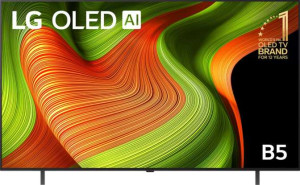
LG OLED83B5PUA 83"
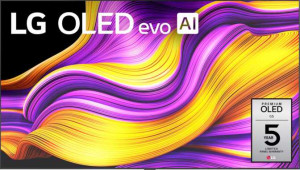
LG OLED97G5WUA 97"

LG OLED83B5PUA 83" LG OLED97G5WUA 97"

Overview

When choosing between the LG OLED83B5PUA 83″ and the LG OLED97G5WUA 97″, buyers face a fascinating split across several key battlegrounds. Both televisions share the same stunning OLED panel technology, 4K UHD resolution, and a rich smart TV ecosystem, yet they diverge notably in screen size and physical footprint, built-in audio hardware, power consumption, and warranty coverage. This detailed specification comparison is designed to help you navigate every important distinction before making your decision.

Common Features

  • Both products have a 4K (UHD) display resolution of 3840 x 2160 px.
  • Both products use an OLED/AMOLED display type.
  • Both products display 1070 million colors at a 10-bit depth.
  • Both products have a 120Hz refresh rate.
  • HDR10 support is available on both products.
  • HDR10+ support is not available on either product.
  • Bluetooth is available on both products at version 5.3.
  • Both products support Wi-Fi, including Wi-Fi 4, Wi-Fi 5, Wi-Fi 6, and Wi-Fi 6E.
  • Both products have 4 HDMI 2.1 ports and 1 RJ45 port.
  • Miracast support is available on both products.
  • Dolby Digital support is available on both products.
  • Digital Out support is available on both products.
  • Dolby Digital Plus support is not available on either product.
  • Dolby Atmos and Dolby Audio are available on both products.
  • Stereo speakers are present on both products.
  • Both products support VESA mounting.
  • The operating temperature range is 0 °C to 40 °C on both products.
  • Chromecast built-in and AirPlay are available on both products.
  • Both products are compatible with Google Assistant and work with Alexa.
  • Apple HomeKit/Siri support is not available on either product.
  • Both products have a built-in smart TV and support remote smartphone control.
  • Neither product has a rechargeable remote control.

Main Differences

  • Screen size is 83.5″ on LG OLED83B5PUA 83″ and 97.4″ on LG OLED97G5WUA 97″.
  • Pixel density is 53 ppi on LG OLED83B5PUA 83″ and 45 ppi on LG OLED97G5WUA 97″.
  • USB ports number 2 on LG OLED83B5PUA 83″ and 3 on LG OLED97G5WUA 97″.
  • A built-in subwoofer is present on LG OLED97G5WUA 97″ but not available on LG OLED83B5PUA 83″.
  • Width is 1841.5 mm on LG OLED83B5PUA 83″ and 2153.9 mm on LG OLED97G5WUA 97″.
  • Height is 1054.1 mm on LG OLED83B5PUA 83″ and 1229.4 mm on LG OLED97G5WUA 97″.
  • Thickness is 53.3 mm on LG OLED83B5PUA 83″ and 27.9 mm on LG OLED97G5WUA 97″.
  • Weight is 27714 g on LG OLED83B5PUA 83″ and 64002 g on LG OLED97G5WUA 97″.
  • Volume is 103461.97 cm³ on LG OLED83B5PUA 83″ and 73879.33 cm³ on LG OLED97G5WUA 97″.
  • Operating power consumption is 195.5W on LG OLED83B5PUA 83″ and 300W on LG OLED97G5WUA 97″.
  • Annual power consumption is 360 kWh on LG OLED83B5PUA 83″ and 550 kWh on LG OLED97G5WUA 97″.
  • Warranty period is 1 year on LG OLED83B5PUA 83″ and 5 years on LG OLED97G5WUA 97″.
Specs Comparison
LG OLED83B5PUA 83"

LG OLED83B5PUA 83"

LG OLED97G5WUA 97"

LG OLED97G5WUA 97"

Display:
display resolution 4K (UHD) 4K (UHD)
Display type OLED/AMOLED OLED/AMOLED
screen size 83.5" 97.4"
resolution 3840 x 2160 px 3840 x 2160 px
pixel density 53 ppi 45 ppi
display colors 1070 million 1070 million
bit depth 10-bit 10-bit
refresh rate 120Hz 120Hz
supports HDR10
supports HDR10+
supports Dolby Vision
supports HLG
Adaptive synchronization Nvidia G-Sync, AMD FreeSync, AMD FreeSync Premium Nvidia G-Sync, AMD FreeSync, AMD FreeSync Premium
response time 0.1 ms 0.1 ms
has anti-reflection coating
has an ambient light sensor
maximum horizontal viewing angle 178º 178º
maximum vertical viewing angle 178º 178º

Both the LG OLED83B5PUA and the LG OLED97G5WUA share the same fundamental display DNA: identical 4K (3840 x 2160) OLED panels with 120Hz refresh rates, 0.1ms response times, 10-bit color depth rendering 1.07 billion colors, and identical HDR support across Dolby Vision, HDR10, and HLG. Both also offer the same wide 178° viewing angles, adaptive sync compatibility with Nvidia G-Sync and AMD FreeSync Premium, anti-reflection coating, and an ambient light sensor. For the vast majority of picture-quality considerations, these two TVs are effectively identical in specification.

The single meaningful differentiator within this spec group is screen size — and its downstream effect on pixel density. The B5PUA measures 83.5″ at 53 ppi, while the G5WUA stretches to 97.4″ at 45 ppi. In practice, at typical TV viewing distances (10 feet or more), neither pixel density is distinguishable to the naked eye — both will appear razor-sharp. However, the 14-inch size difference is dramatic in a living room context: the 97″ panel delivers nearly 36% more screen area, which translates to a significantly more immersive, cinematic experience, particularly for large rooms.

For this display spec group, the LG OLED97G5WUA holds the edge purely on screen real estate — the larger canvas with no trade-off in core picture quality specs makes it the more impactful viewing experience, assuming the room and budget accommodate it. If size is not a priority, the B5PUA is effectively its equal in every measurable display attribute.
Connectivity:
Has Bluetooth
HDMI version HDMI 2.1 HDMI 2.1
HDMI ports 4 4
supports Wi-Fi
Wi-Fi version Wi-Fi 4 (802.11n), Wi-Fi 5 (802.11ac), Wi-Fi 6 (802.11ax), Wi-Fi 6E (802.11ax) Wi-Fi 4 (802.11n), Wi-Fi 5 (802.11ac), Wi-Fi 6 (802.11ax), Wi-Fi 6E (802.11ax)
Bluetooth version 5.3 5.3
USB ports 2 3
RJ45 ports 1 1
supports Miracast
has a socket for a 3.5 mm audio jack
has an external memory slot
has a VGA connector
DVB standards DVB-T, DVB-T2, DVB-C, DVB-S, DVB-S2 DVB-T, DVB-T2, DVB-C, DVB-S, DVB-S2
has a DVI connector

Connectivity between the LG OLED83B5PUA and the LG OLED97G5WUA is nearly identical across the board. Both carry 4 HDMI 2.1 ports — future-proof connections capable of handling 4K/120Hz, 8K, and VRR passthrough — alongside Bluetooth 5.3, a full suite of Wi-Fi 6E (plus backward-compatible Wi-Fi 4/5/6) wireless support, a single RJ45 Ethernet port, and Miracast for wireless screen mirroring. The shared DVB tuner support (T/T2/C/S/S2) also ensures broad over-the-air and satellite compatibility.

The only concrete differentiator is USB port count: the B5PUA offers 2 USB ports while the G5WUA steps up to 3 USB ports. In practical terms, this extra port matters for users who simultaneously connect multiple USB devices — such as a hard drive for media playback, a webcam, and a USB audio adapter — without needing a hub. It is a modest but genuinely useful advantage in a home theater setup.

The G5WUA takes a narrow edge in this category on the strength of its additional USB port. For most users the difference will be minor, but in a feature-matched spec group like this one, it is the only meaningful distinction — making it the slightly more versatile option for peripheral-heavy setups.

Audio:
supports Dolby Digital
supports Digital Out
supports Dolby Digital Plus
has SRS TheaterSound HD
has stereo speakers
has Dolby Atmos
has Dolby Audio
supports Dolby Virtual
has a subwoofer
has a DTS-HD High Resolution
has DTS:X
HDMI ARC / eARC HDMI ARC, HDMI eARC HDMI ARC, HDMI eARC

On the audio format support front, these two TVs are perfectly matched. Both decode Dolby Atmos, DTS:X, and DTS-HD High Resolution, cover standard Dolby Digital, and support both HDMI ARC and eARC — the latter being particularly important, as eARC carries full-bandwidth Dolby Atmos and DTS:X bitstreams to a connected soundbar without compression. For anyone routing audio through an external system, this shared eARC support is the most practically significant spec in this group.

The one hardware distinction is that the LG OLED97G5WUA includes a built-in subwoofer, while the OLED83B5PUA does not. A dedicated subwoofer handles low-frequency reproduction independently from the main drivers, which typically results in more defined bass and better overall sonic separation — a tangible improvement for users who rely primarily on the TV's internal speakers rather than a separate audio system.

The G5WUA earns a clear edge here. For users planning to pair either TV with a high-end soundbar, the subwoofer distinction becomes irrelevant given the identical eARC passthrough capability. But for those watching without external audio, the G5WUA's built-in subwoofer delivers a more complete out-of-the-box listening experience that the B5PUA simply cannot match on its own.

Design:
width 1841.5 mm 2153.9 mm
weight 27714 g 64002 g
thickness 53.3 mm 27.9 mm
height 1054.1 mm 1229.4 mm
volume 103461.970495 cm³ 73879.330014 cm³
Supports VESA mount
maximum operating temperature 40 °C 40 °C
lowest potential operating temperature 0 °C 0 °C

Size differences aside, the most striking design contrast here is thickness. The LG OLED97G5WUA measures just 27.9 mm deep — nearly half the 53.3 mm profile of the OLED83B5PUA. This is a meaningful aesthetic distinction: at under 3 cm, the G5WUA has the kind of ultra-slim, wall-hugging profile typically associated with premium gallery-style TVs, making it far more visually unobtrusive when wall-mounted. Interestingly, despite its much larger screen footprint, the G5WUA's dramatically reduced depth actually gives it a smaller total volume (approx. 73,879 cm³ vs 103,462 cm³ for the B5PUA).

Weight tells the opposite story. The G5WUA comes in at 64 kg — more than twice the 27.7 kg of the B5PUA. For installation purposes, this is a critical practical consideration: mounting a 64 kg panel typically requires reinforced wall structures, professional installation, and heavy-duty VESA hardware. The B5PUA, while still substantial, is far more manageable for a standard wall or stand setup. Both models support VESA mounting, and both share identical operating temperature ranges.

There is no single winner in this group — it depends entirely on priorities. The G5WUA wins decisively on thinness and visual elegance, making it the superior choice for a premium wall-mounted installation. The B5PUA, however, is dramatically lighter, making it far easier and less costly to install safely. Buyers should factor structural requirements and installation logistics heavily before committing to the G5WUA's considerable weight.

Features:
release date March 2025 March 2025
has Chromecast built-in
has AirPlay
has built-in smart TV
compatible with Google Assistant
works with Alexa
works with Siri/Apple HomeKit
supports a remote smartphone
has a rechargeable remote control
supports USB recording
operating power consumption 195.5W 300W
standby power consumption 0.5W 0.5W
has a search browser
has a sleep timer
has a child lock
annual power consumption 360 kWh 550 kWh
warranty period 1 years 5 years
has voice commands

Smart platform capabilities are identical across both TVs — Chromecast built-in, AirPlay, Google Assistant, Alexa, smartphone remote support, USB recording, and a full browser are all present on both the LG OLED83B5PUA and the LG OLED97G5WUA. Neither supports Apple HomeKit/Siri, and neither ships with a rechargeable remote. For day-to-day smart TV use, buyers will find no functional difference between the two.

Where the specs diverge meaningfully is power consumption and warranty coverage. The G5WUA draws 300W during operation versus 195.5W for the B5PUA — a 54% increase that compounds over time: annual consumption is estimated at 550 kWh versus 360 kWh, a difference of 190 kWh per year. At average U.S. electricity rates, that gap translates to a notable recurring cost difference over the TV's lifespan. On the flip side, the G5WUA comes with a 5-year warranty compared to just 1 year on the B5PUA — a substantial long-term ownership advantage for a high-investment panel.

The G5WUA holds the stronger overall position in this group. Its significantly longer warranty provides meaningful financial protection that offsets the higher running costs for many buyers — especially given the premium price tier both TVs occupy. The B5PUA's lower power draw is a genuine operational advantage, but the four-year warranty gap is difficult to overlook on a flagship purchase.

Comparison Summary & Verdict

After examining all available specifications, these two televisions clearly serve different audiences. The LG OLED83B5PUA 83″ is the leaner, more energy-efficient option, drawing just 195.5W and consuming 360 kWh annually, making it well-suited for large living rooms where running costs and manageability matter. Its higher pixel density of 53 ppi also delivers a sharper image relative to typical viewing distances. The LG OLED97G5WUA 97″, by contrast, commands attention with its massive 97.4-inch screen, a built-in subwoofer for richer, fuller audio, an additional USB port, and a remarkably slim 27.9 mm profile. Most notably, it backs its premium positioning with an outstanding 5-year warranty, far exceeding the one-year coverage of its sibling. Choose the 83″ for efficiency and a more versatile fit; choose the 97″ for an uncompromising, future-proof home-cinema investment.

LG OLED83B5PUA 83
Buy LG OLED83B5PUA 83" if...

Buy the LG OLED83B5PUA 83″ if you want a large OLED TV with lower power consumption, a higher pixel density, and a lighter, more manageable form factor that fits a wider range of room sizes.

LG OLED97G5WUA 97
Buy LG OLED97G5WUA 97" if...

Buy the LG OLED97G5WUA 97″ if you want the ultimate big-screen home-cinema experience, complete with a built-in subwoofer, an extra USB port, a slimmer design, and the long-term confidence of a 5-year warranty.