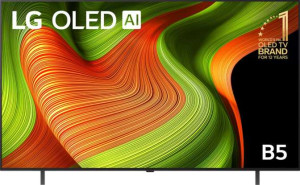
LG OLED83B5PUA 83"
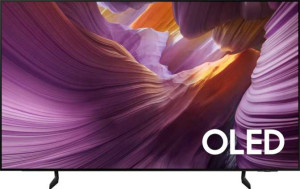
Samsung QN83S85FAE 83"

LG OLED83B5PUA 83" Samsung QN83S85FAE 83"

Overview

When it comes to large-screen OLED televisions, the LG OLED83B5PUA 83″ and the Samsung QN83S85FAE 83″ represent two compelling takes on the 83-inch format. Both share a stunning 4K OLED panel, a 120Hz refresh rate, and Dolby Atmos audio support, yet they diverge in meaningful ways across HDR format compatibility, adaptive sync options, Wi-Fi standards, and physical design. This comparison breaks down exactly where each TV stands apart to help you find the right fit.

Common Features

  • Both TVs have a 4K (UHD) display resolution.
  • Both TVs use an OLED/AMOLED display type.
  • Both TVs share a native resolution of 3840 x 2160 px.
  • Both TVs have a pixel density of 53 ppi.
  • Both TVs support 1070 million display colors at 10-bit depth.
  • Both TVs have a 120Hz refresh rate.
  • HDR10 support is available on both TVs.
  • Both TVs have 4 HDMI 2.1 ports and 2 USB ports.
  • Both TVs include Bluetooth 5.3 and Wi-Fi connectivity.
  • Both TVs support Miracast and have 1 RJ45 port.
  • Both TVs feature stereo speakers with Dolby Atmos and Dolby Audio support.
  • SRS TheaterSound HD is not available on either TV.
  • Dolby Virtual support is not available on either TV.
  • Neither TV includes a subwoofer.
  • Both TVs support Digital Out and include HDMI ARC and HDMI eARC.
  • Both TVs are compatible with VESA mounting and have a maximum operating temperature of 40 °C.
  • AirPlay is available on both TVs.
  • Both TVs have a built-in smart TV platform and support remote smartphone control.
  • Both TVs are compatible with Google Assistant and Alexa.
  • Apple HomeKit and Siri compatibility is not available on either TV.
  • Neither TV has a rechargeable remote control.
  • USB recording is supported on both TVs.

Main Differences

  • Screen size is 83.5″ on LG OLED83B5PUA 83″ and 82.5″ on Samsung QN83S85FAE 83″.
  • HDR10+ support is present on Samsung QN83S85FAE 83″ but not available on LG OLED83B5PUA 83″.
  • Dolby Vision support is present on LG OLED83B5PUA 83″ but not available on Samsung QN83S85FAE 83″.
  • Adaptive synchronization includes Nvidia G-Sync, AMD FreeSync, and AMD FreeSync Premium on LG OLED83B5PUA 83″, while Samsung QN83S85FAE 83″ supports only AMD FreeSync and AMD FreeSync Premium.
  • Wi-Fi support extends to Wi-Fi 4, Wi-Fi 5, Wi-Fi 6, and Wi-Fi 6E on LG OLED83B5PUA 83″, whereas Samsung QN83S85FAE 83″ supports only Wi-Fi 4 and Wi-Fi 5.
  • Weight is 27714 g on LG OLED83B5PUA 83″ and 33900 g on Samsung QN83S85FAE 83″.
  • Thickness is 53.3 mm on LG OLED83B5PUA 83″ and 34.9 mm on Samsung QN83S85FAE 83″.
  • Width is 1841.5 mm on LG OLED83B5PUA 83″ and 1849 mm on Samsung QN83S85FAE 83″.
  • Height is 1054.1 mm on LG OLED83B5PUA 83″ and 1059 mm on Samsung QN83S85FAE 83″.
  • Volume is 103461.97 cm³ on LG OLED83B5PUA 83″ and 68337.38 cm³ on Samsung QN83S85FAE 83″.
  • The lowest potential operating temperature is 0 °C on LG OLED83B5PUA 83″ and 10 °C on Samsung QN83S85FAE 83″.
  • Operating power consumption is 195.5W on LG OLED83B5PUA 83″ and 197W on Samsung QN83S85FAE 83″.
Specs Comparison
LG OLED83B5PUA 83"

LG OLED83B5PUA 83"

Samsung QN83S85FAE 83"

Samsung QN83S85FAE 83"

Display:
display resolution 4K (UHD) 4K (UHD)
Display type OLED/AMOLED OLED/AMOLED
screen size 83.5" 82.5"
resolution 3840 x 2160 px 3840 x 2160 px
pixel density 53 ppi 53 ppi
display colors 1070 million 1070 million
bit depth 10-bit 10-bit
refresh rate 120Hz 120Hz
supports HDR10
supports HDR10+
supports Dolby Vision
supports HLG
Adaptive synchronization Nvidia G-Sync, AMD FreeSync, AMD FreeSync Premium AMD FreeSync, AMD FreeSync Premium
has anti-reflection coating
has an ambient light sensor
maximum horizontal viewing angle 178º 178º
maximum vertical viewing angle 178º 178º

Both the LG OLED83B5PUA and the Samsung QN83S85FAE share a strong display foundation: identical OLED/AMOLED panel technology, a native 3840 x 2160 resolution at 53 ppi, a 10-bit color pipeline rendering over a billion colors, a 120Hz refresh rate, and wide 178° viewing angles in both axes. In practice, this means both screens deliver the hallmark OLED traits — perfect blacks, infinite contrast, and color accuracy — at a size and refresh rate well suited for both cinematic content and fast-motion sports.

The most consequential split between these two sets lies in HDR format support. The LG supports Dolby Vision but not HDR10+, while the Samsung supports HDR10+ but not Dolby Vision. This is a real-world content compatibility issue: streaming platforms like Netflix and Apple TV+ lean heavily on Dolby Vision, making the LG the stronger pick for those ecosystems. Samsung's HDR10+ advantage, on the other hand, is more relevant to 4K Blu-ray titles and Amazon Prime Video content encoded in that format. Neither format is universally superior in image quality, so the ″right″ choice depends entirely on where the user sources their content. Both sets share HDR10 and HLG support as a common baseline.

For gaming, the LG holds a notable edge: it adds Nvidia G-Sync compatibility on top of the AMD FreeSync and FreeSync Premium tiers that the Samsung also carries. This matters if the user connects a PC with an Nvidia GPU, as G-Sync ensures tear-free, low-latency output that FreeSync alone cannot guarantee on Nvidia hardware. The Samsung is limited to the AMD FreeSync ecosystem. Overall, the LG has a slight advantage for mixed-platform gaming setups and Dolby Vision content, while the Samsung edges ahead specifically for HDR10+ content libraries — making the HDR format question the deciding factor for most buyers.
Connectivity:
Has Bluetooth
HDMI version HDMI 2.1 HDMI 2.1
HDMI ports 4 4
supports Wi-Fi
Wi-Fi version Wi-Fi 4 (802.11n), Wi-Fi 5 (802.11ac), Wi-Fi 6 (802.11ax), Wi-Fi 6E (802.11ax) Wi-Fi 4 (802.11n), Wi-Fi 5 (802.11ac)
Bluetooth version 5.3 5.3
USB ports 2 2
RJ45 ports 1 1
supports Miracast
has a socket for a 3.5 mm audio jack
has an external memory slot
has a VGA connector
DVB standards DVB-T, DVB-T2, DVB-C, DVB-S, DVB-S2 DVB-T, DVB-T2, DVB-S, DVB-S2, DVB-C
has a DVI connector

The wired connectivity foundation is identical across both TVs: 4 HDMI 2.1 ports, 2 USB ports, a single RJ45 ethernet jack, and shared support for Miracast wireless mirroring. HDMI 2.1 is worth highlighting here — it supports the full bandwidth needed for 4K 120Hz signals with VRR from modern consoles, so neither TV is bottlenecked on that front.

Where these two diverge is wireless networking. The LG OLED83B5PUA reaches up to Wi-Fi 6E (802.11ax), while the Samsung QN83S85FAE tops out at Wi-Fi 5 (802.11ac). This is a meaningful real-world gap: Wi-Fi 6E operates on the 6GHz band, which is far less congested than the 2.4GHz and 5GHz bands used by older standards. In a dense apartment building or a home with many connected devices, the LG is significantly better positioned to maintain stable, high-throughput streaming and reduce interference. For 8K streaming or high-bitrate local network playback, this headroom matters even today.

The DVB tuner support is effectively a wash — both sets cover the major terrestrial, cable, and satellite broadcast standards, just listed in slightly different order, with no practical difference for most markets. With Bluetooth 5.3 shared between both, there is no gap in wireless peripheral connectivity either. The connectivity verdict is clear: the LG holds a tangible advantage purely on the strength of its Wi-Fi 6E support, which future-proofs the set for increasingly congested home networks and faster wireless standards.

Audio:
supports Digital Out
has SRS TheaterSound HD
has stereo speakers
has Dolby Atmos
has Dolby Audio
supports Dolby Virtual
has a subwoofer
HDMI ARC / eARC HDMI ARC, HDMI eARC HDMI ARC, HDMI eARC

Across every audio specification provided, the LG OLED83B5PUA and the Samsung QN83S85FAE are a perfect match. Both carry Dolby Atmos and Dolby Audio decoding, stereo speaker configurations, HDMI ARC and eARC support, and digital audio output — with neither including a built-in subwoofer or Dolby Virtual processing.

The practical upshot of shared eARC support is worth noting: unlike standard ARC, eARC carries enough bandwidth to pass lossless audio formats — such as Dolby TrueHD and DTS-HD Master Audio — directly to a compatible soundbar or AV receiver. This makes both TVs equally capable as a hub in a higher-end audio chain without needing a separate optical or HDMI connection for audio.

There is no differentiator to call out here. On audio specifications alone, these two TVs are evenly matched in every category provided, and neither holds an advantage over the other.

Design:
width 1841.5 mm 1849 mm
weight 27714 g 33900 g
thickness 53.3 mm 34.9 mm
height 1054.1 mm 1059 mm
volume 103461.970495 cm³ 68337.3759 cm³
Supports VESA mount
maximum operating temperature 40 °C 40 °C
lowest potential operating temperature 0 °C 10 °C

At nearly the same screen size, the footprint of these two TVs is almost identical in width and height — but their physical profiles tell very different stories. The Samsung QN83S85FAE is dramatically slimmer at 34.9 mm thick compared to the LG OLED83B5PUA's 53.3 mm, and its calculated volume is roughly 34% smaller. For wall-mount installations where minimizing the gap between panel and wall is a priority, the Samsung has a clear aesthetic advantage.

Weight, however, flips the equation. Despite its slimmer chassis, the Samsung is considerably heavier at 33,900 g versus the LG's 27,714 g — a difference of over 6 kg. That gap is highly relevant during installation: heavier panels place greater stress on wall mounts and typically require two people to safely maneuver. It also suggests the Samsung's thinner profile is achieved through a denser internal construction rather than a lighter one, which is worth factoring into mounting hardware selection.

One understated but practical difference is the minimum operating temperature: the LG is rated down to 0 °C, while the Samsung's floor is 10 °C. This matters for installations in garages, sunrooms, or other semi-conditioned spaces that can dip near freezing. Overall, neither TV has a sweep advantage in design — the Samsung wins on slim profile, the LG wins on weight and cold-environment flexibility — so the better choice depends on the specific installation context.

Features:
release date March 2025 March 2025
has AirPlay
has built-in smart TV
compatible with Google Assistant
works with Alexa
works with Siri/Apple HomeKit
supports a remote smartphone
has a rechargeable remote control
supports USB recording
operating power consumption 195.5W 197W
standby power consumption 0.5W 0.5W
has a search browser
has a sleep timer
has a child lock
warranty period 1 years 1 years
has voice commands

From a smart platform and ecosystem standpoint, these two TVs are functionally identical. Both offer a built-in smart TV experience with AirPlay, Google Assistant, and Alexa integration, while neither supports Siri or Apple HomeKit. That shared omission is worth flagging for users deeply embedded in the Apple ecosystem — neither TV can be natively controlled through the Home app or Siri Shortcuts, despite both supporting AirPlay for content mirroring.

Power consumption is virtually indistinguishable: the LG draws 195.5W in operation versus the Samsung's 197W, and both idle at 0.5W in standby. At that margin, neither will produce a noticeable difference on an electricity bill regardless of usage volume. Utility features — USB recording, sleep timer, child lock, smartphone remote, and voice commands — are also a complete match, as is the 1-year warranty period on both units.

There is no meaningful differentiator to identify in this category. Every feature present on one TV is present on the other, and the single numerical difference in power draw is too small to influence a purchasing decision. On features, these two TVs are evenly matched in every respect the provided data covers.

Comparison Summary & Verdict

Both the LG OLED83B5PUA 83″ and the Samsung QN83S85FAE 83″ deliver a premium 4K OLED experience with 120Hz refresh, Dolby Atmos, four HDMI 2.1 ports, and broad smart platform support. The LG is the stronger pick for gamers and home theater enthusiasts who rely on Dolby Vision or Nvidia G-Sync-compatible hardware, and its support for Wi-Fi 6E offers a more future-proof wireless connection. It also weighs significantly less at 27,714 g versus 33,900 g, making installation easier. The Samsung counters with a considerably slimmer 34.9 mm profile, making it a natural choice for sleek wall-mount setups, and it supports the HDR10+ format for those with content libraries built around that standard. Choose the LG for broader adaptive sync coverage and next-generation Wi-Fi; choose the Samsung if a refined, low-profile design and HDR10+ compatibility are your top priorities.

LG OLED83B5PUA 83
Buy LG OLED83B5PUA 83" if...

Buy the LG OLED83B5PUA 83″ if you prioritize Dolby Vision, Nvidia G-Sync compatibility, Wi-Fi 6E support, or a lighter TV that is easier to install.

Samsung QN83S85FAE 83
Buy Samsung QN83S85FAE 83" if...

Buy the Samsung QN83S85FAE 83″ if you prefer a significantly slimmer wall-mount profile and need HDR10+ support for your content library.