LG XBoom Bounce
Marshall Middleton II

LG XBoom Bounce Marshall Middleton II

Overview

Welcome to our in-depth specification comparison between the LG XBoom Bounce and the Marshall Middleton II. Both portable Bluetooth speakers share a solid IP67 waterproof rating and 30 hours of battery life, yet they diverge sharply in areas like audio output power, wireless range, and unique feature sets. Whether portability, connectivity innovation, or raw acoustic performance matters most to you, this side-by-side breakdown will help you decide which speaker truly fits your lifestyle.

Common Features

  • Both products have an IP67 ingress protection rating.
  • Both products are waterproof with a depth rating of 1 m.
  • A control panel is present on both devices.
  • Neither product includes a travel bag.
  • Neither product has a touch screen.
  • Neither product is a neckband speaker.
  • Neither product has a remote control.
  • Both products have stereo speakers.
  • Neither product has a subwoofer.
  • Both products have a passive radiator.
  • Both products have one microphone.
  • Neither product has a noise-canceling microphone.
  • Neither product has magnetic shielding.
  • Both products offer 30 hours of battery life.
  • Both products have a charge time of 3 hours.
  • Both products have a battery level indicator.
  • Both products have a rechargeable battery.
  • Neither product supports wireless charging.
  • Both products support multipoint connection with 2 devices simultaneously.
  • Both products use Bluetooth version 5.3.
  • Neither product supports Bluetooth pairing using NFC.
  • Neither product has a 3.5 mm audio jack socket or AUX input.
  • Neither product supports aptX Lossless, LDAC, or aptX Adaptive.
  • Both products can be used wirelessly.
  • Both products support remote smartphone control.
  • Neither product has fast pairing.
  • Neither product has a built-in radio.
  • Both products have voice prompts.
  • Both products have a sleep timer.

Main Differences

  • Volume is 2435.59 cm³ on LG XBoom Bounce and 2479.4 cm³ on Marshall Middleton II.
  • A neodymium magnet is present on Marshall Middleton II but not on LG XBoom Bounce.
  • RGB lighting is available on LG XBoom Bounce but not on Marshall Middleton II.
  • A detachable cable is included with LG XBoom Bounce but not with Marshall Middleton II.
  • Weight is 1315.42 g on LG XBoom Bounce and 1800 g on Marshall Middleton II.
  • Height is 99.06 mm on LG XBoom Bounce and 110 mm on Marshall Middleton II.
  • Width is 261.62 mm on LG XBoom Bounce and 230 mm on Marshall Middleton II.
  • Thickness is 93.98 mm on LG XBoom Bounce and 98 mm on Marshall Middleton II.
  • Audio output power is 3 x 13.3W on LG XBoom Bounce and 4 x 80W on Marshall Middleton II.
  • A removable battery is available on LG XBoom Bounce but not on Marshall Middleton II.
  • Auracast support is present on LG XBoom Bounce but not available on Marshall Middleton II.
  • Bluetooth LE Audio is supported on LG XBoom Bounce but not on Marshall Middleton II.
  • Maximum Bluetooth range is 10 m on LG XBoom Bounce and 60 m on Marshall Middleton II.
  • Voice commands are supported on LG XBoom Bounce but not on Marshall Middleton II.
  • The ability to work as a power bank is present on Marshall Middleton II but not on LG XBoom Bounce.
  • Stereo sound pairing is supported on LG XBoom Bounce but not on Marshall Middleton II.
Specs Comparison
LG XBoom Bounce

LG XBoom Bounce

Marshall Middleton II

Marshall Middleton II

Design:
Ingress Protection (IP) rating IP67 IP67
volume 2435.592935256 cm³ 2479.4 cm³
has a neodymium magnet
control panel placed on a device
water resistance Waterproof Waterproof
travel bag is included
has a touch screen
has RGB lighting
has a detachable cable
is a neckband speaker
has a remote control
weight 1315.42 g 1800 g
waterproof depth rating 1 m 1 m
height 99.06 mm 110 mm
width 261.62 mm 230 mm
thickness 93.98 mm 98 mm

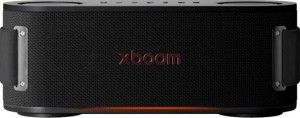
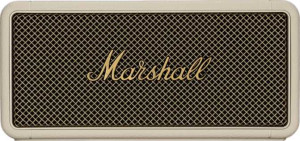
Both the LG XBoom Bounce and the Marshall Middleton II share an IP67 waterproof rating with a 1 m depth tolerance, meaning neither has an advantage in ruggedness — both can handle rain, splashes, and brief submersion equally well. Their overall volumes are also remarkably close (2435.6 cm³ vs. 2479.4 cm³), so they occupy essentially the same amount of space. The real dimensional story, however, is in shape: the XBoom Bounce is noticeably wider (261.62 mm) but shorter (99.06 mm), giving it a flatter, more horizontal profile, while the Middleton II is taller (110 mm) and narrower (230 mm), lending it a more upright, classic speaker silhouette. Neither form is objectively superior — it comes down to placement preference and bag ergonomics.

Where the two products diverge most sharply is weight. The XBoom Bounce comes in at 1315 g, while the Middleton II tips the scales at 1800 g — a difference of nearly 485 g, or roughly the weight of a full water bottle. For a portable speaker carried to the beach, a campsite, or a backpack trip, that gap is very tangible over the course of a day. The Middleton II does counter with a neodymium magnet driver, which typically enables stronger magnetic flux in a more compact driver assembly — a meaningful hardware quality indicator — but the XBoom Bounce brings its own lifestyle features: RGB lighting for ambiance and a detachable cable, which adds practical longevity since cables are a common failure point.

On balance, the LG XBoom Bounce holds a clear edge in the Design category for users who prioritize portability, thanks to its substantially lighter build and the added convenience of a replaceable cable. The Marshall Middleton II appeals more to those who prefer a traditional aesthetic and value the engineering pedigree of a neodymium driver, but must accept a noticeably heavier package in return.
Sound quality:
has stereo speakers
has a subwoofer
audio output power 3 x 13.3W 4 x 80W
Has a passive radiator
number of microphones 1 1
has a noise-canceling microphone
has a magnetic shielding

The most consequential difference in this group is raw amplification power. The LG XBoom Bounce drives three channels at 13.3W each for a combined ~40W, while the Marshall Middleton II runs four channels at 80W each, totaling a commanding 320W. That is an eight-fold gap in output power — not a subtle engineering nuance but a fundamental difference in what each speaker is designed to do. The Middleton II can fill a large outdoor space or a party room with volume headroom to spare, whereas the XBoom Bounce is better suited to personal listening, small gatherings, or indoor rooms where extreme loudness is not the goal.

It is worth noting that wattage alone does not define sound quality — driver tuning, cabinet design, and passive radiator implementation all shape the final result. Both speakers share a similar acoustic architecture: stereo output, no dedicated subwoofer, and a passive radiator to extend low-frequency response without requiring a powered woofer. This means both are engineering their bass through the same fundamental mechanism, and the XBoom Bounce can still deliver a respectable low-end presence relative to its size. However, at the Middleton II's power level, those passive radiators have considerably more energy to work with, which generally translates to deeper, more authoritative bass reproduction at higher listening volumes.

The microphone specifications are identical and unremarkable — a single, non-noise-canceling mic on each unit — so call quality is a wash. The Marshall Middleton II holds an unambiguous edge in this group. Its power advantage is too large to dismiss, and for any use case where volume, dynamic range, or large-space coverage matters, it is the significantly more capable performer of the two.

Power:
Battery life 30 hours 30 hours
charge time 3 hours 3 hours
has a battery level indicator
has a rechargeable battery
has a removable battery
has wireless charging

On paper, these two speakers are virtually identical in power management: both deliver 30 hours of battery life, both recharge in 3 hours, and both include a battery level indicator. For most buyers, that headline figure of 30 hours is more than enough to cover a full weekend of outdoor use without hunting for a wall outlet, and the charge time is reasonable rather than exceptional on either side. Neither product supports wireless charging, so that convenience is off the table for both.

The only meaningful split between them is the LG XBoom Bounce's removable battery, a feature the Marshall Middleton II lacks. In practical terms, this distinction matters most in two scenarios: long multi-day trips where carrying a spare battery pack is more feasible than finding power, and long-term ownership where battery degradation becomes a concern. A non-removable battery that has aged past 70% capacity is a permanent limitation; a user with the XBoom Bounce can simply swap in a fresh cell and restore the speaker to full runtime, effectively extending its useful lifespan at lower cost than replacing the entire unit.

Given that every other power specification is a dead tie, the LG XBoom Bounce takes a narrow but genuine edge here solely on the strength of its removable battery. It is not a feature that matters to every user, but for anyone planning extended adventures or thinking about multi-year ownership costs, it is a tangible and practical advantage.

Connectivity:
multipoint count 2 2
Bluetooth version 5.3 5.3
supports Bluetooth pairing using NFC
has a socket for a 3.5 mm audio jack
has an AUX input
has aptX Lossless
has LDAC
has aptX Adaptive
has aptX HD
has aptX
has aptX Low Latency
has AAC
has AirPlay
has Chromecast built-in
has Auracast
has Bluetooth LE Audio
maximum Bluetooth range 10 m 60 m
supports Wi-Fi
USB ports 1 1
Has USB Type-C
has a 3.5mm male connector
has an external memory slot
is DLNA-certified
supports Ethernet
has a microphone input

The shared connectivity foundation is solid but unspectacular for both speakers: Bluetooth 5.3, 2-device multipoint, AAC codec support, and a USB-C port. Neither offers Wi-Fi, AirPlay, Chromecast, NFC pairing, or any of the high-fidelity codecs like LDAC or aptX HD — so wired and network-based streaming are simply not part of the picture for either product. AAC is a reasonable codec for most listeners, but the absence of higher-quality options means audio purists will find both speakers equally limited in this regard.

Two divergences stand out sharply. First, the Marshall Middleton II advertises a 60 m Bluetooth range against the LG XBoom Bounce's 10 m — a six-fold gap. In open-air settings like a backyard, a park, or a poolside, that extra range means the Middleton II can maintain a stable connection even when the source device is left far across the space, while the XBoom Bounce demands you stay within a much tighter radius. Second, the XBoom Bounce supports Bluetooth LE Audio and Auracast, technologies the Middleton II lacks entirely. Auracast enables broadcast audio — the ability to stream to multiple compatible receivers simultaneously — which is a forward-looking feature for multi-speaker setups or public sharing scenarios, even if its ecosystem adoption is still maturing.

This group produces a split verdict that depends heavily on the use case. The Marshall Middleton II wins decisively on practical, day-one utility with its vastly superior 60 m wireless range. The LG XBoom Bounce counters with future-facing Auracast and LE Audio support, which carry more weight for users invested in emerging multi-speaker ecosystems. For most buyers today, the range advantage is the more immediately impactful differentiator.

Features:
release date March 2025 July 2025
Can be used wirelessly
supports a remote smartphone
has fast pairing
has voice commands
Has a radio
Has voice prompts
works as a power bank
has a sleep timer

Functionally, these two speakers share a comfortable common ground: both operate wirelessly, support smartphone remote control, deliver voice prompts, and include a sleep timer. None of these are differentiating features — they represent the expected baseline for a modern portable speaker at this price tier, and users of either product will find the day-to-day control experience broadly comparable.

The meaningful split comes down to one exclusive feature on each side. The Marshall Middleton II can function as a power bank, allowing it to charge other devices directly from its battery — a genuinely useful capability when outdoors or away from outlets, especially given its already substantial battery. The LG XBoom Bounce, meanwhile, supports voice commands, enabling hands-free control without reaching for a phone or pressing a button. Depending on how a user actually interacts with their speaker, one of these will feel far more relevant than the other: the power bank feature is a practical utility that benefits virtually anyone on a long outing, while voice command support appeals more to those who are deeply integrated into a voice assistant ecosystem.

Weighing these two exclusives, the Marshall Middleton II holds a slight edge in this group. The ability to act as a power bank adds a concrete, hardware-level utility that complements outdoor and travel use cases — scenarios where this class of speaker is most commonly deployed. Voice commands on the XBoom Bounce are convenient, but remain a softer advantage given that smartphone control is already available on both devices.

Miscellaneous:
supports pairing for stereo sound

This group contains a single specification, but it carries real practical weight. The LG XBoom Bounce supports stereo pairing — the ability to link two units together, assigning one as a left channel and one as a right, to create a true stereo soundstage. The Marshall Middleton II does not support this feature at all.

For users who already own or plan to own two of the same speaker, this distinction is significant. True stereo separation — with distinct left and right channels reproduced from physically separated enclosures — delivers a wider, more immersive listening experience than a single speaker playing a stereo mix from one point in space. It is a feature that transforms the XBoom Bounce from a standalone device into a scalable audio system, without requiring any additional hardware beyond a second unit.

The LG XBoom Bounce wins this group outright. Stereo pairing is an unambiguous capability advantage, and the Middleton II's lack of support for it leaves a meaningful gap for anyone who values spatial audio or is building a multi-speaker setup.

Comparison Summary & Verdict

After examining every specification, it is clear that the LG XBoom Bounce and the Marshall Middleton II are built for quite different audiences. The LG XBoom Bounce stands out with its lighter 1315 g frame, removable battery, RGB lighting, Auracast and Bluetooth LE Audio support, and stereo pairing capability, making it a compelling choice for tech-forward users who value flexibility and modern connectivity standards. The Marshall Middleton II, on the other hand, counters with a dramatically higher 4 x 80W audio output, an impressive 60 m Bluetooth range, and the ability to function as a power bank, positioning it as the stronger performer for those who prioritize sheer sound power and extended outdoor usability. Both speakers match on battery endurance and core Bluetooth specs, so the decision ultimately comes down to whether you want cutting-edge connectivity features or uncompromising acoustic muscle.

LG XBoom Bounce
Buy LG XBoom Bounce if...

Buy the LG XBoom Bounce if you want a lighter speaker with a removable battery, modern Auracast and Bluetooth LE Audio support, stereo pairing capability, and fun RGB lighting.

Marshall Middleton II
Buy Marshall Middleton II if...

Buy the Marshall Middleton II if you demand significantly more audio output power, a much longer Bluetooth range of 60 m, and the added convenience of using your speaker as a power bank.