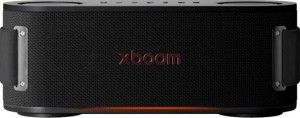
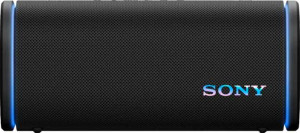
The most striking design difference between these two speakers is sheer physical scale. The LG XBoom Bounce measures 99 × 262 × 94 mm and weighs 1,315 g, while the Sony ULT Field 5 is substantially larger at 144 × 320 × 125 mm and tips the scales at 3,300 g — more than twice as heavy. In terms of total volume, the Sony is roughly 2.4× bulkier (5,760 cm³ vs 2,436 cm³). This isn't a minor gap; it fundamentally separates two use cases. The XBoom Bounce is a genuinely portable, carry-anywhere unit, whereas the ULT Field 5 is better described as a transportable speaker — movable, but not something you'd toss into a daypack without thinking twice.
On water protection, the XBoom Bounce holds a meaningful edge: its IP67 rating means it is fully dustproof and can survive submersion up to 1 meter, earning the ″Waterproof″ classification. The ULT Field 5's IP66 rating still provides solid dust and high-pressure water-jet resistance — categorized here as ″Water resistant″ — but it lacks that submersion tolerance. For beach or poolside use, the XBoom's rating gives more real-world confidence. Additionally, the XBoom Bounce includes a detachable cable, which the ULT Field 5 does not — a practical convenience for cable replacement or charging flexibility. Both speakers share RGB lighting and an on-device control panel, so neither holds an advantage there.
Overall, the LG XBoom Bounce has a clear design edge for users prioritizing portability and weather resilience: it is dramatically lighter, more compact, and better waterproofed. The Sony ULT Field 5, by contrast, is built for scenarios where size is less of a constraint and raw physical presence — likely in service of acoustic output — is the priority. Your choice here hinges almost entirely on whether you need a speaker you can carry comfortably or one you're willing to lug for the potential performance payoff.