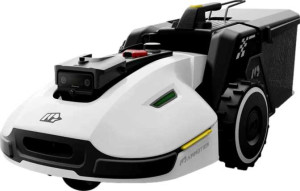
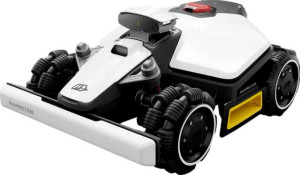
Both the Mammotion Yuka 1000 and the Luba mini AWD 1500 share an identical connectivity and noise profile — Wi-Fi, Bluetooth, a dedicated smartphone app, and remote control support are standard on each, and both produce 60 dB at full speed (dropping to 50 dB in eco mode). These are table-stakes features for modern robotic mowers, so neither product earns an edge here.
The most striking divergence lies in the relationship between physical size and coverage capability. The Yuka 1000 is the larger machine by a significant margin — its volume of 110,769 cm³ dwarfs the Luba mini's 70,651 cm³ — and its 32 cm cutting width is 60% wider than the Luba mini's 20 cm. Yet despite being physically smaller and narrower, the Luba mini AWD 1500 is rated for a recommended area of 1,497 m² versus just 1,012 m² for the Yuka 1000, and its maximum lawn coverage of 1,781 m² outpaces the Yuka's 1,214 m². This suggests the Luba mini compensates for its narrower blade through greater operational efficiency or runtime. The trade-off is weight: at 14,969 g, the Luba mini is roughly 44% heavier than the Yuka's 10,433 g, which matters for manual handling, transport, and stress on terrain.
For users with larger lawns, the Luba mini AWD 1500 holds a clear coverage advantage in this group, making it the stronger choice on paper despite its more compact footprint. The Yuka 1000 is better suited to smaller plots where its wider cutting deck could mean fewer passes and faster sessions, and its lighter weight is a genuine practical benefit. The right pick ultimately depends on lawn size: the Luba mini scales further, while the Yuka 1000 is the more manageable machine for sub-1,000 m² gardens.