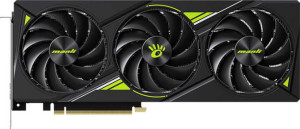
Manli Nebula GeForce RTX 5070
Nvidia GeForce RTX 5060 Ti 8GB

Manli Nebula GeForce RTX 5070 Nvidia GeForce RTX 5060 Ti 8GB

Overview

When choosing between the Manli Nebula GeForce RTX 5070 and the Nvidia GeForce RTX 5060 Ti 8GB, buyers are navigating two distinct tiers within Nvidia's Blackwell generation. Both cards share GDDR7 memory, full DirectX 12 Ultimate support, ray tracing, and DLSS, yet they diverge sharply on compute power, VRAM capacity, memory bandwidth, and overall power draw. Read on to explore how every key specification stacks up.

Common Features

  • GPU memory speed is 1750 MHz on both products.
  • Both products support Double Precision Floating Point (DPFP).
  • Effective memory speed is 28000 MHz on both products.
  • Both products use GDDR7 memory.
  • Both products support ECC memory.
  • Both products support DirectX 12 Ultimate.
  • OpenGL version is 4.6 on both products.
  • OpenCL version is 3 on both products.
  • Multi-display technology is supported on both products.
  • Ray tracing is supported on both products.
  • 3D support is available on both products.
  • DLSS is supported on both products.
  • XeSS (XMX) support is not available on either product.
  • Both products have one HDMI output running HDMI 2.1b.
  • Both products have 3 DisplayPort outputs.
  • Neither product has USB-C ports, DVI outputs, or mini DisplayPort outputs.
  • Both products are built on the Blackwell GPU architecture.
  • Both products use PCIe version 5.
  • Both products are manufactured on a 5 nm semiconductor process.
  • Neither product features air-water cooling.

Main Differences

  • GPU clock speed is 2325 MHz on Manli Nebula GeForce RTX 5070 and 2410 MHz on Nvidia GeForce RTX 5060 Ti 8GB.
  • GPU turbo speed is 2512 MHz on Manli Nebula GeForce RTX 5070 and 2570 MHz on Nvidia GeForce RTX 5060 Ti 8GB.
  • Pixel rate is 201 GPixel/s on Manli Nebula GeForce RTX 5070 and 123.4 GPixel/s on Nvidia GeForce RTX 5060 Ti 8GB.
  • Floating-point performance is 30.87 TFLOPS on Manli Nebula GeForce RTX 5070 and 23.69 TFLOPS on Nvidia GeForce RTX 5060 Ti 8GB.
  • Texture rate is 482.3 GTexels/s on Manli Nebula GeForce RTX 5070 and 370.1 GTexels/s on Nvidia GeForce RTX 5060 Ti 8GB.
  • Shading units number 6144 on Manli Nebula GeForce RTX 5070 and 4608 on Nvidia GeForce RTX 5060 Ti 8GB.
  • Texture mapping units (TMUs) total 192 on Manli Nebula GeForce RTX 5070 and 144 on Nvidia GeForce RTX 5060 Ti 8GB.
  • Render output units (ROPs) total 80 on Manli Nebula GeForce RTX 5070 and 48 on Nvidia GeForce RTX 5060 Ti 8GB.
  • Maximum memory bandwidth is 672 GB/s on Manli Nebula GeForce RTX 5070 and 448 GB/s on Nvidia GeForce RTX 5060 Ti 8GB.
  • VRAM is 12GB on Manli Nebula GeForce RTX 5070 and 8GB on Nvidia GeForce RTX 5060 Ti 8GB.
  • Memory bus width is 192-bit on Manli Nebula GeForce RTX 5070 and 128-bit on Nvidia GeForce RTX 5060 Ti 8GB.
  • RGB lighting is present on Manli Nebula GeForce RTX 5070 but not available on Nvidia GeForce RTX 5060 Ti 8GB.
  • Thermal Design Power (TDP) is 250W on Manli Nebula GeForce RTX 5070 and 180W on Nvidia GeForce RTX 5060 Ti 8GB.
  • The number of transistors is 31100 million on Manli Nebula GeForce RTX 5070 and 21900 million on Nvidia GeForce RTX 5060 Ti 8GB.
Specs Comparison
Manli Nebula GeForce RTX 5070

Manli Nebula GeForce RTX 5070

Nvidia GeForce RTX 5060 Ti 8GB

Nvidia GeForce RTX 5060 Ti 8GB

Performance:
GPU clock speed 2325 MHz 2410 MHz
GPU turbo 2512 MHz 2570 MHz
pixel rate 201 GPixel/s 123.4 GPixel/s
floating-point performance 30.87 TFLOPS 23.69 TFLOPS
texture rate 482.3 GTexels/s 370.1 GTexels/s
GPU memory speed 1750 MHz 1750 MHz
shading units 6144 4608
texture mapping units (TMUs) 192 144
render output units (ROPs) 80 48
Has Double Precision Floating Point (DPFP)

The Manli Nebula RTX 5070 and the Nvidia RTX 5060 Ti 8GB share the same GPU memory speed of 1750 MHz, but diverge significantly in raw compute muscle. The RTX 5070 leads with 6144 shading units versus 4608 on the 5060 Ti — a 33% advantage — which directly translates to its substantially higher floating-point performance of 30.87 TFLOPS compared to 23.69 TFLOPS. In practice, this gap matters most in compute-heavy workloads like ray tracing, AI-accelerated rendering, and GPU compute tasks, where more shaders and higher TFLOP throughput reduce processing time meaningfully.

The render pipeline tells a similar story. The RTX 5070 carries 80 ROPs against the 5060 Ti's 48 ROPs, giving it a pixel rate of 201 GPixel/s versus just 123.4 GPixel/s. This ROP advantage is most visible at high resolutions — particularly 4K — where the GPU must write far more pixels per frame. The 5070 also holds a clear edge in texture rate (482.3 vs 370.1 GTexels/s), meaning it can apply textures faster, which benefits complex scene rendering with many detailed surfaces. Notably, the 5060 Ti does have a slightly higher base and boost clock (2410/2570 MHz vs 2325/2512 MHz), but this marginal clock advantage cannot offset the structural difference in shader and ROP count.

Both GPUs support Double Precision Floating Point (DPFP), making either a viable option for workloads that require FP64 precision. Overall, the RTX 5070 holds a clear performance advantage across every throughput metric in this group — more shading units, higher TFLOP rating, more ROPs, and a faster texture rate. The 5060 Ti's slightly higher clock speeds are the only area where it edges ahead, but that advantage is too narrow to shift the overall conclusion.

Memory:
effective memory speed 28000 MHz 28000 MHz
maximum memory bandwidth 672 GB/s 448 GB/s
VRAM 12GB 8GB
GDDR version GDDR7 GDDR7
memory bus width 192-bit 128-bit
Supports ECC memory

Both GPUs are built on GDDR7 memory running at the same effective speed of 28000 MHz, and both support ECC memory — useful for professionals who need error-corrected computation in data science or GPU-accelerated workloads. The commonality ends there, however. The underlying memory architecture diverges considerably, and that gap has real consequences.

The fundamental differentiator is the memory bus width: the RTX 5070 uses a 192-bit bus while the RTX 5060 Ti is limited to 128-bit. Since bandwidth scales directly with bus width, the 5070 achieves 672 GB/s of memory bandwidth versus just 448 GB/s on the 5060 Ti — a 50% advantage. In GPU workloads, memory bandwidth is often the bottleneck at higher resolutions and with larger assets; a faster memory bus means the GPU's shaders spend less time waiting on data, which is especially critical in 4K gaming, texture-heavy scenes, and large AI model inference.

The capacity gap reinforces this advantage: the RTX 5070 offers 12GB of VRAM compared to 8GB on the 5060 Ti. At a time when modern games and creative applications routinely push beyond 8GB — particularly with high-resolution texture packs or when running multiple workloads simultaneously — the extra 4GB provides meaningful headroom. Combined with the wider bus and higher bandwidth, the RTX 5070 holds a decisive memory advantage across every dimension in this group.

Features:
DirectX version DirectX 12 Ultimate DirectX 12 Ultimate
OpenGL version 4.6 4.6
OpenCL version 3 3
Supports multi-display technology
supports ray tracing
Supports 3D
supports DLSS
has XeSS (XMX)
AMD SAM / Intel Resizable BAR Intel Resizable BAR Intel Resizable BAR
has LHR
has RGB lighting
supported displays 4 4

For this specification group, the two GPUs are remarkably well-matched. Both support DirectX 12 Ultimate, OpenGL 4.6, and OpenCL 3, ensuring full compatibility with modern games, creative software, and GPU compute frameworks. Equally important for gamers, both cards support ray tracing and DLSS, meaning users of either GPU can take advantage of Nvidia's AI-driven upscaling and realistic lighting techniques without compromise. Multi-display setups are also covered identically, with both cards supporting up to 4 displays simultaneously.

The only functional differentiator in this group is RGB lighting: the Manli Nebula RTX 5070 includes it, while the RTX 5060 Ti 8GB does not. This is purely an aesthetic consideration with no impact on gaming or compute performance, but it may matter to users building a visually themed system.

On features, these two GPUs are essentially tied. Every meaningful capability — API support, ray tracing, DLSS, Resizable BAR, multi-display output — is shared equally. The RTX 5070's RGB lighting is the sole distinction, making the feature set comparison a non-factor in any performance-driven purchase decision.

Ports:
has an HDMI output
HDMI ports 1 1
HDMI version HDMI 2.1b HDMI 2.1b
DisplayPort outputs 3 3
USB-C ports 0 0
DVI outputs 0 0
mini DisplayPort outputs 0 0

Port selection is identical across both cards. Each offers 1 HDMI 2.1b output and 3 DisplayPort outputs, totaling four display connections — consistent with the four-display limit noted in the Features group. HDMI 2.1b is the latest revision of the standard, supporting high refresh rates at 4K and beyond, as well as 8K output, making either card future-proof for high-end monitors and televisions alike.

This is a straightforward tie. There is no distinction whatsoever between the Manli Nebula RTX 5070 and the RTX 5060 Ti 8GB in terms of connectivity — users of either card will have the same display output options available to them.

General info:
GPU architecture Blackwell Blackwell
release date March 2025 April 2025
Thermal Design Power (TDP) 250W 180W
PCI Express (PCIe) version 5 5
semiconductor size 5 nm 5 nm
number of transistors 31100 million 21900 million
Has air-water cooling

Sharing the same Blackwell architecture, 5nm process node, and PCIe 5.0 interface, both cards come from the same generational platform — which means they benefit equally from Blackwell's architectural improvements over prior generations. The 5nm fabrication process enables high transistor density and efficient power delivery on both designs. Neither card offers air-water hybrid cooling, so both rely solely on air cooling solutions.

Where they diverge meaningfully is in transistor count and power draw. The RTX 5070 packs 31,100 million transistors compared to 21,900 million on the RTX 5060 Ti — a 42% larger die, which directly underlies the performance advantages seen in compute and memory throughput. That larger die comes at a cost, however: the RTX 5070 has a TDP of 250W versus just 180W for the 5060 Ti. In practical terms, this means the 5070 demands a more capable PSU and will generate more heat under sustained load, requiring adequate case airflow.

For system builders, the RTX 5060 Ti holds a clear efficiency advantage in this group — its 70W lower TDP makes it easier to accommodate in smaller or thermally constrained builds and reduces long-term energy costs. The RTX 5070's higher transistor count is what enables its broader performance lead, but users must weigh that against the added power and thermal requirements.

Comparison Summary & Verdict

After examining all specifications, both GPUs share a strong foundation in Nvidia's Blackwell architecture, but they clearly target different users. The Manli Nebula GeForce RTX 5070 stands out with 30.87 TFLOPS of floating-point performance, a generous 12 GB GDDR7 frame buffer on a 192-bit bus, and 672 GB/s of memory bandwidth, making it the stronger pick for high-resolution gaming and memory-intensive creative workloads. It also adds RGB lighting for those who care about aesthetics. The Nvidia GeForce RTX 5060 Ti 8GB counters with marginally higher base and turbo clock speeds and a notably lower 180W TDP, making it a more power-efficient and likely more affordable entry into the Blackwell generation for users who still want ray tracing and DLSS without committing to a higher-wattage, higher-cost card.

Manli Nebula GeForce RTX 5070
Buy Manli Nebula GeForce RTX 5070 if...

Buy the Manli Nebula GeForce RTX 5070 if you need maximum compute performance, a larger 12 GB VRAM buffer, and greater memory bandwidth for demanding gaming or creative workloads, and appreciate RGB lighting as an added bonus.

Nvidia GeForce RTX 5060 Ti 8GB
Buy Nvidia GeForce RTX 5060 Ti 8GB if...

Choose the Nvidia GeForce RTX 5060 Ti 8GB if you want a capable Blackwell-generation GPU with a lower 180W power draw and slightly higher clock speeds, ideally suited for users prioritizing energy efficiency and a more accessible price point.