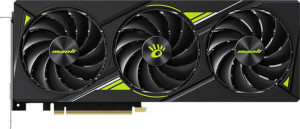
The most telling story in this performance group is raw compute throughput. The MSI RTX 5090 delivers 106.1 TFLOPS of floating-point performance versus 56.28 TFLOPS on the Manli RTX 5080 — nearly double the arithmetic muscle. This difference is structural: the 5090 packs 21,760 shading units and 680 TMUs compared to the 5080's 10,752 and 336 respectively. In practice, this translates to dramatically higher throughput in shader-heavy workloads, ray tracing scenes, and GPU compute tasks like AI inference or 3D rendering, where parallelism is everything.
Where the Manli RTX 5080 punches back is on clock speed. Its 2,295 MHz base and 2,617 MHz turbo significantly outpace the 5090 Ventus's 2,017 MHz base and 2,437 MHz boost. Higher clocks mean each individual shader core runs faster, which can benefit workloads that are more latency-sensitive than throughput-bound. The 5080 also edges ahead on GPU memory speed at 1,875 MHz versus 1,750 MHz, giving it slightly snappier memory bus transactions. However, these clock advantages are not enough to close the massive gap in parallel execution resources.
Overall, the MSI RTX 5090 Ventus 3X OC holds a decisive performance advantage in this group. Its superior shading unit count, higher pixel and texture fill rates — 428.9 GPixel/s and 1,657 GTexels/s versus 293.1 and 879.3 — and nearly 2× floating-point throughput make it the clear winner for demanding rendering, gaming at extreme resolutions, and GPU-accelerated workloads. The Manli RTX 5080's clock speed lead is a real but secondary advantage, more relevant in specific scenarios than as a general performance equalizer. Both cards support Double Precision Floating Point, so neither has an edge there.