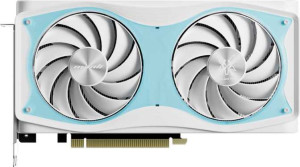
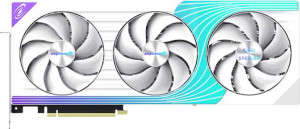
On paper, clock speeds tell a deceptively close story: the Polar Fox RTX 5060 Ti actually edges out the Stellar RTX 5080 at base frequency (2407 MHz vs 2295 MHz), while the two converge almost entirely at boost (2602 MHz vs 2640 MHz). However, raw clock speed is only one dimension of GPU performance — what truly determines throughput is how many execution units are running at those clocks.
This is where the RTX 5080 separates itself decisively. With 10,752 shading units versus 4,608 on the 5060 Ti — a 2.3× advantage — the 5080 delivers proportionally higher throughput across every computed metric: 56.77 TFLOPS of floating-point performance versus 23.98 TFLOPS, a 887 GTexels/s texture rate versus 374.7 GTexels/s, and a 295.7 GPixel/s pixel fill rate versus 124.9 GPixel/s. In practice, this translates to the 5080 handling higher resolutions, more complex shading workloads, and denser scenes with considerably more headroom. The slight memory bandwidth advantage (1875 MHz vs 1750 MHz) further supports sustained performance under heavy load.
Both cards support Double Precision Floating Point, which matters for GPU compute and certain professional workloads, so neither has an edge there. Overall, the RTX 5080 holds a clear and substantial performance advantage across every meaningful throughput metric — the 5060 Ti's marginally higher base clock is a structural quirk, not a competitive edge. The 5080 is the stronger performer by a wide margin in this group.