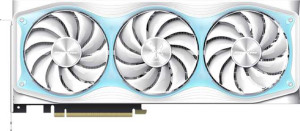
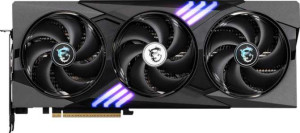
At their foundation, both the Manli Polar Fox RTX 5070 Ti OC and the MSI Gaming Trio OC Plus share the same silicon DNA: identical base clocks of 2295 MHz, the same 8960 shading units, 280 TMUs, 96 ROPs, and matched memory speeds of 1750 MHz. This means the vast majority of their theoretical throughput pipeline is built on equal footing, and neither card holds a structural advantage in parallelism or memory bandwidth at the hardware configuration level.
The meaningful split comes at boost clock. The MSI Gaming Trio OC Plus reaches a GPU turbo of 2572 MHz versus the Manli's 2482 MHz — a 90 MHz advantage that flows directly into every derived performance metric. Its floating-point throughput of 46.09 TFLOPS edges out the Manli's 44.48 TFLOPS, its texture rate of 720.2 GTexels/s versus 695 GTexels/s translates to sharper texture throughput in rendering-heavy scenes, and its pixel rate of 246.9 GPixel/s compared to 238.3 GPixel/s means a modest but real improvement in fill-rate-bound workloads. In practice, these gaps — roughly 3.6% across the board — are unlikely to produce dramatic frame-rate differences in most games, but they become more relevant under sustained loads, GPU compute tasks, or AI-accelerated workloads where peak throughput is continuously exploited.
The MSI GeForce RTX 5070 Ti Gaming Trio OC Plus holds a clear, if narrow, performance edge in this group, driven entirely by its higher boost clock. The Manli Polar Fox is not meaningfully slower for everyday gaming, but for users who prioritize peak compute throughput or want the highest factory-overclocked headroom out of the box, the MSI card is the stronger choice on paper.