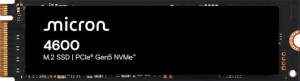
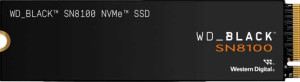
Micron 4600 2TB
Western Digital WD Black SN8100 2TB

Micron 4600 2TB Western Digital WD Black SN8100 2TB

Overview

Welcome to this in-depth specification comparison between the Micron 4600 2TB and the Western Digital WD Black SN8100 2TB. Both drives share a strong common foundation, including the M.2 form factor, PCIe 5.0 interface, NVMe 2.0 protocol, DRAM cache, and the Silicon Motion SM2508 controller. Yet despite this shared DNA, the two drives diverge in meaningful ways, particularly around sequential and random write performance and reliability ratings. Read on to see how every spec stacks up.

Common Features

  • Both use the M.2 form factor.
  • Both feature a DRAM cache.
  • Both are NVMe SSDs.
  • Both support NVMe version 2.
  • Both offer 2000GB of internal storage.
  • Both use the Silicon Motion SM2508 controller.
  • Both use TLC NAND flash storage.
  • Both use PCIe version 5.

Main Differences

  • Sequential read speed is 14500 MB/s on Micron 4600 2TB and 14900 MB/s on Western Digital WD Black SN8100 2TB.
  • Random read speed is 2100000 IOPS on Micron 4600 2TB and 2300000 IOPS on Western Digital WD Black SN8100 2TB.
  • Sequential write speed is 12000 MB/s on Micron 4600 2TB and 14000 MB/s on Western Digital WD Black SN8100 2TB.
  • Random write speed is 2100000 IOPS on Micron 4600 2TB and 2300000 IOPS on Western Digital WD Black SN8100 2TB.
  • MTBF is 2 million hours on Micron 4600 2TB and 1.8 million hours on Western Digital WD Black SN8100 2TB.
Specs Comparison
Micron 4600 2TB

Micron 4600 2TB

Western Digital WD Black SN8100 2TB

Western Digital WD Black SN8100 2TB

Read speed:
sequential read speed 14500 MB/s 14900 MB/s
random read speed 2100000 IOPS 2300000 IOPS

Both drives operate at the bleeding edge of consumer NVMe storage, with sequential read speeds of 14500 MB/s and 14900 MB/s for the Micron 4600 and WD Black SN8100 respectively. At this tier, sequential throughput differences rarely surface in everyday tasks — the gap only becomes meaningful in sustained large-file transfers, such as moving multi-gigabyte video archives or loading massive datasets, where the SN8100's slight lead could shave a fraction of a second off completion times.

The more telling differentiator is random read performance: the SN8100 reaches 2300000 IOPS versus the Micron 4600's 2100000 IOPS — roughly a 10% advantage. Random IOPS governs how quickly a drive handles the fragmented, small-block requests that dominate real workloads: OS boot sequences, application launches, database queries, and virtualization. A 200K IOPS edge at this scale is non-trivial and will be more perceptibly felt than the sequential gap.

The WD Black SN8100 holds a clear edge in this group. While neither drive will bottleneck a modern PCIe 5.0 system in typical use, the SN8100's combination of higher sequential throughput and meaningfully better random read IOPS makes it the stronger performer across both bandwidth-heavy and latency-sensitive scenarios.

Write speed:
sequential write speed 12000 MB/s 14000 MB/s
random write speed 2100000 IOPS 2300000 IOPS

Write performance is where the gap between these two drives widens considerably. The WD Black SN8100 achieves 14000 MB/s sequential write speed against the Micron 4600's 12000 MB/s — a difference of roughly 17%. Unlike the read side where both drives were neck-and-neck, this margin is substantial enough to matter in practice during write-intensive workloads like video ingestion, large backup jobs, or compiling sizable codebases.

Random write IOPS follow the same pattern established on the read side: the SN8100 posts 2300000 IOPS to the Micron 4600's 2100000 IOPS. In write-heavy transactional scenarios — think database write commits, log file generation, or swap-heavy virtual machines — this sustained IOPS advantage translates to lower write latency and more consistent responsiveness under pressure.

The WD Black SN8100 takes a decisive edge here, and this group arguably reveals a stronger advantage than the read comparison. A 2 GB/s sequential write lead is meaningful for content creators and power users who regularly push large volumes of data to disk, while the IOPS gap reinforces the SN8100's superiority in mixed, random-access write workloads as well.

General info:
type M2 M2
SSD cache DRAM cache DRAM cache
Is an NVMe SSD
NVMe version 2 2
internal storage 2000GB 2000GB
release date February 2025 May 2025
controller Silicon Motion SM2508 Silicon Motion SM2508
SSD storage type TLC TLC
PCI Express (PCIe) version 5 5
Controller channels 8 8
Terabytes Written (TBW) 1200 1200
MTBF 2million hours 1.8million hours
warranty period 5 years 5 years
Has an integrated heatsink
has RGB lighting

At the foundational level, these two drives are remarkably alike. Both are M.2 NVMe SSDs built on PCIe 5.0 with NVMe 2.0, equipped with DRAM cache, using TLC NAND flash, and controlled by the same Silicon Motion SM2508 chip with 8 channels. Sharing an identical controller and interface generation means their architectural baseline is essentially the same — any performance differences observed elsewhere stem from firmware tuning and NAND implementation rather than fundamental hardware divergence.

Endurance ratings are also identical at 1200 TBW, and both carry a 5-year warranty. The one differentiator in this group is MTBF: the Micron 4600 is rated at 2 million hours versus the SN8100's 1.8 million hours. MTBF is a statistical reliability projection rather than a guaranteed lifespan, but a higher figure does reflect greater confidence in long-term component stability — a consideration more relevant to enterprise-adjacent or always-on workloads than typical consumer use.

This group is essentially a near-tie, with a narrow edge to the Micron 4600 on reliability grounds alone. For most users, the shared specs — identical controller, endurance, and warranty — mean the general architecture offers no meaningful advantage either way. The MTBF difference is the only data point here that could influence a decision, and primarily for those prioritizing long-term dependability over raw performance.

Comparison Summary & Verdict

After reviewing all the evidence, both the Micron 4600 2TB and the Western Digital WD Black SN8100 2TB are top-tier PCIe 5.0 NVMe SSDs that share the same controller, form factor, and storage technology. Where they differ is notable: the WD Black SN8100 2TB pulls ahead with a higher sequential write speed of 14000 MB/s versus 12000 MB/s, and superior random read and write performance of 2300000 IOPS versus 2100000 IOPS, making it the stronger choice for workloads that are heavily write-intensive. On the other hand, the Micron 4600 2TB counters with a meaningfully better MTBF rating of 2 million hours compared to 1.8 million hours, giving it an edge for users who prioritize long-term endurance and reliability in demanding environments.

Micron 4600 2TB
Buy Micron 4600 2TB if...

Buy the Micron 4600 2TB if long-term drive reliability is your top priority, as it offers a higher MTBF rating of 2 million hours compared to the WD Black SN8100 2TB.

Western Digital WD Black SN8100 2TB
Buy Western Digital WD Black SN8100 2TB if...

Buy the Western Digital WD Black SN8100 2TB if you need maximum write throughput and IOPS, as it leads with 14000 MB/s sequential write speed and 2300000 random read and write IOPS.