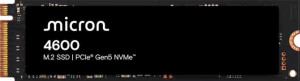
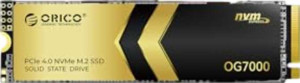
Several architectural decisions separate these two drives at a fundamental level. The most consequential is interface generation: the Micron 4600 runs on PCIe 5, while the Orico OG7000 operates on PCIe 4 — the generational gap that directly explains the substantial read speed delta seen elsewhere in this comparison. Equally significant is the cache architecture: the Micron uses dedicated DRAM cache, which provides consistently low-latency access to the drive's mapping table regardless of system load. The OG7000 relies on HMB (Host Memory Buffer), borrowing a slice of system RAM instead — a cost-saving approach that works well under light workloads but can introduce latency variability when system memory is under pressure.
On endurance, the picture shifts. The OG7000 declares a TBW of 1000 versus the Micron's 300 TBW — though this must be read in context: the OG7000 carries four times the storage capacity (2TB vs 512GB), so the raw TBW figures are not directly comparable on a per-gigabyte basis. A notable asymmetry exists on security: the Micron supports 256-bit hardware encryption, while the OG7000 offers no encryption support at all. For enterprise use cases, regulated environments, or privacy-conscious users, this distinction matters considerably.
Both drives share M.2 form factor, NVMe protocol, TLC NAND, 8 controller channels, and a 5-year warranty — a solid common baseline. Overall, the Micron 4600 holds a architectural edge in performance-critical and security-sensitive contexts thanks to its PCIe 5 interface, DRAM cache, and encryption support. The OG7000 counters with far greater raw capacity, making it the more practical choice where storage volume outweighs peak performance.