Motorola Edge 60 Fusion
Realme P4 Pro 5G

Motorola Edge 60 Fusion Realme P4 Pro 5G

Overview

When comparing the Motorola Edge 60 Fusion and the Realme P4 Pro 5G, two mid-range contenders emerge with surprisingly different priorities. From waterproofing standards and display refresh rates to battery capacity and audio codec support, these phones carve out distinct identities despite sharing a common Android 15 foundation. Whether you care most about camera versatility, display performance, or all-day endurance, this head-to-head breakdown covers every spec that matters.

Common Features

  • Neither product has a rugged build.
  • Neither product can be folded.
  • Both products feature an OLED/AMOLED display type.
  • Both products use Gorilla Glass 7i for damage-resistant screen protection.
  • HDR10 support is available on both products.
  • HDR10+ support is available on both products.
  • Dolby Vision support is not available on either product.
  • Neither product has a secondary screen.
  • Both products have a touchscreen.
  • Both products offer 512GB of internal storage.
  • Both products come with 12GB of RAM.
  • Both products have integrated LTE.
  • Both products use a 4 nm semiconductor size.
  • Both products support 64-bit processing.
  • Both products support DirectX 12.
  • Both products have integrated graphics.
  • Both products use big.LITTLE technology.
  • Both products run Android 15.
  • Wireless charging is not available on either product.
  • Both products support fast charging.
  • Both products come with a charger included.
  • Neither product has a removable battery.
  • Both products have stereo speakers.
  • Neither product has a 3.5mm audio jack.
  • Both products support 5G connectivity.
  • Both products support Wi-Fi 4, Wi-Fi 5, and Wi-Fi 6.
  • Both products have dual SIM card slots.
  • Both products have Bluetooth version 5.4.
  • Both products feature a USB Type-C connector.
  • Both products use USB version 2.
  • Both products have NFC.
  • Both products have a fingerprint scanner.
  • Both products have a video light.
  • Neither product has a sapphire glass display.
  • Neither product has an e-paper display.
  • Both products have clipboard warnings.
  • Both products offer location privacy options.
  • Both products offer camera and microphone privacy options.
  • Mail Privacy Protection is not available on either product.
  • Both products support theme customization.
  • Both products can block app tracking.
  • Cross-site tracking blocking is not available on either product.
  • Both products have a multi-lens main camera.
  • Both products have built-in optical image stabilization.
  • Neither product has a dual-tone LED flash.
  • Both products have a single LED flash.
  • Both products have a CMOS sensor.
  • Both products support continuous autofocus when recording video.

Main Differences

  • Water resistance rating is IP68 (waterproof) on Motorola Edge 60 Fusion and IP66 (water resistant) on Realme P4 Pro 5G.
  • Weight is 180.1 g on Motorola Edge 60 Fusion and 189 g on Realme P4 Pro 5G.
  • Thickness is 8.25 mm on Motorola Edge 60 Fusion and 7.7 mm on Realme P4 Pro 5G.
  • Width is 73.08 mm on Motorola Edge 60 Fusion and 76.2 mm on Realme P4 Pro 5G.
  • Height is 161.2 mm on Motorola Edge 60 Fusion and 162.3 mm on Realme P4 Pro 5G.
  • Volume is 97.19 cm³ on Motorola Edge 60 Fusion and 95.23 cm³ on Realme P4 Pro 5G.
  • Screen size is 6.67″ on Motorola Edge 60 Fusion and 6.8″ on Realme P4 Pro 5G.
  • Pixel density is 446 ppi on Motorola Edge 60 Fusion and 453 ppi on Realme P4 Pro 5G.
  • Resolution is 1220 x 2712 px on Motorola Edge 60 Fusion and 1280 x 2800 px on Realme P4 Pro 5G.
  • Refresh rate is 120Hz on Motorola Edge 60 Fusion and 144Hz on Realme P4 Pro 5G.
  • Touch sampling rate is 300Hz on Motorola Edge 60 Fusion and 240Hz on Realme P4 Pro 5G.
  • Typical brightness is 1500 nits on Motorola Edge 60 Fusion and 1800 nits on Realme P4 Pro 5G.
  • Always-On Display is available on Realme P4 Pro 5G but not on Motorola Edge 60 Fusion.
  • The chipset is MediaTek Dimensity 7300 on Motorola Edge 60 Fusion and Qualcomm Snapdragon 7 Gen 4 on Realme P4 Pro 5G.
  • CPU speed is 4 x 2.5 & 4 x 2 GHz on Motorola Edge 60 Fusion and 1 x 2.8 & 4 x 2.4 & 3 x 1.8 GHz on Realme P4 Pro 5G.
  • GPU clock speed is 1047 MHz on Motorola Edge 60 Fusion and 1000 MHz on Realme P4 Pro 5G.
  • RAM speed is 6400 MHz on Motorola Edge 60 Fusion and 4200 MHz on Realme P4 Pro 5G.
  • Main camera megapixels are 50 & 13 MP on Motorola Edge 60 Fusion and 50 & 2 MP on Realme P4 Pro 5G.
  • Front camera megapixels are 32 MP on Motorola Edge 60 Fusion and 50 MP on Realme P4 Pro 5G.
  • Main camera video recording goes up to 2160p at 30 fps on Motorola Edge 60 Fusion and 2160p at 60 fps on Realme P4 Pro 5G.
  • RAW photo shooting is supported on Motorola Edge 60 Fusion but not on Realme P4 Pro 5G.
  • Front camera aperture is f/2.2 on Motorola Edge 60 Fusion and f/2.4 on Realme P4 Pro 5G.
  • Battery capacity is 5200 mAh on Motorola Edge 60 Fusion and 7000 mAh on Realme P4 Pro 5G.
  • Charging speed is 68W on Motorola Edge 60 Fusion and 80W on Realme P4 Pro 5G.
  • aptX support is present on Realme P4 Pro 5G but not available on Motorola Edge 60 Fusion.
  • LDAC support is present on Realme P4 Pro 5G but not available on Motorola Edge 60 Fusion.
  • External memory card slot is available on Motorola Edge 60 Fusion but not on Realme P4 Pro 5G.
  • A curved display is featured on Motorola Edge 60 Fusion but not on Realme P4 Pro 5G.
Specs Comparison
Motorola Edge 60 Fusion

Motorola Edge 60 Fusion

Realme P4 Pro 5G

Realme P4 Pro 5G

Design:
water resistance Waterproof Water resistant
weight 180.1 g 189 g
thickness 8.25 mm 7.7 mm
width 73.08 mm 76.2 mm
height 161.2 mm 162.3 mm
volume 97.189092 cm³ 95.227902 cm³
Ingress Protection (IP) rating IP68 IP66
has a rugged build
can be folded

The most consequential difference in this group is water protection. The Motorola Edge 60 Fusion carries an IP68 rating, meaning it is fully waterproof and can withstand submersion in water — a meaningful real-world safeguard for rain, spills, or accidental drops in water. The Realme P4 Pro 5G, by contrast, is rated IP66, which certifies resistance to powerful water jets but not submersion. For most everyday scenarios this distinction may not matter, but for users who swim, work outdoors, or want maximum peace of mind, IP68 is the clear step up.

On physical dimensions, the two phones tell slightly different stories. The Realme P4 Pro is noticeably thinner at 7.7 mm versus the Edge 60 Fusion's 8.25 mm, and that 0.55 mm gap is perceptible in-hand. However, the Realme is also wider (76.2 mm) and heavier at 189 g, compared to the Edge 60 Fusion's more manageable 180.1 g and narrower 73.08 mm frame. The Realme's slimmer profile may feel sleeker on a flat surface, but the Edge 60 Fusion's reduced width and lighter weight generally translate to more comfortable one-handed use over extended periods.

Neither device has a rugged build or a foldable form factor, so those are non-factors in this comparison. Overall, the Motorola Edge 60 Fusion holds a clear design advantage: it wins on superior water protection, lighter weight, and a narrower grip, with the Realme's only tangible design edge being its slimmer thickness.
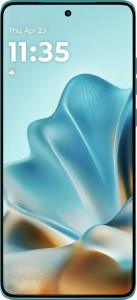

Display:
Display type OLED/AMOLED OLED/AMOLED
screen size 6.67" 6.8"
pixel density 446 ppi 453 ppi
resolution 1220 x 2712 px 1280 x 2800 px
refresh rate 120Hz 144Hz
touch sampling rate 300Hz 240Hz
brightness (typical) 1500 nits 1800 nits
has branded damage-resistant glass
Gorilla Glass version Gorilla Glass 7i Gorilla Glass 7i
supports HDR10
supports HDR10+
Always-On Display
supports Dolby Vision
Has a secondary screen
has a touch screen

Both phones use OLED/AMOLED panels with identical Gorilla Glass 7i protection and shared support for HDR10 and HDR10+, establishing a solid shared baseline. Where they diverge is in the finer metrics that separate a good display from a great one. The Realme P4 Pro 5G edges ahead on sheer panel quality: its 1800 nits of typical brightness versus the Edge 60 Fusion's 1500 nits means noticeably better legibility under direct sunlight, a difference that is genuinely felt outdoors. Its slightly higher 453 ppi pixel density on a 6.8″ screen also delivers marginally sharper rendering than the Edge 60 Fusion's 446 ppi at 6.67″, though both are sharp enough that most users will not distinguish them in daily use.

The refresh rate gap carries more practical weight. The Realme's 144Hz panel produces smoother scrolling and more fluid animations compared to the Edge 60 Fusion's 120Hz — a difference gamers and power users will appreciate, though casual users may find 120Hz perfectly adequate. Interestingly, the situation flips for touch responsiveness: the Edge 60 Fusion's 300Hz touch sampling rate outpaces the Realme's 240Hz, meaning it registers finger inputs faster — an advantage in fast-paced gaming scenarios even if the visual refresh rate is lower.

One exclusive feature tips the balance further toward the Realme: its Always-On Display capability lets users glance at time, notifications, and widgets without waking the screen — a convenience the Edge 60 Fusion simply lacks. Taken together, the Realme P4 Pro 5G holds the display advantage, driven by higher brightness, a faster refresh rate, and Always-On Display support, with the Edge 60 Fusion's superior touch sampling rate being its only meaningful counter-point in this category.

Performance:
internal storage 512GB 512GB
RAM 12GB 12GB
Chipset (SoC) name MediaTek Dimensity 7300 Qualcomm Snapdragon 7 Gen 4
CPU speed 4 x 2.5 & 4 x 2 GHz 1 x 2.8 & 4 x 2.4 & 3 x 1.8 GHz
GPU clock speed 1047 MHz 1000 MHz
Has integrated LTE
RAM speed 6400 MHz 4200 MHz
semiconductor size 4 nm 4 nm
Supports 64-bit
DirectX version DirectX 12 DirectX 12
Has integrated graphics
Uses big.LITTLE technology
DDR memory version 5 5

At a glance, these two phones look nearly identical on paper — same 12GB of RAM, same 512GB storage, same 4nm fabrication node, and both running DDR5 memory with DirectX 12 support. The real story is in the silicon underneath. The Realme P4 Pro 5G runs on the Snapdragon 7 Gen 4, which employs a more sophisticated three-tier CPU cluster — a 2.8 GHz prime core, four performance cores at 2.4 GHz, and three efficiency cores at 1.8 GHz. That prime core gives it a higher peak single-threaded ceiling, which matters for latency-sensitive tasks like app launches and UI responsiveness. The Edge 60 Fusion's Dimensity 7300 uses a simpler two-tier layout topping out at 2.5 GHz, which is a tangibly lower peak frequency.

Where the Edge 60 Fusion fights back is in memory bandwidth and GPU throughput. Its 6400 MHz RAM speed is substantially faster than the Realme's 4200 MHz — a gap that directly impacts how quickly data moves between the processor and memory, benefiting multitasking, large file handling, and sustained workloads. The Edge 60 Fusion also has a marginally quicker GPU clock at 1047 MHz versus 1000 MHz, though the practical gaming difference at this clock delta is minimal.

Weighing these tradeoffs, the two phones are closely matched but lean in different directions: the Realme P4 Pro 5G has the faster peak CPU core for snappy single-threaded performance, while the Edge 60 Fusion's dramatically superior RAM speed gives it an edge in sustained and memory-intensive scenarios. Neither holds a commanding overall lead in performance — this group is best called a narrow split, with chip preference likely coming down to whether a user prioritizes peak CPU responsiveness or memory bandwidth.

Cameras:
megapixels (main camera) 50 & 13 MP 50 & 2 MP
wide aperture (main camera) 2.2 & 1.8f 2.2 & 1.8f
Has a dual-lens (or multi-lens) main camera
megapixels (front camera) 32MP 50MP
has built-in optical image stabilization
video recording (main camera) 2160 x 30 fps 2160 x 60 fps
Has a dual-tone LED flash
number of flash LEDs 1 1
has a BSI sensor
has a CMOS sensor
has continuous autofocus when recording movies
Has phase-detection autofocus for photos
supports slow-motion video recording
has a built-in HDR mode
has manual exposure
has a flash
optical zoom 0x 0x
has manual ISO
has a serial shot mode
has manual focus
has a front camera
Has laser autofocus
Shoots 360° panorama
has manual white balance
shoots raw
has touch autofocus
has manual shutter speed
can create panoramas in-camera
wide aperture (front camera) 2.2f 2.4f
Has timelapse function
Has a front-facing LED flash
has a dual-lens (or multi-lens) front camera
supports HDR10 recording
supports Dolby Vision recording
has a front-facing camera under the display
Has a RGB LED flash
has 3D photo/video recording capabilities

The main cameras share an identical 50MP primary sensor and matching apertures, with OIS and phase-detection autofocus on both — so the rear shooting experience starts from the same foundation. The secondary lens is where the rear systems diverge sharply. The Edge 60 Fusion pairs its main sensor with a 13MP ultrawide, a genuinely useful second perspective for landscapes and group shots. The Realme P4 Pro 5G's secondary lens is just 2MP, which in practice functions as little more than a depth-sensing aid — it contributes almost nothing to versatility or image quality on its own.

Video recording is a clear win for the Realme: it captures 4K at 60fps versus the Edge 60 Fusion's 30fps ceiling. That doubled frame rate produces dramatically smoother footage and offers more flexibility in post-production for slow-motion effects at full resolution. For anyone who shoots video regularly, this is a meaningful real-world advantage. The Edge 60 Fusion counters with RAW shooting support — a capability the Realme lacks entirely — giving photography enthusiasts full control over post-processing with uncompressed image data, which is a significant tool for serious stills photographers.

Selfie shooters will find the Realme's 50MP front camera considerably more capable than the Edge 60 Fusion's 32MP, and the Edge 60 Fusion's slightly wider f/2.2 front aperture (versus f/2.4 on the Realme) offers marginally better low-light performance that partially offsets the megapixel gap. Overall, this group is a split verdict defined by use case: the Realme P4 Pro 5G is the stronger choice for video creators and selfie-focused users, while the Motorola Edge 60 Fusion serves photography enthusiasts better through its more useful ultrawide lens and RAW capture support.

Operating system:
Android version Android 15 Android 15
has clipboard warnings
has location privacy options
has camera/microphone privacy options
has Mail Privacy Protection
has theme customization
can block app tracking
blocks cross-site tracking
has on-device machine learning
has notification permissions
has media picker
Can play games while they download
has dark mode
has Wi-Fi password sharing
has battery health check
has an extra dim mode
has focus modes
has dynamic theming
can offload apps
Has customizable notifications
has Live Text
has full-page screenshots
supports split screen
gets direct OS updates
has PiP
Can be used as a PC
Has sharing intents
has a child lock
Supports widgets
Is free and open source
Has offline voice recognition
has voice commands
Tracks the current position of a mobile device
is a multi-user system
has Quick Start

Rarely does a spec group produce such a clean result: every single data point in this category is identical across both devices. Both run Android 15, share the same privacy toolkit — including location controls, camera/microphone permissions, and app tracking blocks — and support the same productivity and usability features, from split-screen multitasking and Picture-in-Picture to dynamic theming, offline voice recognition, and widget support.

Neither phone receives direct OS updates from Google, meaning both depend on their respective manufacturers for software patches and version upgrades — a consideration worth tracking over the device's lifespan, though it is a shared limitation rather than a differentiator. The privacy feature set is solid on both sides, with on-device machine learning, clipboard warnings, and granular notification permissions all present, giving users meaningful control without one device outpacing the other.

This group is an unambiguous tie. There is no basis in the provided data to favor either phone on software — the operating system experience, feature set, and privacy capabilities are point-for-point equivalent. A buyer's decision here should rest entirely on the other specification groups.

Battery:
battery power 5200 mAh 7000 mAh
has wireless charging
Supports fast charging
charging speed 68W 80W
comes with a charger
has a removable battery
has a battery level indicator
has a rechargeable battery

Battery capacity is where the Realme P4 Pro 5G makes its most emphatic statement in this entire comparison. Its 7000 mAh cell dwarfs the Edge 60 Fusion's already-respectable 5200 mAh — a difference of 1800 mAh, or roughly 35% more energy storage. In practical terms, that gap translates directly to significantly more screen-on time, fewer top-ups across a full day, and a much larger buffer for heavy users who travel, game, or go long stretches without access to a charger.

Charging speed is competitive but again favors the Realme: its 80W fast charging edges out the Edge 60 Fusion's 68W. The real-world implication is nuanced — the Realme's larger battery means absolute charge times will still be longer even at the higher wattage, but the faster rate helps close that gap. Both phones ship with a charger in the box and support fast charging as a standard feature, so no additional accessories are needed. Neither device offers wireless charging, which is a shared omission at this tier.

The Realme P4 Pro 5G wins this category decisively. A 7000 mAh battery is an exceptional capacity by any current standard, and combined with the faster charging rate, it is the clear choice for users who prioritize battery endurance above all else. The Edge 60 Fusion's 5200 mAh is far from inadequate, but it simply cannot compete with the Realme's substantial advantage in raw energy reserves.

Audio:
has a socket for a 3.5 mm audio jack
has stereo speakers
has aptX
has LDAC
has aptX HD
has aptX Adaptive
has aptX Lossless

Wired audio listeners will find no difference here — both phones have dropped the 3.5mm headphone jack, and both feature stereo speakers for built-in playback. The divergence arrives the moment you connect a Bluetooth headset. The Realme P4 Pro 5G supports both aptX and LDAC, two high-resolution Bluetooth audio codecs that the Edge 60 Fusion lacks entirely. This is a meaningful gap for anyone who owns a compatible wireless headset or speaker.

LDAC in particular is the more significant of the two — developed by Sony, it transmits up to three times more data than standard Bluetooth audio, preserving far more detail and dynamic range when streaming to a compatible device. aptX similarly raises the quality ceiling above the baseline SBC codec. For casual listeners, the difference may be subtle, but for users with quality wireless headphones who care about audio fidelity, the Realme's codec support is a genuine and functional advantage rather than a spec-sheet footnote.

The Realme P4 Pro 5G wins this category clearly. While the two phones are evenly matched for speaker-based listening, the Realme's LDAC and aptX support opens up a higher tier of wireless audio quality that the Edge 60 Fusion simply cannot access — a straightforward win for wireless audio enthusiasts.

Connectivity & Features:
release date April 2025 August 2025
has 5G support
Wi-Fi version Wi-Fi 4 (802.11n), Wi-Fi 5 (802.11ac), Wi-Fi 6 (802.11ax) Wi-Fi 4 (802.11n), Wi-Fi 5 (802.11ac), Wi-Fi 6 (802.11ax)
SIM cards 2 SIM 2 SIM
Bluetooth version 5.4 5.4
has an external memory slot
Has USB Type-C
USB version 2 2
has NFC
Has a fingerprint scanner
has emergency SOS via satellite
has crash detection
is DLNA-certified
has a gyroscope
supports ANT+
Has a heart rate monitor
has GPS
has a compass
supports Wi-Fi
Has an infrared sensor
has an accelerometer
has a cellular module
Has a barometer
has an HDMI output
Uses 3D facial recognition
Has an iris scanner
Stylus included
supports Galileo
Has motion tracking
Has optical tracking
Has a built-in projector

Across the vast majority of this spec group, the two phones are effectively identical. Both support 5G, Wi-Fi 6, Bluetooth 5.4, NFC, and dual SIM — covering all the connectivity bases a modern user would expect. Sensors, navigation (including Galileo support), USB Type-C at USB 2.0 speeds, and fingerprint scanning are all present and matched on both sides.

The single differentiator in this entire group is the external memory slot, which the Motorola Edge 60 Fusion has and the Realme P4 Pro 5G does not. For users who rely on microSD cards to expand storage, archive photos and videos, or transfer files between devices, this is a practical and tangible advantage. Given that both phones ship with 512GB of internal storage, the omission on the Realme may not sting for most users — but for those who specifically want expandable storage, the Edge 60 Fusion is the only option here.

The Motorola Edge 60 Fusion takes a narrow win in this group purely on the strength of its external memory slot. Everything else is a dead heat, making storage flexibility the sole deciding factor for connectivity-conscious buyers.

Miscellaneous:
has a video light
Has sapphire glass display
Has a curved display
Has an e-paper display

This is a short group with a single point of difference. Both phones share a video light and forgo sapphire glass — neither factor sets one apart. The only distinguishing spec is the display curvature: the Motorola Edge 60 Fusion features a curved display, while the Realme P4 Pro 5G uses a flat panel.

Curved displays are a matter of personal preference as much as function. They lend a premium, immersive feel and can make edge-to-edge content like video look more enveloping, but they also introduce tradeoffs — screen protectors are harder to apply reliably, and accidental edge touches can occasionally register unintended inputs. Flat displays, by contrast, are more practical for case compatibility and touch precision, and are generally preferred by users who prioritize function over form.

Whether the Edge 60 Fusion's curved display counts as an advantage depends entirely on the buyer's preference — it is a deliberate design choice rather than an objective improvement. For those who value the aesthetic and cinematic feel of a curved screen, the Motorola wins this group; for those who prefer a flat, no-compromise panel, the Realme P4 Pro 5G is the more practical pick. On purely neutral grounds, this group is a tie decided by taste.

Comparison Summary & Verdict

After a thorough comparison, both phones prove compelling but serve different users. The Motorola Edge 60 Fusion stands out with its superior IP68 waterproofing, lighter 180.1 g build, curved display, RAW photo shooting, a higher-resolution secondary camera (13 MP vs 2 MP), and an expandable storage slot — making it the better pick for users who value durability and photographic flexibility. The Realme P4 Pro 5G counters with a significantly larger 7000 mAh battery, faster 80W charging, a brighter 1800-nit display with a smoother 144Hz refresh rate, a 50 MP front camera, Always-On Display, and richer audio via LDAC and aptX — positioning it as the stronger choice for media lovers and heavy daily users who prioritize screen quality and battery stamina.

Motorola Edge 60 Fusion
Buy Motorola Edge 60 Fusion if...

Buy the Motorola Edge 60 Fusion if you want superior IP68 waterproofing, a lighter and more compact design, RAW photo capture, and the flexibility of expandable storage.

Realme P4 Pro 5G
Buy Realme P4 Pro 5G if...

Buy the Realme P4 Pro 5G if you prioritize a massive 7000 mAh battery, a brighter 144Hz display, a high-resolution 50 MP front camera, and premium audio with LDAC and aptX support.