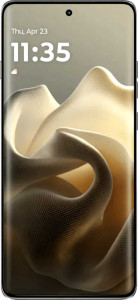
Motorola Edge 60 Pro
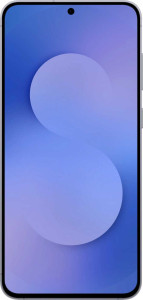
Samsung Galaxy S25 FE

Motorola Edge 60 Pro Samsung Galaxy S25 FE

Overview

When comparing the Motorola Edge 60 Pro and the Samsung Galaxy S25 FE, two compelling mid-to-upper-range Android smartphones come face to face. Both share a 6.7″ 120Hz OLED display and IP68 waterproofing, yet they take very different paths when it comes to battery capacity and charging, raw processing power, and camera capabilities. Which one better fits your needs? Read on to find out.

Common Features

  • Both phones are waterproof with an IP68 ingress protection rating.
  • Neither phone has a rugged build.
  • Neither phone can be folded.
  • Both phones feature a 6.7″ OLED/AMOLED display.
  • Both phones have a 120Hz refresh rate.
  • Both phones feature damage-resistant glass.
  • HDR10 support is available on both phones.
  • HDR10+ support is available on both phones.
  • Dolby Vision support is not available on either phone.
  • Neither phone has a secondary screen.
  • Both phones use a 4 nm semiconductor.
  • Both phones have integrated LTE.
  • Both phones support 64-bit processing.
  • Both phones have integrated graphics.
  • Both phones use big.LITTLE technology.
  • Both phones have a multi-lens main camera with optical image stabilization.
  • Both phones support slow-motion video recording and have a built-in HDR mode.
  • Both phones have phase-detection autofocus and continuous autofocus when recording.
  • Both phones have theme customization and can block app tracking.
  • Both phones support 5G, NFC, USB Type-C, and have a fingerprint scanner.
  • Both phones use 1 SIM and 1 eSIM and have no external memory slot.
  • Both phones support wireless charging and fast charging and have a non-removable battery.
  • Both phones have stereo speakers but no 3.5 mm audio jack and no radio.
  • Emergency SOS via satellite is not available on either phone.
  • Both phones support Wi-Fi 6E (802.11ax).

Main Differences

  • Weight is 186 g on Motorola Edge 60 Pro and 190 g on Samsung Galaxy S25 FE.
  • Thickness is 8.2 mm on Motorola Edge 60 Pro and 7.4 mm on Samsung Galaxy S25 FE.
  • Width is 73.1 mm on Motorola Edge 60 Pro and 76.6 mm on Samsung Galaxy S25 FE.
  • Pixel density is 444 ppi on Motorola Edge 60 Pro and 385 ppi on Samsung Galaxy S25 FE.
  • Resolution is 1220 x 2712 px on Motorola Edge 60 Pro and 1080 x 2340 px on Samsung Galaxy S25 FE.
  • Typical brightness is 4500 nits on Motorola Edge 60 Pro and 1200 nits on Samsung Galaxy S25 FE.
  • The display is protected by Gorilla Glass 7i on Motorola Edge 60 Pro and Gorilla Glass Victus on Samsung Galaxy S25 FE.
  • Internal storage is 512 GB on Motorola Edge 60 Pro and 256 GB on Samsung Galaxy S25 FE.
  • RAM is 12 GB on Motorola Edge 60 Pro and 8 GB on Samsung Galaxy S25 FE.
  • The chipset is MediaTek Dimensity 8350 on Motorola Edge 60 Pro and Samsung Exynos 2400 on Samsung Galaxy S25 FE.
  • AnTuTu benchmark score is 1,375,600 on Motorola Edge 60 Pro and 2,147,521 on Samsung Galaxy S25 FE.
  • Geekbench 6 multi-core score is 4700 on Motorola Edge 60 Pro and 7000 on Samsung Galaxy S25 FE.
  • Geekbench 6 single-core score is 1536 on Motorola Edge 60 Pro and 2198 on Samsung Galaxy S25 FE.
  • Main camera megapixels are 50 & 50 & 10 MP on Motorola Edge 60 Pro and 50 & 12 & 8 MP on Samsung Galaxy S25 FE.
  • Front camera resolution is 50 MP on Motorola Edge 60 Pro and 12 MP on Samsung Galaxy S25 FE.
  • Maximum video recording resolution is 2160p at 30 fps on Motorola Edge 60 Pro and 4320p at 30 fps on Samsung Galaxy S25 FE.
  • A BSI sensor is present on Samsung Galaxy S25 FE but not on Motorola Edge 60 Pro.
  • Laser autofocus is available on Samsung Galaxy S25 FE but not on Motorola Edge 60 Pro.
  • Manual shutter speed control is available on Samsung Galaxy S25 FE but not on Motorola Edge 60 Pro.
  • Android version is Android 15 on Motorola Edge 60 Pro and Android 16 on Samsung Galaxy S25 FE.
  • Battery capacity is 6000 mAh on Motorola Edge 60 Pro and 4900 mAh on Samsung Galaxy S25 FE.
  • Wired charging speed is 90W on Motorola Edge 60 Pro and 45W on Samsung Galaxy S25 FE.
  • Wireless charging speed is 15W on Motorola Edge 60 Pro and 25W on Samsung Galaxy S25 FE.
  • Reverse wireless charging is available on Samsung Galaxy S25 FE but not on Motorola Edge 60 Pro.
  • A charger is included in the box with Motorola Edge 60 Pro but not with Samsung Galaxy S25 FE.
  • aptX Adaptive support is present on Motorola Edge 60 Pro but not on Samsung Galaxy S25 FE.
  • Motorola Edge 60 Pro has 2 microphones while Samsung Galaxy S25 FE has 3 microphones.
  • A curved display is featured on Motorola Edge 60 Pro but not on Samsung Galaxy S25 FE.
  • A barometer is present on Samsung Galaxy S25 FE but not on Motorola Edge 60 Pro.
Specs Comparison
Motorola Edge 60 Pro

Motorola Edge 60 Pro

Samsung Galaxy S25 FE

Samsung Galaxy S25 FE

Design:
water resistance Waterproof Waterproof
weight 186 g 190 g
thickness 8.2 mm 7.4 mm
width 73.1 mm 76.6 mm
height 160.7 mm 161.3 mm
volume 96.326794 cm³ 91.431292 cm³
Ingress Protection (IP) rating IP68 IP68
has a rugged build
can be folded

Both the Motorola Edge 60 Pro and the Samsung Galaxy S25 FE share the same IP68 waterproof rating, meaning both can withstand submersion in fresh water up to 1.5 meters for 30 minutes. Neither offers a rugged build or a foldable form factor, so on those fronts they are evenly matched.

Where the two diverge meaningfully is in their physical footprint. The S25 FE is notably slimmer at 7.4 mm versus 8.2 mm for the Edge 60 Pro — a 0.8 mm difference that is genuinely perceptible in-hand and in a pocket. However, the S25 FE is also wider at 76.6 mm compared to the Edge 60 Pro's 73.1 mm, which can make one-handed use more of a stretch for users with smaller hands. Interestingly, despite being wider and taller, the S25 FE has a smaller overall volume (91.4 cm³ vs 96.3 cm³), a direct result of its thinner profile. The Edge 60 Pro is slightly lighter at 186 g versus 190 g, though a 4-gram difference is unlikely to be noticed during normal use.

In terms of design, the S25 FE holds a clear edge in thinness, which generally translates to a more premium, sleek feel. The Edge 60 Pro counters with a narrower width that may suit one-handed users better. If slim profile is a priority, the S25 FE wins; if a narrower grip is preferred, the Edge 60 Pro is the better fit.

Display:
Display type OLED/AMOLED OLED/AMOLED
screen size 6.7" 6.7"
pixel density 444 ppi 385 ppi
resolution 1220 x 2712 px 1080 x 2340 px
refresh rate 120Hz 120Hz
brightness (typical) 4500 nits 1200 nits
has branded damage-resistant glass
Gorilla Glass version Gorilla Glass 7i Gorilla Glass Victus
supports HDR10
supports HDR10+
supports Dolby Vision
Has a secondary screen
has a touch screen

Both phones sport a 6.7″ OLED/AMOLED panel with a 120Hz refresh rate, HDR10+ support, and branded glass protection — a solid shared foundation. The similarities, however, end there. The Motorola Edge 60 Pro pulls significantly ahead in two critical areas: resolution and brightness. Its 1220 x 2712 px screen yields a pixel density of 444 ppi, compared to the S25 FE's 1080 x 2340 px at 385 ppi. That 59 ppi gap is clearly visible — text appears crisper, fine UI details are sharper, and media looks noticeably more refined on the Edge 60 Pro.

The brightness difference is even more striking. The Edge 60 Pro's 4500 nits peak brightness dwarfs the S25 FE's 1200 nits. In practice, this means the Edge 60 Pro remains easily legible in direct sunlight — a scenario where the S25 FE will visibly struggle. For users who frequently use their phone outdoors, this is one of the most impactful real-world differentiators possible.

On glass protection, the S25 FE uses Gorilla Glass Victus, which is generally considered a more premium and scratch-resistant option than the Edge 60 Pro's Gorilla Glass 7i — though both offer meaningful drop and scratch protection. Still, that advantage is minor relative to the Edge 60 Pro's commanding leads in sharpness and brightness. Overall, the Motorola Edge 60 Pro has a clear and decisive advantage in display quality within this spec group.

Performance:
internal storage 512GB 256GB
RAM 12GB 8GB
AnTuTu benchmark score 1375600 2147521
Chipset (SoC) name MediaTek Dimensity 8350 Samsung Exynos 2400
GPU name Mali G615 MC6 Xclipse 940
CPU speed 1 x 3.35 & 3 x 3.2 & 4 x 2.2 GHz 2 x 2.9 & 3 x 2.6 & 4 x 2 & 1 x 3.2 GHz
Geekbench 6 result (multi) 4700 7000
Geekbench 6 result (single) 1536 2198
GPU clock speed 1400 MHz 1009 MHz
Has integrated LTE
RAM speed 8533 MHz 4200 MHz
semiconductor size 4 nm 4 nm
Supports 64-bit
DirectX version DirectX 12 DirectX 12
Has integrated graphics
Uses big.LITTLE technology
CPU threads 8 threads 10 threads
Uses HMP
Has TrustZone
maximum memory bandwidth 68.2 GB/s 64 GB/s
maximum memory amount 24GB 24GB
DDR memory version 5 5

The chipset battle here is genuinely split, depending on what you value. The Samsung Exynos 2400 in the S25 FE dominates raw CPU benchmarks by a wide margin — its Geekbench 6 multi-core score of 7000 versus 4700 for the Motorola Edge 60 Pro's MediaTek Dimensity 8350 is a 49% lead, and the single-core gap (2198 vs 1536) is equally commanding. The AnTuTu score tells the same story: 2,147,521 versus 1,375,600. In practice, the S25 FE will handle demanding tasks — complex app switching, heavy processing, sustained workloads — with noticeably more headroom.

The Edge 60 Pro fights back on memory. It ships with 12GB of RAM running at a blistering 8533 MHz, compared to the S25 FE's 8GB at 4200 MHz. More RAM and faster memory bandwidth means the Edge 60 Pro can keep more apps resident in memory simultaneously and feed data to the CPU quicker — useful for heavy multitaskers. It also doubles down on storage, offering 512GB versus the S25 FE's 256GB, which is a meaningful advantage for users who store large media libraries or games locally.

Taken together, the S25 FE holds a clear advantage in outright processing power, which matters most for gaming, video rendering, and future-proofing. The Edge 60 Pro's superior RAM configuration makes it a stronger multitasking device and better value on storage. Users who prioritize peak performance should lean toward the S25 FE; those who want a more capable memory setup and greater onboard storage will find the Edge 60 Pro more compelling.

Cameras:
megapixels (main camera) 50 & 50 & 10 MP 50 & 12 & 8 MP
wide aperture (main camera) 1.8 & 2 & 2f 1.8 & 2.2 & 2.4f
Has a dual-lens (or multi-lens) main camera
megapixels (front camera) 50MP 12MP
has built-in optical image stabilization
video recording (main camera) 2160 x 30 fps 4320 x 30 fps
Has a dual-tone LED flash
number of flash LEDs 1 1
has a BSI sensor
has a CMOS sensor
has continuous autofocus when recording movies
Has phase-detection autofocus for photos
supports slow-motion video recording
has a built-in HDR mode
has manual exposure
has a flash
optical zoom 3x 3x
has manual ISO
has a serial shot mode
has manual focus
has a front camera
Has laser autofocus
Shoots 360° panorama
has manual white balance
has touch autofocus
has manual shutter speed
can create panoramas in-camera
wide aperture (front camera) 2f 2.2f
Has timelapse function
Has a front-facing LED flash
has a dual-lens (or multi-lens) front camera
supports HDR10 recording
Has a RGB LED flash

The main cameras open on equal footing — both lead with a 50MP f/1.8 primary sensor with OIS and 3x optical zoom — but the supporting cast diverges sharply. The Edge 60 Pro's secondary lenses are significantly higher resolution (50MP + 10MP) versus the S25 FE's 12MP + 8MP, meaning the Motorola captures considerably more detail from its ultrawide and telephoto shots. Where the S25 FE counters is in sensor technology: it includes a BSI (Back-Side Illuminated) sensor, which is designed to improve light gathering and low-light performance — an advantage the raw megapixel count alone doesn't reflect.

Video recording is another meaningful split. The S25 FE tops out at 4320p (8K) at 30fps, a full tier above the Edge 60 Pro's 2160p (4K) ceiling — useful for those who want maximum video resolution for cropping or future-proofing footage. The S25 FE also adds laser autofocus and manual shutter speed control, giving it more precise focusing in low-contrast scenes and greater manual control for photography enthusiasts. Its dual-tone LED flash produces more natural-looking skin tones in flash photography compared to the Edge 60 Pro's single-tone flash.

The Edge 60 Pro's standout camera advantage is its 50MP front camera, which vastly outresolves the S25 FE's 12MP selfie shooter — a decisive edge for selfie-focused users. On balance, however, the S25 FE offers a more well-rounded and feature-complete camera system overall, with higher video resolution, better low-light sensor design, laser AF, and more manual controls. The S25 FE holds the broader camera advantage, while the Edge 60 Pro leads specifically in selfie resolution.

Operating system:
Android version Android 15 Android 16
has clipboard warnings
has location privacy options
has camera/microphone privacy options
has Mail Privacy Protection
has theme customization
can block app tracking
blocks cross-site tracking
has on-device machine learning
has notification permissions
has media picker
Can play games while they download
has dark mode
has Wi-Fi password sharing
has battery health check
has an extra dim mode
has focus modes
has dynamic theming
can offload apps
Has customizable notifications
has Live Text
has full-page screenshots
supports split screen
gets direct OS updates
has PiP
Can be used as a PC
Has sharing intents
has a child lock
Supports widgets
Is free and open source
Has offline voice recognition
has voice commands
Tracks the current position of a mobile device
is a multi-user system
has Quick Start

Across the entire operating system spec sheet, these two phones are virtually identical — every single feature flag matches, from privacy controls and dynamic theming to split-screen, Picture-in-Picture, and offline voice recognition. The only differentiator in this entire group is the Android version: the Samsung Galaxy S25 FE ships with Android 16, while the Motorola Edge 60 Pro launches on Android 15.

That one-generation gap does carry some practical weight. Android 16 brings incremental improvements in security, privacy, and system-level optimizations over Android 15 — meaning the S25 FE starts its lifecycle one step ahead in terms of OS maturity. More importantly, being on a newer version means the S25 FE will likely reach the end of its supported update window one cycle later than the Edge 60 Pro, all else being equal.

Given that every other software feature is matched spec-for-spec, the S25 FE holds a narrow but real advantage here solely by virtue of launching on a more current Android version. It is not a decisive gap, but for users who care about longevity and staying current with platform updates, it is the only meaningful differentiator this group provides.

Battery:
battery power 6000 mAh 4900 mAh
has wireless charging
Supports fast charging
charging speed 90W 45W
wireless charging speed 15W 25W
has reverse wireless charging
comes with a charger
has a removable battery
has a battery level indicator
has a rechargeable battery

Battery capacity is where the Motorola Edge 60 Pro makes one of its strongest statements in this entire comparison. Its 6000 mAh cell outpaces the S25 FE's 4900 mAh by a substantial 1100 mAh — a 22% larger reserve that translates directly into longer time between charges. For heavy users, that gap can realistically mean the difference between reaching the end of a full day and needing a top-up by evening. The Edge 60 Pro also wired charging speeds are considerably faster at 90W versus the S25 FE's 45W, meaning that when it does need a charge, it refills in roughly half the time.

The S25 FE counters with a meaningful advantage of its own: 25W wireless charging versus the Edge 60 Pro's 15W, making it the faster option for users who rely on wireless pads at home or at work. It also supports reverse wireless charging, which the Edge 60 Pro lacks entirely — a handy feature for topping up wireless earbuds or a smartwatch directly from the phone. Notably, the S25 FE does not include a charger in the box, whereas the Edge 60 Pro does, which is a practical out-of-box consideration.

On balance, the Motorola Edge 60 Pro holds a clear battery advantage for most users — its larger capacity and dramatically faster wired charging are higher-impact benefits for day-to-day use. The S25 FE's faster wireless charging and reverse wireless capability are genuine perks, but they serve a more specific use case and don't offset the Edge 60 Pro's lead in raw endurance and wired charging speed.

Audio:
has a socket for a 3.5 mm audio jack
has stereo speakers
has aptX Adaptive
Has a radio
number of microphones 2 3

Shared ground is extensive here: neither phone has a 3.5mm headphone jack or a radio, and both feature stereo speakers — a baseline that ensures a reasonably immersive media experience without wired headphones. The two key differentiators are wireless audio codec support and microphone count.

The Motorola Edge 60 Pro supports aptX Adaptive, which the S25 FE lacks. This Qualcomm-developed codec delivers higher-resolution wireless audio with lower latency over Bluetooth compared to standard codecs — a tangible benefit for users with compatible aptX Adaptive headphones who care about audio fidelity or use their phone for gaming with wireless audio. The S25 FE, without this codec, will fall back to less capable alternatives when paired with the same headphones.

Conversely, the S25 FE edges ahead for voice capture with 3 microphones versus the Edge 60 Pro's 2. The additional microphone improves noise cancellation, spatial audio capture, and call clarity — particularly in noisy environments. This is a meaningful advantage for frequent callers and video creators. Overall, this group is a genuine trade-off: the Edge 60 Pro wins for wireless audio quality, while the S25 FE wins for voice and microphone performance, leaving no single clear overall victor.

Connectivity & Features:
release date April 2025 September 2025
has 5G support
Wi-Fi version Wi-Fi 6E (802.11ax) Wi-Fi 4 (802.11n), Wi-Fi 6E (802.11ax), Wi-Fi 6 (802.11ax), Wi-Fi 5 (802.11ac)
SIM cards 1 SIM, 1 eSIM 1 SIM, 1 eSIM
has an external memory slot
Has USB Type-C
USB version 2 2
has NFC
Has a fingerprint scanner
has emergency SOS via satellite
has crash detection
has a gyroscope
Has a heart rate monitor
has GPS
has a compass
supports Wi-Fi
Has an infrared sensor
has an accelerometer
has a cellular module
Has a barometer
Uses 3D facial recognition
Has an iris scanner
Stylus included
supports Galileo

For the most part, these two phones are remarkably well-matched on connectivity: both support 5G, Wi-Fi 6E, NFC, USB Type-C, a fingerprint scanner, GPS with Galileo, and a 1 SIM + 1 eSIM configuration. Neither offers expandable storage, an infrared sensor, satellite SOS, or crash detection. For the majority of users, day-to-day connectivity will feel identical on both devices.

Two specs separate them. The S25 FE includes a barometer, which the Edge 60 Pro lacks — a sensor useful for altitude tracking, weather trend detection, and more accurate GPS elevation data, making it a meaningful addition for outdoor and fitness-oriented users. The Edge 60 Pro, meanwhile, lists Wi-Fi 6E as its sole Wi-Fi standard, while the S25 FE explicitly supports the full backward-compatible stack — Wi-Fi 4, 5, 6, and 6E. In practice both phones will connect to the same networks, but the S25 FE's explicit multi-standard listing suggests broader certified compatibility across legacy and modern routers alike.

Neither difference is a dealbreaker, but taken together they give the Samsung Galaxy S25 FE a slight edge in this category — the barometer is a genuinely useful real-world addition, and its broader documented Wi-Fi compatibility adds a layer of reassurance for users across varied network environments.

Miscellaneous:
has a video light
Has sapphire glass display
Has a curved display
Has an e-paper display

This spec group is lean, with both phones sharing every attribute except one: the Motorola Edge 60 Pro features a curved display, while the Samsung Galaxy S25 FE uses a flat panel. Both have a video light and neither uses sapphire glass or an e-paper display — those shared points require no further analysis.

The curved screen on the Edge 60 Pro is a purely aesthetic and ergonomic distinction. Curved edges can give a phone a more premium, sleek visual identity and may feel more natural where the screen meets the palm during extended use. The trade-off is that curved displays are generally more prone to accidental edge touches and can make screen protector application more difficult. The S25 FE's flat panel, by contrast, is more practical for case compatibility and everyday durability, and many users actively prefer it for those reasons.

There is no objectively superior choice here — it comes down entirely to personal preference. Users who prize a premium, sculpted aesthetic will appreciate the Edge 60 Pro's curved display, while those who prioritize practicality and ease of screen protection will favor the S25 FE's flat design. This group is effectively a tie in functional terms, with the differentiator being a matter of taste rather than capability.

Comparison Summary & Verdict

After a thorough look at the specs, both phones have clear strengths suited to different types of users. The Motorola Edge 60 Pro shines with its massive 6000 mAh battery, blazing 90W wired charging, superior display brightness at 4500 nits, higher pixel density, more storage and RAM, and a high-resolution 50 MP front camera — making it ideal for power users who prioritize endurance and media. The Samsung Galaxy S25 FE counters with significantly higher benchmark scores, 8K video recording, Android 16, reverse wireless charging, laser autofocus, a BSI sensor, and a slimmer build — making it the better pick for those who value top-tier processing performance and advanced camera versatility.

Motorola Edge 60 Pro
Buy Motorola Edge 60 Pro if...

Buy the Motorola Edge 60 Pro if you want a longer-lasting battery with faster wired charging, a significantly brighter display, and more RAM and storage for the price.

Samsung Galaxy S25 FE
Buy Samsung Galaxy S25 FE if...

Buy the Samsung Galaxy S25 FE if you prioritize higher benchmark performance, 8K video recording, a slimmer design, and advanced camera features like laser autofocus and manual shutter control.