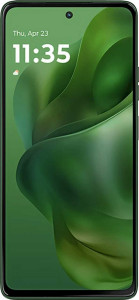
Motorola Moto G Play (2026)
Motorola Moto G Power (2025)

Motorola Moto G Play (2026) Motorola Moto G Power (2025)

Overview

Welcome to our detailed spec comparison between the Motorola Moto G Play (2026) and the Motorola Moto G Power (2025). Both phones share the same MediaTek Dimensity 6300 chipset and a smooth 120Hz LCD display, making this a fascinating head-to-head within the same ecosystem. The key battlegrounds include display resolution and pixel density, camera capabilities, battery and charging technology, and overall build quality. Read on to see how these two mid-range contenders stack up across every major specification.

Common Features

  • Neither product has a rugged build.
  • Neither product can be folded.
  • Both products have an LCD IPS display with a 120Hz refresh rate.
  • Both products feature branded damage-resistant glass.
  • HDR10 support is not available on either product.
  • HDR10+ support is not available on either product.
  • Always-On Display is not available on either product.
  • Dolby Vision support is not available on either product.
  • Neither product has a secondary screen.
  • Both products use the MediaTek Dimensity 6300 chipset and Arm Mali-G57 MC2 GPU.
  • Both products share the same CPU speed of 2 x 2.4 and 6 x 2 GHz.
  • Both products achieve a Geekbench 6 multi-core score of 2012 and single-core score of 782.
  • Both products have integrated LTE and RAM speed of 2133 MHz.
  • Main camera video recording on both products is capped at 1080p at 30 fps.
  • Neither product has a dual-tone LED flash, and both have a single LED flash.
  • Both products support continuous autofocus when recording movies.
  • Both products feature phase-detection autofocus for photos.
  • Both products support slow-motion video recording and have a built-in HDR mode.
  • Both products run on Android and include clipboard warnings, location privacy options, and camera/microphone privacy options.
  • Both products support fast charging, have a non-removable rechargeable battery, and include a battery level indicator.
  • Neither product supports reverse wireless charging.
  • Both products have a 3.5mm audio jack and stereo speakers, with no aptX, LDAC, or aptX HD support.
  • Both products support 5G, Wi-Fi 4 and Wi-Fi 5, dual SIM, external memory slot, USB Type-C (USB 2.0), NFC, and a download speed of 3300 MBits/s.
  • Neither product has sapphire glass, a curved display, or an e-paper display.
  • Both products include a video light.

Main Differences

  • Water resistance is rated as water resistant on Motorola Moto G Play (2026) and waterproof on Motorola Moto G Power (2025).
  • Weight is 202 g on Motorola Moto G Play (2026) and 208 g on Motorola Moto G Power (2025).
  • Thickness is 8.5 mm on Motorola Moto G Play (2026) and 8.7 mm on Motorola Moto G Power (2025).
  • Screen size is 6.7″ on Motorola Moto G Play (2026) and 6.8″ on Motorola Moto G Power (2025).
  • Pixel density is 263 ppi on Motorola Moto G Play (2026) and 385 ppi on Motorola Moto G Power (2025).
  • Resolution is 720 x 1604 px on Motorola Moto G Play (2026) and 1080 x 2388 px on Motorola Moto G Power (2025).
  • Gorilla Glass version is Gorilla Glass 3 on Motorola Moto G Play (2026) and Gorilla Glass 5 on Motorola Moto G Power (2025).
  • Internal storage is 64GB on Motorola Moto G Play (2026) and 128GB on Motorola Moto G Power (2025).
  • RAM is 4GB on Motorola Moto G Play (2026) and 8GB on Motorola Moto G Power (2025).
  • Main camera resolution is 32 MP on Motorola Moto G Play (2026) and 50 and 8 MP on Motorola Moto G Power (2025).
  • A dual-lens main camera is present on Motorola Moto G Power (2025) but not available on Motorola Moto G Play (2026).
  • Optical image stabilization is present on Motorola Moto G Power (2025) but not available on Motorola Moto G Play (2026).
  • Front camera resolution is 8MP on Motorola Moto G Play (2026) and 16MP on Motorola Moto G Power (2025).
  • A CMOS sensor is present on Motorola Moto G Play (2026) but not on Motorola Moto G Power (2025).
  • Front camera aperture is f/2.0 on Motorola Moto G Play (2026) and f/2.4 on Motorola Moto G Power (2025).
  • Android version is Android 16 on Motorola Moto G Play (2026) and Android 15 on Motorola Moto G Power (2025).
  • Battery capacity is 5200 mAh on Motorola Moto G Play (2026) and 5000 mAh on Motorola Moto G Power (2025).
  • Wireless charging is available on Motorola Moto G Power (2025) but not on Motorola Moto G Play (2026).
  • Charging speed is 18W on Motorola Moto G Play (2026) and 30W on Motorola Moto G Power (2025).
  • A barometer is present on Motorola Moto G Play (2026) but not available on Motorola Moto G Power (2025).
Specs Comparison
Motorola Moto G Play (2026)

Motorola Moto G Play (2026)

Motorola Moto G Power (2025)

Motorola Moto G Power (2025)

Design:
water resistance Water resistant Waterproof
weight 202 g 208 g
thickness 8.5 mm 8.7 mm
width 76.4 mm 76.3 mm
height 167.2 mm 166.6 mm
volume 108.57968 cm³ 110.590746 cm³
has a rugged build
can be folded

In terms of physical form, these two phones are nearly identical twins. The dimension differences — a fraction of a millimeter in width, height, and thickness — are imperceptible in daily handling, and the 6g weight gap (202g vs. 208g) is equally negligible in a real-world grip. Neither device has a rugged build or a foldable form factor, placing both firmly in the standard consumer slab category.

The one meaningful distinction in this group is water protection. The Moto G Power (2025) is rated Waterproof, while the Moto G Play (2026) is only Water resistant. This is not a trivial difference: waterproof typically implies a certified ingress protection rating capable of surviving submersion, whereas water resistant usually means it can handle splashes and light rain but should not be submerged. For users who frequently use their phone near pools, in the shower, or in heavy rain, this distinction matters significantly.

Overall, the Moto G Power (2025) holds a clear edge in this category, strictly due to its superior water protection level. The physical dimensions and weight are so close that they are effectively a wash, but the stronger water protection on the G Power provides a tangible durability advantage that the G Play cannot match.

Display:
Display type LCD, IPS LCD, IPS
screen size 6.7" 6.8"
pixel density 263 ppi 385 ppi
resolution 720 x 1604 px 1080 x 2388 px
refresh rate 120Hz 120Hz
has branded damage-resistant glass
Gorilla Glass version Gorilla Glass 3 Gorilla Glass 5
supports HDR10
supports HDR10+
Always-On Display
supports Dolby Vision
Has a secondary screen
has a touch screen

Both phones share the same LCD IPS panel type and a smooth 120Hz refresh rate, meaning neither has an advantage in motion fluidity or display technology class. Where they diverge significantly is in resolution. The G Power (2025) packs a 1080 x 2388 px panel at 385 ppi, while the G Play (2026) tops out at 720 x 1604 px at just 263 ppi — a gap of over 120 pixels per inch. At typical viewing distances, this difference is visible to the naked eye: text on the G Play will appear noticeably softer, and fine detail in photos or video will be less crisp.

Screen protection tells a similar story. The G Power ships with Gorilla Glass 5, which offers meaningfully better resistance to drops and scratches than the Gorilla Glass 3 on the G Play. Over the lifespan of a daily-use device, that two-generation gap in glass durability translates to a lower likelihood of surface damage from everyday accidents. Neither phone supports HDR10 or Dolby Vision, so content from streaming platforms will render in standard dynamic range on both devices equally.

The Moto G Power (2025) wins this category decisively. The sharper full-HD+ resolution and newer Gorilla Glass make a practical, visible difference in day-to-day use, and the marginal 0.1-inch screen size advantage is a bonus. The G Play's display is adequate, but it is outclassed on the two specs that matter most — sharpness and protection.

Performance:
internal storage 64GB 128GB
RAM 4GB 8GB
Chipset (SoC) name MediaTek Dimensity 6300 MediaTek Dimensity 6300
GPU name Arm Mali-G57 MC2 Arm Mali-G57 MC2
CPU speed 2 x 2.4 & 6 x 2 GHz 2 x 2.4 & 6 x 2 GHz
Geekbench 6 result (multi) 2012 2012
Geekbench 6 result (single) 782 782
GPU clock speed 950 MHz 950 MHz
Has integrated LTE
RAM speed 2133 MHz 2133 MHz
semiconductor size 6 nm 6 nm
Supports 64-bit
DirectX version DirectX 12 DirectX 12
Has integrated graphics
Uses big.LITTLE technology
CPU threads 8 threads 8 threads
Uses HMP
maximum memory bandwidth 17.07 GB/s 17.07 GB/s
L2 cache 1 MB 1 MB
L1 cache 512 KB 512 KB
maximum memory amount 12GB 12GB
uses multithreading
DDR memory version 4 4
L3 cache 2 MB 2 MB

At the silicon level, these two phones are identical. Both run on the MediaTek Dimensity 6300 chipset, pair it with the same Arm Mali-G57 MC2 GPU, and produce exactly the same Geekbench 6 scores — 782 single-core and 2012 multi-core. Every architectural detail, from the 6nm fabrication process to cache sizes and memory bandwidth, is a carbon copy. Raw processing power is a complete tie.

The only differentiators in this group are RAM and storage. The G Power (2025) ships with 8GB of RAM and 128GB of storage, while the G Play (2026) offers 4GB of RAM and 64GB of storage. In practical terms, double the RAM means the G Power can keep more apps active in the background without forcing reloads, handle heavier multitasking more gracefully, and sustain performance better as the Android OS matures over the device's lifespan. The storage gap is equally consequential — 64GB fills up quickly once apps, photos, and offline media accumulate, whereas 128GB provides meaningful breathing room.

The Moto G Power (2025) takes a clear edge here. The chipset parity means neither phone outmuscles the other in raw compute, but the G Power's doubled RAM and storage translate directly into a smoother, less constrained everyday experience — advantages that compound over time as the device ages.

Cameras:
megapixels (main camera) 32 MP 50 & 8 MP
wide aperture (main camera) 2.2f 2.2 & 1.8f
Has a dual-lens (or multi-lens) main camera
megapixels (front camera) 8MP 16MP
has built-in optical image stabilization
video recording (main camera) 1080 x 30 fps 1080 x 30 fps
Has a dual-tone LED flash
number of flash LEDs 1 1
has a BSI sensor
has a CMOS sensor
has continuous autofocus when recording movies
Has phase-detection autofocus for photos
supports slow-motion video recording
has a built-in HDR mode
has manual exposure
has a flash
optical zoom 0x 0x
has manual ISO
has a serial shot mode
has manual focus
has a front camera
Has laser autofocus
Shoots 360° panorama
has manual white balance
shoots raw
has touch autofocus
has manual shutter speed
can create panoramas in-camera
wide aperture (front camera) 2f 2.4f
Has timelapse function
Has a front-facing LED flash
has a dual-lens (or multi-lens) front camera
supports HDR10 recording
supports Dolby Vision recording
has a front-facing camera under the display
Has a RGB LED flash
has 3D photo/video recording capabilities

The rear camera system is where these two phones diverge most starkly. The G Play (2026) fields a single 32 MP shooter, while the G Power (2025) offers a dual-lens setup combining a 50 MP main and an 8 MP secondary lens. The megapixel advantage on the G Power's primary sensor means more detail and greater flexibility for cropping, but the second lens adds a compositional option — whether for wider shots or depth effects — that the G Play simply cannot replicate. On top of that, the G Power includes optical image stabilization (OIS), which physically compensates for hand shake during shooting. The G Play lacks OIS entirely, making it more susceptible to blur in low-light or while moving.

Selfie capability also skews toward the G Power. Its 16 MP front camera doubles the G Play's 8 MP, which matters for users who prioritize portrait quality or video calls. Interestingly, the G Play's front aperture is slightly wider (f/2.0 vs. f/2.4 on the G Power), meaning the G Play admits more light to its selfie sensor — a modest offset, but not enough to close the resolution gap. Both phones cap video recording at 1080p at 30fps, so neither has an edge in video quality.

The Moto G Power (2025) wins this category convincingly. The combination of a higher-resolution dual rear camera, OIS, and a significantly sharper front camera gives it a well-rounded imaging advantage across virtually every shooting scenario the G Play also supports.

Operating system:
Android version Android 16 Android 15
has clipboard warnings
has location privacy options
has camera/microphone privacy options
has Mail Privacy Protection
has theme customization
can block app tracking
blocks cross-site tracking
has on-device machine learning
has notification permissions
has media picker
Can play games while they download
has dark mode
has Wi-Fi password sharing
has battery health check
has an extra dim mode
has focus modes
has dynamic theming
can offload apps
Has customizable notifications
has Live Text
has full-page screenshots
supports split screen
gets direct OS updates
has PiP
Can be used as a PC
Has sharing intents
has a child lock
Supports widgets
Is free and open source
Has offline voice recognition
has voice commands
Tracks the current position of a mobile device
is a multi-user system
has Quick Start

Strip away the one meaningful difference here and these two phones are running an essentially identical software stack. Every feature in the provided specs — from privacy controls and dark mode to split-screen, widgets, and offline voice recognition — is present on both devices. The feature parity is total across all listed capabilities, which means neither phone has a software advantage in day-to-day functionality based on this data.

The sole differentiator is the Android version. The G Play (2026) ships with Android 16, while the G Power (2025) runs Android 15. Being one major version ahead matters for a few reasons: Android 16 brings the latest security patches baked in from day one, and the G Play starts its lifecycle one rung higher on the update ladder. Neither phone receives direct OS updates according to the specs, which limits the long-term software longevity of both — but the G Play at least begins from a more current baseline.

A narrow but real edge goes to the Motorola Moto G Play (2026), purely by virtue of launching on a newer Android version. Given that all other software features are identical, the fresher OS is the only meaningful distinction in this category.

Battery:
battery power 5200 mAh 5000 mAh
has wireless charging
Supports fast charging
charging speed 18W 30W
has reverse wireless charging
has a removable battery
has a battery level indicator
has a rechargeable battery

Capacity and charging speed cut in opposite directions here, making this an interesting trade-off rather than a clean win. The G Play (2026) carries a slightly larger 5200 mAh battery against the G Power's 5000 mAh — a 4% difference that, in practice, translates to a marginal extension in time between charges. Both phones will comfortably last a full day of typical use, so this gap is unlikely to be decisive for most users.

Where the G Power (2025) pulls ahead more meaningfully is in how quickly it recovers. Its 30W fast charging is notably faster than the G Play's 18W, meaning significantly less time tethered to a wall outlet when topping up. The G Power also supports wireless charging, a convenience feature the G Play lacks entirely — useful for users with a charging pad on their desk or nightstand who want a cable-free routine.

On balance, the Moto G Power (2025) holds the edge in this category. The G Play's slightly larger battery is a real but modest advantage, whereas the G Power's faster wired charging and exclusive wireless charging support offer more tangible quality-of-life benefits for everyday use.

Audio:
has a socket for a 3.5 mm audio jack
has stereo speakers
has aptX
has LDAC
has aptX HD
has aptX Adaptive
has aptX Lossless

Audio is a category where these two phones are in complete lockstep. Both offer a 3.5mm headphone jack — a feature increasingly absent from mid-range devices — and both deliver stereo speakers for a wider, more immersive sound stage compared to a single mono driver. Neither phone supports any advanced Bluetooth audio codec, with aptX, aptX HD, LDAC, and their variants all absent from both devices.

The lack of high-resolution wireless audio codecs means that users who stream music over Bluetooth will be limited to standard SBC or AAC quality, which is adequate for casual listening but falls short for audiophiles seeking lossless wireless fidelity. That said, the presence of the headphone jack on both phones provides a reliable wired alternative that bypasses Bluetooth compression entirely.

This category is a complete tie. Every audio spec listed is identical across both devices, and neither holds any advantage over the other in this area. The choice between these two phones will have to rest on the differences found in other categories.

Connectivity & Features:
release date November 2025 January 2025
has 5G support
Wi-Fi version Wi-Fi 4 (802.11n), Wi-Fi 5 (802.11ac) Wi-Fi 4 (802.11n), Wi-Fi 5 (802.11ac)
SIM cards 2 SIM 2 SIM
has an external memory slot
Has USB Type-C
USB version 2 2
has NFC
download speed 3300 MBits/s 3300 MBits/s
Has a fingerprint scanner
has emergency SOS via satellite
has crash detection
is DLNA-certified
has a gyroscope
supports ANT+
Has a heart rate monitor
has GPS
has a compass
supports Wi-Fi
Has an infrared sensor
has an accelerometer
has a cellular module
Has a barometer
has an HDMI output
Uses 3D facial recognition
Has an iris scanner
Stylus included
supports Galileo
Has motion tracking
Has optical tracking
Has a built-in projector

Connectivity is remarkably uniform across these two phones. Both support 5G, dual SIM, NFC, Wi-Fi 5, USB Type-C, and identical download speeds, meaning users of either device will have the same network reach, payment capabilities, and data transfer options. Shared sensor hardware — gyroscope, accelerometer, compass, and GPS with Galileo support — further reinforces just how closely matched these devices are in this category.

The single point of divergence is the presence of a barometer on the G Play (2026), which the G Power (2025) lacks. A barometer measures atmospheric pressure and is primarily useful for altitude tracking and enhanced location accuracy in navigation apps, as well as weather-related features. It is a niche sensor that most users will never actively notice, but it does give the G Play a marginal edge for outdoor and fitness-oriented use cases that leverage pressure data.

This category is effectively a near-tie with a slight technical edge to the Moto G Play (2026). The barometer is a genuine differentiator, but its practical impact is narrow enough that it will only matter to a small subset of users. For the vast majority of connectivity and feature needs, both phones deliver an identical experience.

Miscellaneous:
has a video light
Has sapphire glass display
Has a curved display
Has an e-paper display

Both the Motorola Moto G Play (2026) and the Motorola Moto G Power (2025) come with a video light to assist with low-light photography. Neither phone features sapphire glass displays, curved displays, or e-paper displays, as these are not present on either model.

Thus, both phones are identical in this miscellaneous category, with no significant differences between them regarding display technology or additional lighting features.

Comparison Summary & Verdict

After examining every spec, it is clear that these two phones serve slightly different priorities. The Motorola Moto G Power (2025) is the stronger all-rounder for users who demand more: its 1080p display with 385 ppi, 8GB of RAM, 128GB storage, dual rear camera with optical image stabilization, 16MP front camera, 30W fast charging, and wireless charging make it a noticeably more capable device for photography enthusiasts and power users alike. On the other hand, the Motorola Moto G Play (2026) brings its own advantages: a slightly larger 5200 mAh battery, a newer Android 16 out of the box, a built-in barometer, and a marginally lighter and thinner body. For users who value software freshness, a longer-lasting charge, and a leaner form factor over raw performance specs, the Moto G Play (2026) remains a solid choice in the budget-friendly segment.

Motorola Moto G Play (2026)
Buy Motorola Moto G Play (2026) if...

Buy the Motorola Moto G Play (2026) if you want the latest Android 16 software out of the box, a slightly larger battery, and a lighter and thinner design with a built-in barometer.

Motorola Moto G Power (2025)
Buy Motorola Moto G Power (2025) if...

Buy the Motorola Moto G Power (2025) if you prioritize a sharper Full HD+ display, more RAM and storage, a versatile dual camera system with optical image stabilization, faster 30W charging, and wireless charging support.