Motorola Moto G67 Power
Realme P4 Pro 5G

Motorola Moto G67 Power Realme P4 Pro 5G

Overview

Choosing between the Motorola Moto G67 Power and the Realme P4 Pro 5G means navigating two distinct mid-range philosophies. Both phones pack a massive 7000 mAh battery and run Android 15, but they diverge sharply across display technology, charging speed, camera capabilities, and overall performance. Whether you care most about screen quality, everyday versatility, or build practicality, this side-by-side comparison covers everything you need to make an informed decision.

Common Features

  • Both phones are water resistant.
  • Neither phone has a rugged build.
  • Neither phone can be folded.
  • Both phones feature Gorilla Glass 7i for display protection.
  • Both phones support HDR10.
  • Neither phone supports Dolby Vision.
  • Neither phone has a secondary screen.
  • Both phones have a touch screen.
  • Both phones have integrated LTE.
  • Both phones use a 4 nm semiconductor.
  • Both phones support 64-bit processing.
  • Both phones run Android 15.
  • Both phones have a 7000 mAh battery.
  • Neither phone supports wireless charging.
  • Both phones support fast charging.
  • Neither phone has a removable battery.
  • Both phones have stereo speakers.
  • Both phones support 5G.
  • Both phones have NFC.
  • Both phones have a fingerprint scanner.

Main Differences

  • Weight is 210 g on Motorola Moto G67 Power and 189 g on Realme P4 Pro 5G.
  • Thickness is 8.6 mm on Motorola Moto G67 Power and 7.7 mm on Realme P4 Pro 5G.
  • IP rating is IP64 on Motorola Moto G67 Power and IP66 on Realme P4 Pro 5G.
  • Display type is LCD IPS on Motorola Moto G67 Power and OLED/AMOLED on Realme P4 Pro 5G.
  • Screen size is 6.7″ on Motorola Moto G67 Power and 6.8″ on Realme P4 Pro 5G.
  • Pixel density is 391 ppi on Motorola Moto G67 Power and 453 ppi on Realme P4 Pro 5G.
  • Refresh rate is 120Hz on Motorola Moto G67 Power and 144Hz on Realme P4 Pro 5G.
  • HDR10+ support is present on Realme P4 Pro 5G but not available on Motorola Moto G67 Power.
  • Always-On Display is available on Realme P4 Pro 5G but not on Motorola Moto G67 Power.
  • Chipset is Qualcomm Snapdragon 7s Gen 2 on Motorola Moto G67 Power and Qualcomm Snapdragon 7 Gen 4 on Realme P4 Pro 5G.
  • RAM is 8 GB on Motorola Moto G67 Power and 12 GB on Realme P4 Pro 5G.
  • Internal storage is 256 GB on Motorola Moto G67 Power and 512 GB on Realme P4 Pro 5G.
  • Maximum memory bandwidth is 25.6 GB/s on Motorola Moto G67 Power and 33.6 GB/s on Realme P4 Pro 5G.
  • Main camera secondary lens is 8 MP on Motorola Moto G67 Power and 2 MP on Realme P4 Pro 5G.
  • Front camera is 32 MP on Motorola Moto G67 Power and 50 MP on Realme P4 Pro 5G.
  • Optical image stabilization is available on Realme P4 Pro 5G but not on Motorola Moto G67 Power.
  • Maximum video recording frame rate is 30 fps at 2160p on Motorola Moto G67 Power and 60 fps at 2160p on Realme P4 Pro 5G.
  • Charging speed is 30W on Motorola Moto G67 Power and 80W on Realme P4 Pro 5G.
  • A 3.5 mm audio jack is present on Motorola Moto G67 Power but absent on Realme P4 Pro 5G.
  • LDAC audio support is available on Realme P4 Pro 5G but not on Motorola Moto G67 Power.
  • Wi-Fi 6 (802.11ax) support is available on Realme P4 Pro 5G but not on Motorola Moto G67 Power.
  • Bluetooth version is 5.1 on Motorola Moto G67 Power and 5.4 on Realme P4 Pro 5G.
Specs Comparison
Motorola Moto G67 Power

Motorola Moto G67 Power

Realme P4 Pro 5G

Realme P4 Pro 5G

Design:
water resistance Water resistant Water resistant
weight 210 g 189 g
thickness 8.6 mm 7.7 mm
width 76.5 mm 76.2 mm
height 166.2 mm 162.3 mm
volume 109.34298 cm³ 95.227902 cm³
Ingress Protection (IP) rating IP64 IP66
has a rugged build
can be folded

Both phones share a non-rugged, non-foldable form factor and are rated water resistant, but the details reveal a meaningful gap. The Realme P4 Pro 5G carries an IP66 rating versus the Moto G67 Power's IP64, which is a practical upgrade: IP66 adds protection against powerful water jets, while IP64 only guards against water splashes. For everyday scenarios like caught in rain or accidental sink splashes both are fine, but the Realme offers a noticeably higher margin of safety.

The more tangible day-to-day difference is in physical ergonomics. The Realme P4 Pro 5G weighs 189 g compared to the Moto G67 Power's 210 g — a 21 g difference that is genuinely perceptible during prolonged one-handed use or when the phone sits in a shirt pocket. Paired with a slimmer profile of 7.7 mm versus 8.6 mm, the Realme also feels noticeably less bulky in hand. Its overall volume of 95.2 cm³ versus 109.3 cm³ confirms it is a more compact device despite sharing a nearly identical width.

The Realme P4 Pro 5G holds a clear edge in this category. It is lighter, thinner, more compact, and better protected against water ingress — all without sacrificing the non-rugged standard form factor both phones share.

Display:
Display type LCD, IPS OLED/AMOLED
screen size 6.7" 6.8"
pixel density 391 ppi 453 ppi
resolution 1080 x 2400 px 1280 x 2800 px
refresh rate 120Hz 144Hz
touch sampling rate 0Hz 240Hz
brightness (typical) 0 nits 1800 nits
has branded damage-resistant glass
Gorilla Glass version Gorilla Glass 7i Gorilla Glass 7i
supports HDR10
supports HDR10+
Always-On Display
supports Dolby Vision
contrast ratio 0:1 5000000:1
Has a secondary screen
has a touch screen

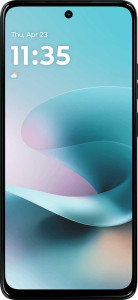
The panel technology gap here is the most decisive differentiator. The Moto G67 Power uses an IPS LCD, while the Realme P4 Pro 5G uses an OLED/AMOLED panel — and that distinction cascades into nearly every other display metric. The Realme's contrast ratio of 5,000,000:1 versus the Moto's 0:1 (unlisted) reflects OLED's fundamental advantage: true pixel-level black, which produces far richer colors, deeper shadows, and more cinematic image quality. The Realme also hits 1800 nits of typical brightness, making it significantly more readable under direct sunlight, while the Moto G67 Power provides no brightness figure at all.

Resolution and sharpness also favor the Realme. Its 1280 x 2800 px panel at 453 ppi is noticeably crisper than the Moto's 1080 x 2400 px at 391 ppi — the difference is visible when reading fine text or viewing detailed photos. On top of that, the Realme's 144Hz refresh rate edges out the Moto's 120Hz, and its 240Hz touch sampling rate means faster, more responsive input recognition — relevant for gaming and quick gesture navigation. The Realme also supports HDR10+ and an Always-On Display, features absent on the Moto.

Both phones share Gorilla Glass 7i protection, HDR10 support, and a standard single-screen design, so they are evenly matched on durability and baseline content compatibility. But the overall display advantage belongs decisively to the Realme P4 Pro 5G — it outclasses the Moto G67 Power on panel quality, brightness, sharpness, smoothness, and responsiveness across the board.

Performance:
internal storage 256GB 512GB
RAM 8GB 12GB
Chipset (SoC) name Qualcomm Snapdragon 7s Gen 2 Qualcomm Snapdragon 7 Gen 4
CPU speed 4 x 2.4 & 4 x 1.95 GHz 1 x 2.8 & 4 x 2.4 & 3 x 1.8 GHz
GPU clock speed 940 MHz 1000 MHz
Has integrated LTE
RAM speed 3200 MHz 4200 MHz
semiconductor size 4 nm 4 nm
Supports 64-bit
DirectX version DirectX 12 DirectX 12
Has integrated graphics
OpenGL ES version 3.2 3.2
Uses big.LITTLE technology
Has TrustZone
maximum memory bandwidth 25.6 GB/s 33.6 GB/s
OpenCL version 2 2
uses multithreading
Thermal Design Power (TDP) 5W 6W
DDR memory version 5 5

Both phones are built on a 4 nm process and share the same foundational architecture choices — big.LITTLE CPU design, DDR5 memory, DirectX 12, and OpenGL ES 3.2 — so the platform baseline is comparable. The real separation comes from the specific chipsets: the Moto G67 Power runs a Snapdragon 7s Gen 2, while the Realme P4 Pro 5G steps up to a Snapdragon 7 Gen 4. The Gen 4 is a newer, higher-tier chip, and the numbers back that up across every meaningful dimension.

On the CPU side, the Realme's tri-cluster configuration peaks at 2.8 GHz on its prime core, compared to the Moto's dual-cluster cap of 2.4 GHz — giving the Realme an edge in single-threaded workloads like app launches and UI responsiveness. Memory bandwidth tells a similar story: 33.6 GB/s on the Realme versus 25.6 GB/s on the Moto, which translates to faster data throughput for gaming, multitasking, and media processing. The Realme also pairs its chip with 12 GB of RAM at 4200 MHz, against the Moto's 8 GB at 3200 MHz — more headroom for keeping apps open simultaneously and snappier memory access overall. Storage doubles too, at 512 GB versus 256 GB.

The Realme P4 Pro 5G holds a clear and well-rounded performance advantage here. Its higher-tier chipset, faster and more abundant RAM, superior memory bandwidth, and double the storage make it the stronger performer across everyday use, multitasking, and sustained workloads.

Cameras:
megapixels (main camera) 50 & 8 MP 50 & 2 MP
wide aperture (main camera) 2.2 & 1.8f 2.2 & 1.8f
Has a dual-lens (or multi-lens) main camera
megapixels (front camera) 32MP 50MP
has built-in optical image stabilization
video recording (main camera) 2160 x 30 fps 2160 x 60 fps
Has a dual-tone LED flash
number of flash LEDs 2 1
has a BSI sensor
has a CMOS sensor
has continuous autofocus when recording movies
Has phase-detection autofocus for photos
supports slow-motion video recording
has a built-in HDR mode
has manual exposure
has a flash
optical zoom 0x 0x
has manual ISO
has a serial shot mode
has manual focus
has a front camera
Has laser autofocus
Shoots 360° panorama
has manual white balance
shoots raw
has touch autofocus
has manual shutter speed
can create panoramas in-camera
wide aperture (front camera) 2.2f 2.4f
Has timelapse function
Has a front-facing LED flash
has a dual-lens (or multi-lens) front camera
supports HDR10 recording
supports Dolby Vision recording
has a front-facing camera under the display
Has a RGB LED flash
has 3D photo/video recording capabilities

On paper the two main cameras look nearly identical — both are 50 MP dual-lens systems sharing the same apertures — but a closer look reveals meaningful differences. The Moto G67 Power pairs its primary sensor with an 8 MP secondary lens, while the Realme P4 Pro 5G's second lens is just 2 MP, effectively a depth sensor with little practical imaging utility. For users who rely on a secondary lens for real shots, the Moto's configuration is more capable here.

Elsewhere, the Realme pulls ahead in ways that matter more for overall camera quality. It includes optical image stabilization (OIS), which the Moto lacks entirely — OIS is one of the most impactful features for reducing blur in low-light photos and keeping handheld video footage smooth. On the video side, the Realme records at 2160p 60 fps versus the Moto's 2160p 30 fps, doubling the frame rate at 4K for noticeably smoother motion capture. The selfie camera is also a significant step up: 50 MP on the Realme against 32 MP on the Moto, which delivers more detail and more flexibility for cropping in portrait shots.

The feature set for manual controls, autofocus, HDR, slow-motion, and panorama is effectively identical across both phones. Taking everything together, the Realme P4 Pro 5G has the camera edge — OIS and 4K 60 fps alone are upgrades that directly improve real-world results, and the 50 MP front camera adds further separation. The Moto's stronger secondary lens is a partial offset, but not enough to close the gap.

Operating system:
Android version Android 15 Android 15
has clipboard warnings
has location privacy options
has camera/microphone privacy options
has Mail Privacy Protection
has theme customization
can block app tracking
blocks cross-site tracking
has on-device machine learning
has notification permissions
has media picker
Can play games while they download
has dark mode
has Wi-Fi password sharing
has battery health check
has an extra dim mode
has focus modes
has dynamic theming
can offload apps
Has customizable notifications
has Live Text
has full-page screenshots
supports split screen
gets direct OS updates
has PiP
Can be used as a PC
Has sharing intents
has a child lock
Supports widgets
Is free and open source
Has offline voice recognition
has voice commands
Tracks the current position of a mobile device
is a multi-user system
has Quick Start

This is a rare category where the data leaves no room for differentiation: every single specification provided is identical across both phones. Both run Android 15, share the same privacy controls (location, camera/microphone, and app tracking), and offer the same productivity and usability features — split-screen multitasking, Picture-in-Picture, widgets, dynamic theming, dark mode, and offline voice recognition, among others.

Notably, neither phone receives direct OS updates from Google, meaning updates are mediated through their respective manufacturers. Neither supports Wi-Fi password sharing, focus modes, or PC desktop mode. These shared omissions are worth flagging for users who prioritize those features, but they affect both devices equally.

This category is a complete tie. Based strictly on the provided specs, no advantage exists for either the Motorola Moto G67 Power or the Realme P4 Pro 5G — the software feature set is point-for-point identical, and any real-world differences would come from each manufacturer's custom Android skin rather than the underlying OS capabilities listed here.

Battery:
battery power 7000 mAh 7000 mAh
has wireless charging
Supports fast charging
charging speed 30W 80W
has reverse wireless charging
has a removable battery
has a battery level indicator
has a rechargeable battery

Capacity is a dead heat: both phones pack an identical 7000 mAh battery, which is a genuinely large cell by any standard and should comfortably support heavy users through a full day and lighter users well into a second. Neither supports wireless or reverse wireless charging, and both use non-removable batteries — so on those fronts, there is nothing to separate them.

Where the Realme P4 Pro 5G pulls decisively ahead is charging speed. Its 80W fast charging versus the Moto G67 Power's 30W is not a marginal difference — it is transformative. Charging a 7000 mAh cell at 80W can realistically take the battery from near-empty to full in roughly an hour, whereas 30W will take significantly longer, potentially two-and-a-half to three hours for the same cell. For anyone who plugs in during a lunch break or before heading out, that gap is felt daily.

The Realme P4 Pro 5G wins this category on the strength of its charging speed alone. Both phones offer equally impressive battery longevity given the shared 7000 mAh capacity, but the Realme's 80W charging makes replenishing that large battery far less of a waiting game.

Audio:
has a socket for a 3.5 mm audio jack
has stereo speakers
has aptX
has LDAC
has aptX HD
has aptX Adaptive
has aptX Lossless

Audio is a category where each phone makes a clear trade-off, and the right choice depends entirely on how you listen. The Moto G67 Power retains a 3.5 mm headphone jack, which the Realme P4 Pro 5G drops entirely. For users who own wired headphones or earphones — or simply prefer not to manage Bluetooth pairing and charging — the Moto's jack is a genuine daily convenience that is increasingly rare in this segment.

The Realme counters by offering meaningfully superior wireless audio quality. It supports both aptX and LDAC, while the Moto supports neither. LDAC in particular is significant: it transmits audio at up to three times the bandwidth of standard Bluetooth codecs, enabling near-lossless quality when paired with compatible wireless headphones. AptX adds broader compatibility with higher-quality Bluetooth audio devices. For wireless listeners who own premium headphones, these codecs make a real and audible difference.

Both phones feature stereo speakers, so speaker output is evenly matched. The overall verdict here is user-dependent: the Moto G67 Power is the better pick for wired audio users, while the Realme P4 Pro 5G is the stronger choice for those invested in high-quality wireless listening. Neither holds an unconditional advantage — it comes down to which listening style fits your habits.

Connectivity & Features:
release date November 2025 August 2025
has 5G support
Wi-Fi version Wi-Fi 4 (802.11n), Wi-Fi 5 (802.11ac) Wi-Fi 4 (802.11n), Wi-Fi 5 (802.11ac), Wi-Fi 6 (802.11ax)
SIM cards 2 SIM 2 SIM
Bluetooth version 5.1 5.4
has an external memory slot
Has USB Type-C
USB version 2 2
has NFC
Has a fingerprint scanner
has emergency SOS via satellite
has crash detection
is DLNA-certified
has a gyroscope
supports ANT+
Has a heart rate monitor
has GPS
has a compass
supports Wi-Fi
Has an infrared sensor
has an accelerometer
has a cellular module
Has a barometer
has an HDMI output
Uses 3D facial recognition
Has an iris scanner
Stylus included
supports Galileo
Has motion tracking
Has optical tracking
Has a built-in projector

The connectivity foundation is largely shared: both phones support 5G, dual SIM, NFC, USB Type-C, and an identical sensor suite covering GPS, gyroscope, accelerometer, compass, and Galileo. Neither offers expandable storage, HDMI output, or advanced biometrics beyond a fingerprint scanner. For most everyday connectivity needs, the two are functionally equivalent.

The meaningful separations emerge in Wi-Fi and Bluetooth. The Realme P4 Pro 5G adds Wi-Fi 6 (802.11ax) to its stack, while the Moto G67 Power tops out at Wi-Fi 5 (802.11ac). Wi-Fi 6 delivers higher throughput, lower latency, and significantly better performance in congested environments — like apartments with many competing networks or offices with heavy wireless traffic. On the Bluetooth side, the Realme's Bluetooth 5.4 versus the Moto's 5.1 brings improved connection stability, slightly better range, and more efficient power use — a modest but real upgrade for wireless audio and peripheral pairing.

The Realme P4 Pro 5G holds a clear edge in this category. The core connectivity checklist is identical, but Wi-Fi 6 support and the newer Bluetooth version give it a forward-looking advantage — particularly for users in dense wireless environments or those who regularly use Bluetooth accessories.

Miscellaneous:
has a video light
Has sapphire glass display
Has a curved display
Has an e-paper display

The miscellaneous specs provided for both phones are identical across every data point: both have a video light, and neither features sapphire glass, a curved display, or an e-paper display. There is simply nothing in this group to differentiate the two products.

This category is a complete tie. Based strictly on the provided specs, the Motorola Moto G67 Power and the Realme P4 Pro 5G are evenly matched here, and this group has no bearing on a purchase decision between them.

Comparison Summary & Verdict

After examining every specification, both phones serve different types of users. The Realme P4 Pro 5G is the stronger all-around performer, offering a superior OLED display with 144Hz refresh rate, a faster Snapdragon 7 Gen 4 chipset, 12 GB of RAM, 80W fast charging, optical image stabilization, and a higher IP66 water resistance rating. It suits users who want a premium visual experience and top-tier performance in the mid-range segment. The Motorola Moto G67 Power, on the other hand, appeals to those who value a 3.5 mm headphone jack, a dual-flash camera system, and a more familiar, compact form factor at likely a lower price point. If audio convenience and everyday reliability matter more than cutting-edge specs, the Motorola remains a solid, practical choice.

Motorola Moto G67 Power
Buy Motorola Moto G67 Power if...

Buy the Motorola Moto G67 Power if you want a reliable mid-range phone with a 3.5 mm headphone jack and an 8 MP secondary camera, and can live with slower 30W charging.

Realme P4 Pro 5G
Buy Realme P4 Pro 5G if...

Buy the Realme P4 Pro 5G if you prioritize a vivid OLED display, faster 80W charging, a more powerful chipset with 12 GB of RAM, and stronger IP66 water resistance.