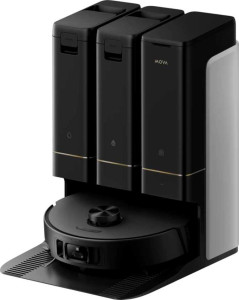
Mova P50 Pro Ultra
Mova Z50 Ultra

Mova P50 Pro Ultra Mova Z50 Ultra

Overview

Welcome to our in-depth comparison of the Mova P50 Pro Ultra and the Mova Z50 Ultra — two capable robot vacuums that share a strong common foundation yet diverge in some meaningful ways. Both machines bring identical suction power, smart mapping, and self-emptying convenience to the table, but key battlegrounds such as battery runtime, warranty coverage, and filtration technology set them apart. Read on to find out which one is the right fit for your home.

Common Features

  • Both products include a HEPA filter.
  • Both products include an allergy filter.
  • Both products are compatible with Google Assistant.
  • Both products work with Alexa.
  • Both products produce an audible noise level of 74 dB.
  • Both products weigh 4600 g.
  • Both products have a width of 350 mm and a thickness of 350 mm.
  • Both products support mapping.
  • Both products support no-go zones.
  • Both products support remote smartphone control.
  • Both products have an obstacle sensor.
  • Both products support problem area cleaning.
  • Both products are self-emptying.
  • Both products have carpet detection.
  • Neither product gets stuck during operation.
  • Neither product has a display.
  • Neither product has twin side brushes.
  • Both products include washable filters.
  • Both products automatically adjust their height.
  • Neither product indicates when the dustbin is full.
  • Both products use bags.
  • Both products have a suction power of 19000 Pa.
  • Both products clean all floor types.
  • Both products offer 4 cleaning modes.
  • Both products support mopping.
  • Both products have a dirt sensor.
  • Neither product has UV light.
  • Both products have a battery power of 6400 mAh.
  • Neither product has an overheating indicator.
  • Neither product has a removable battery.
  • Both products have an auto-off feature.

Main Differences

  • Height is 103.8 mm on Mova P50 Pro Ultra and 111 mm on Mova Z50 Ultra.
  • Volume is 12715.5 cm³ on Mova P50 Pro Ultra and 13597.5 cm³ on Mova Z50 Ultra.
  • Warranty period is 3 years on Mova P50 Pro Ultra and 1 year on Mova Z50 Ultra.
  • Estimated empty time is 100 days on Mova P50 Pro Ultra and 120 days on Mova Z50 Ultra.
  • Docking station size is 90409.2 cm³ on Mova P50 Pro Ultra and 98410.65 cm³ on Mova Z50 Ultra.
  • Dustbin capacity is 0.32 l on Mova P50 Pro Ultra and 0.4 l on Mova Z50 Ultra.
  • An electrostatic filtration system is present on Mova Z50 Ultra but not available on Mova P50 Pro Ultra.
  • Runtime is 170 min on Mova P50 Pro Ultra and 220 min on Mova Z50 Ultra.
  • Charge time is 3.5 hours on Mova P50 Pro Ultra and 4 hours on Mova Z50 Ultra.
Specs Comparison
Mova P50 Pro Ultra

Mova P50 Pro Ultra

Mova Z50 Ultra

Mova Z50 Ultra

General info:
has HEPA filter
audible noise 74 dB 74 dB
has an allergy filter
compatible with Google Assistant
works with Alexa
release date March 2025 March 2025
weight 4600 g 4600 g
width 350 mm 350 mm
height 103.8 mm 111 mm
thickness 350 mm 350 mm
volume 12715.5 cm³ 13597.5 cm³
warranty period 3 years 1 years
estimated empty time 100 days 120 days
docking station size 90409.2 cm³ 98410.65 cm³

At a high level, the Mova P50 Pro Ultra and Mova Z50 Ultra share a surprisingly identical foundation: same 4600 g weight, same 350 × 350 mm footprint, identical 74 dB noise output, and equivalent smart-home integration with both Google Assistant and Alexa. Both also include a HEPA and allergy filter, which matters for households with pets or respiratory sensitivities. For most users scanning the basics, these two robots appear nearly interchangeable — but the details tell a different story.

The clearest practical differentiator is the estimated empty time: the Z50 Ultra goes 120 days between dustbin empties versus 100 days for the P50 Pro Ultra — a 20% advantage that translates to roughly one fewer emptying cycle every six weeks. That said, the Z50 Ultra achieves this with a larger docking station (~98,411 cm³ vs ~90,409 cm³), so it demands more floor space in return. Its robot unit is also marginally taller at 111 mm versus 103.8 mm, which could affect clearance under low-profile furniture like certain sofas or bed frames.

Where the P50 Pro Ultra reclaims the edge is on long-term ownership confidence: its 3-year warranty triples the Z50 Ultra's 1-year coverage — a significant advantage for a premium appliance. Overall, the Z50 Ultra suits users who prioritize less-frequent maintenance and don't mind the extra dock footprint, while the P50 Pro Ultra is the stronger choice for those who value compact docking and substantially better warranty protection.

Features:
has mapping
supports no-go zones
supports a remote smartphone
has an obstacle sensor
has problem area cleaning
is self-emptying
has carpet detection
doesn't get stuck
supports virtual barriers
has route mapping
Has voice prompts
auto docking
has anti-fall sensor
can be scheduled
has a remote control
has water level adjustment
supports Wi-Fi
has mop cleaning
has mop raising
has mop drying

Across every one of the twenty features tracked in this group, the Mova P50 Pro Ultra and Mova Z50 Ultra are a perfect match — and taken together, that shared feature set is genuinely impressive. Both robots cover the full modern autonomy stack: mapping with route optimization, no-go zones, virtual barriers, and problem-area cleaning mean the robot can be precisely directed around furniture, pet bowls, or fragile objects without physical tape or boundary strips.

On the mopping side, both units offer the trifecta of mop cleaning, mop raising, and mop drying — a combination that matters more than it might seem. Mop raising prevents a wet pad from dragging across carpeted areas after mopping hard floors, while onboard drying reduces mildew buildup inside the dock between cycles. Add carpet detection and water level adjustment to the mix, and both robots are equipped to handle genuinely mixed-surface homes without constant user intervention.

Since no differentiators exist within this specification group, the verdict here is a complete tie. Neither robot holds a feature advantage over the other — any decision between them should rest on the distinctions identified in other spec groups, such as warranty length or dock footprint.

Design:
dustbin capacity 0.32 l 0.4 l
Has a display
has twin side brushes
has included washable filters
automatically adjusts its height
Indicates when full
uses bags

The design specs for these two robots are nearly identical, with one meaningful exception: the Mova Z50 Ultra carries a 0.4 L onboard dustbin versus 0.32 L on the P50 Pro Ultra — a 25% larger capacity. In a self-emptying robot this might seem minor, since the dock handles most debris storage, but the onboard bin still acts as a buffer during active cleaning. A larger bin reduces the frequency of mid-session docking runs in heavier debris environments like homes with pets or high foot traffic, helping the robot complete more of a cleaning cycle uninterrupted.

Everything else in this group is shared: both robots use bagged collection at the dock — which is hygienically superior to bagless systems when emptying, as debris is sealed before disposal — and both include washable filters, keeping ongoing maintenance costs low. The automatic height adjustment on both models allows the robot body to adapt to varying floor surfaces without user input, a useful passive feature for homes with mixed flooring types.

On design, the Z50 Ultra holds a narrow edge purely due to its larger dustbin. For most users in self-emptying setups the difference will rarely surface, but in high-debris households it can translate to fewer interruptions per session — a real if modest advantage.

Cleaning power:
suction power 19000 Pa 19000 Pa
cleans all floor types
cleaning modes 4 4
mops
has a dirt sensor
Has an electrostatic filtration system
has UV light

Raw cleaning muscle is identical between these two: both deliver 19,000 Pa of suction — a figure firmly in the high-end tier for robotic vacuums — across all floor types, with 4 cleaning modes, mopping capability, and a dirt sensor that dynamically intensifies suction over soiled patches. For the vast majority of cleaning scenarios, users of either robot will experience the same performance output.

The sole differentiator here is meaningful for a specific audience: the Mova Z50 Ultra includes an electrostatic filtration system, which the P50 Pro Ultra lacks. Electrostatic filters use an electrical charge to attract and trap fine particles — including dust, pollen, and microscopic allergens — that can otherwise pass through mechanical filter layers. Combined with the HEPA filter both robots share, this gives the Z50 Ultra a more layered approach to air quality, which is a tangible benefit in households with allergy sufferers or high fine-dust environments.

On cleaning power overall, the two robots are evenly matched in suction and versatility, but the Z50 Ultra earns the edge in this group thanks to its electrostatic filtration — a genuinely useful addition rather than a spec-sheet flourish, particularly for health-conscious users.

Power:
battery power 6400 mAh 6400 mAh
runtime 170 min 220 min
charge time 3.5 hours 4 hours
Has an overheating indicator
has a removable battery
has auto-off

Both robots draw from an identical 6400 mAh battery, yet the Mova Z50 Ultra converts that same energy into 220 minutes of runtime versus 170 minutes on the P50 Pro Ultra — a 29% gap that points to meaningfully better power efficiency in the Z50 Ultra. In practical terms, 170 minutes is sufficient to cover most medium-sized homes in a single pass, but 220 minutes opens the door to larger floor plans or more thorough multi-pass cleaning without an interruption to recharge.

The tradeoff is charge time: the Z50 Ultra takes 4 hours to fully replenish versus 3.5 hours for the P50 Pro Ultra. That 30-minute difference is relatively minor in the context of overnight charging, but it is worth noting for users who run the robot multiple times per day and rely on quick turnaround between sessions. Both robots share auto-off functionality, which prevents energy waste once charging completes — a sensible baseline feature on any modern device.

On balance, the Z50 Ultra holds a clear power advantage. Squeezing 50 additional minutes from the same battery capacity is a significant efficiency gain, and the slightly longer charge time is an acceptable trade for most usage patterns. Users with larger homes or those who prefer fewer mid-clean dock returns will find the Z50 Ultra the more capable option in this category.

Comparison Summary & Verdict

After examining every specification, both the Mova P50 Pro Ultra and the Mova Z50 Ultra deliver a near-identical cleaning experience at their core — sharing 19000 Pa suction power, four cleaning modes, mopping capability, and a full suite of smart features including mapping, no-go zones, and self-emptying. The differences, however, are telling. The Mova P50 Pro Ultra stands out with a significantly longer 3-year warranty and a faster 3.5-hour charge time, making it a strong choice for buyers who value long-term peace of mind. The Mova Z50 Ultra, on the other hand, pulls ahead with a 220-minute runtime, a larger 0.4 l dustbin, an electrostatic filtration system, and a longer estimated empty cycle of 120 days — advantages that suit larger homes or users who prefer less frequent maintenance. Choose accordingly based on whether longevity of coverage or endurance per charge matters more to you.

Mova P50 Pro Ultra
Buy Mova P50 Pro Ultra if...

Buy the Mova P50 Pro Ultra if you want a longer 3-year warranty and a faster 3.5-hour charge time for quicker turnaround between cleaning sessions.

Mova Z50 Ultra
Buy Mova Z50 Ultra if...

Buy the Mova Z50 Ultra if you need a longer 220-minute runtime, a larger dustbin, and an electrostatic filtration system to better handle bigger spaces and finer particles.