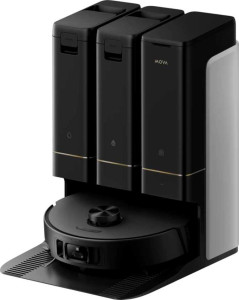
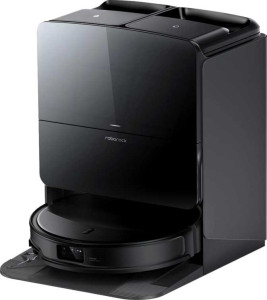
Both the Mova Z50 Ultra and the Roborock Saros 10R share a strong baseline of features: HEPA and allergy filtration, full compatibility with Google Assistant and Alexa, and an identical one-year warranty. Their floor footprints are virtually the same at 350 × 350 mm, so neither has an advantage when navigating tight spaces laterally. The most striking physical difference, however, is in height: the Saros 10R measures just 79.8 mm tall versus the Z50 Ultra's 111 mm, making the Roborock meaningfully better at squeezing under low-clearance furniture like sofas and bed frames — a practical advantage that directly expands cleaning coverage in real homes.
On acoustics, the Saros 10R operates at 68 dB compared to the Z50 Ultra's 74 dB. A 6 dB gap is perceptually significant — roughly twice as loud to the human ear — meaning the Mova will be noticeably more disruptive during daytime use or in quieter households. Conversely, the Z50 Ultra is the lighter unit at 4,600 g versus 5,000 g, though this matters mainly during manual carrying since both are self-navigating robots. The Saros 10R also wins on compactness, with a smaller robot body volume and a more modest docking station footprint (88,315 cm³ vs. 98,410 cm³), which is relevant in apartments where dock placement is constrained.
Where the Z50 Ultra pulls ahead decisively is bin capacity: its estimated empty cycle of 120 days dwarfs the Saros 10R's 49 days, suggesting a substantially larger auto-empty bin. For users who want true set-and-forget convenience with minimal maintenance, this is a significant lifestyle advantage. In summary, the Saros 10R edges out on noise, slimness, and overall compactness, making it the better fit for furniture-dense or noise-sensitive environments, while the Z50 Ultra offers a clear maintenance edge with more than twice the dustbin autonomy.