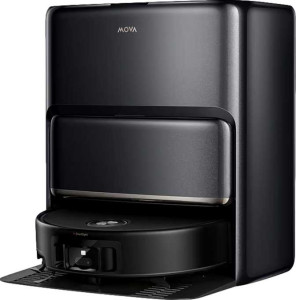
At a high level, the Mova Z60 Ultra Roller Complete and Narwal Flow share a striking number of traits: both weigh exactly 4600 g, carry HEPA and allergy filters, and support Google Assistant and Alexa — meaning neither robot has an advantage in filtration quality or smart-home compatibility. Their physical footprints are also nearly identical, with heights of 96 mm and 95 mm respectively, making both equally suited to sliding under most standard furniture.
Where meaningful differences emerge is in noise and autonomy. The Narwal Flow operates at 57 dB versus the Mova's 74 dB — a 17 dB gap that is not subtle. Because decibels are logarithmic, the Mova is roughly five times louder in perceived intensity, which matters considerably if you run the robot while working from home or during light sleep hours. On autonomy, the Narwal Flow also pulls ahead with an estimated empty time of 120 days versus 100 days for the Mova, meaning its dustbin or self-empty system requires attention about 20% less often — a real convenience advantage for low-maintenance households. Counterbalancing this, the Mova's docking station is physically larger (98,410 cm³ vs. 84,893 cm³), so despite needing more frequent emptying, it demands more floor space.
Overall, the Narwal Flow holds a clear edge in this category. Its significantly quieter operation and longer between-empty interval are practical, day-to-day advantages that most users will notice, while the shared warranty period of 1 year and near-identical physical profile mean neither product stands out on those fronts. The Mova's larger dock footprint only compounds the Narwal's lead.