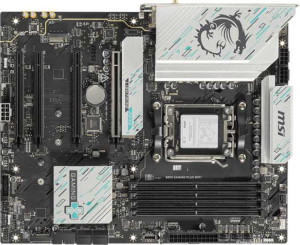
MSI B840 Gaming Plus WiFi
MSI B850 Gaming Plus WiFi

MSI B840 Gaming Plus WiFi MSI B850 Gaming Plus WiFi

Overview

When comparing the MSI B840 Gaming Plus WiFi and the MSI B850 Gaming Plus WiFi, you are looking at two AM5 ATX motherboards that share a solid common foundation yet diverge in meaningful ways. The real battlegrounds lie in their chipset generation, PCIe slot configuration, M.2 storage capacity, and rear-panel connectivity — differences that can have a real impact depending on the kind of build you are planning. Read on for a full side-by-side breakdown of every specification.

Common Features

  • Both boards use the AM5 CPU socket.
  • Both use the ATX form factor.
  • Wi-Fi is supported on both products, covering Wi-Fi 4, Wi-Fi 5, Wi-Fi 6, Wi-Fi 6E, and Wi-Fi 7.
  • Bluetooth 5.4 is available on both products.
  • Overclocking support is present on both products.
  • RGB lighting is featured on both products.
  • Both support up to 256GB of maximum memory.
  • Both have a maximum native RAM speed of 5600 MHz.
  • Both boards have 4 memory slots.
  • Both use DDR5 memory.
  • Both operate on a dual-channel memory configuration.
  • ECC memory is not supported on either product.
  • Both have 1 USB 3.2 Gen 2 port (USB-A).
  • Neither board has any USB 3.2 Gen 1 ports (USB-C).
  • Both have 4 USB 2.0 ports.
  • Neither board has USB 3.2 Gen 2x2, USB 4 40Gbps, USB 4 20Gbps, Thunderbolt 4, or Thunderbolt 3 ports.
  • Both provide 4 USB 2.0 ports through expansion.
  • Both have 4 SATA 3 connectors.
  • Both have 6 fan headers.
  • A TPM connector is present on both products.
  • Neither board has a U.2 socket or mSATA connector.
  • Both support 7.1 audio channels.
  • Both have 1 PCIe 4.0 x16 slot.
  • Neither board has PCI, PCIe 2.0 x16, PCIe x4, or PCIe x8 slots.
  • Both support RAID 0 and RAID 1, but neither supports RAID 5, RAID 10, or RAID 0+1.
  • Both use the B-series chipset platform.

Main Differences

  • The chipset is B840 on the MSI B840 Gaming Plus WiFi and B850 on the MSI B850 Gaming Plus WiFi.
  • The maximum overclocked RAM speed is 8000 MHz on the MSI B840 Gaming Plus WiFi and 8200 MHz on the MSI B850 Gaming Plus WiFi.
  • USB 3.2 Gen 1 ports (USB-A) count is 2 on the MSI B840 Gaming Plus WiFi and 1 on the MSI B850 Gaming Plus WiFi.
  • USB 3.2 Gen 2 ports (USB-C) count is 1 on the MSI B840 Gaming Plus WiFi and 2 on the MSI B850 Gaming Plus WiFi.
  • An HDMI output is present on the MSI B840 Gaming Plus WiFi but not available on the MSI B850 Gaming Plus WiFi.
  • DisplayPort outputs number 0 on the MSI B840 Gaming Plus WiFi and 1 on the MSI B850 Gaming Plus WiFi.
  • USB 3.2 Gen 1 ports through expansion number 2 on the MSI B840 Gaming Plus WiFi and 4 on the MSI B850 Gaming Plus WiFi.
  • USB 3.0 ports through expansion number 2 on the MSI B840 Gaming Plus WiFi and 4 on the MSI B850 Gaming Plus WiFi.
  • M.2 sockets number 2 on the MSI B840 Gaming Plus WiFi and 3 on the MSI B850 Gaming Plus WiFi.
  • A PCIe 5.0 x16 slot is absent on the MSI B840 Gaming Plus WiFi but present on the MSI B850 Gaming Plus WiFi.
  • A PCIe 3.0 x16 slot is present on the MSI B840 Gaming Plus WiFi but absent on the MSI B850 Gaming Plus WiFi.
  • PCIe x1 slots number 3 on the MSI B840 Gaming Plus WiFi and 2 on the MSI B850 Gaming Plus WiFi.
  • An S/PDIF Out port is absent on the MSI B840 Gaming Plus WiFi but present on the MSI B850 Gaming Plus WiFi.
  • Audio connectors number 3 on the MSI B840 Gaming Plus WiFi and 2 on the MSI B850 Gaming Plus WiFi.
Specs Comparison
MSI B840 Gaming Plus WiFi

MSI B840 Gaming Plus WiFi

MSI B850 Gaming Plus WiFi

MSI B850 Gaming Plus WiFi

General info:
CPU socket AM5 AM5
chipset B840 B850
form factor ATX ATX
release date January 2025 January 2025
supports Wi-Fi
Wi-Fi version Wi-Fi 4 (802.11n), Wi-Fi 5 (802.11ac), Wi-Fi 6 (802.11ax), Wi-Fi 6E (802.11ax), Wi-Fi 7 (802.11be) Wi-Fi 4 (802.11n), Wi-Fi 5 (802.11ac), Wi-Fi 6 (802.11ax), Wi-Fi 6E (802.11ax), Wi-Fi 7 (802.11be)
Has Bluetooth
Bluetooth version 5.4 5.4
Easy to overclock
has RGB lighting
Easy to reset BIOS
Has dual BIOS
has aptX
CPU sockets 1 1
Has integrated graphics
warranty period 3 years 3 years
height 243.8 mm 243.8 mm
width 304.8 mm 304.8 mm
Has integrated CPU

At first glance, the MSI B840 Gaming Plus WiFi and MSI B850 Gaming Plus WiFi appear nearly identical in their general profile — and for good reason. Both share the same ATX form factor (304.8 × 243.8 mm), the same AM5 socket for AMD Ryzen compatibility, identical wireless stacks up to Wi-Fi 7 and Bluetooth 5.4, and the same set of convenience features: dual BIOS, easy BIOS reset, RGB lighting, and overclocking support. Even the 3-year warranty is the same. For a user scanning the general info tab, these two boards look like twins.

The sole differentiator here is the chipsetB840 on the first board versus B850 on the second. Within AMD's platform hierarchy, the B850 sits one tier above the B840, which in practice typically translates to more PCIe lanes, broader overclocking flexibility for memory and interconnects, and better headroom for future platform features. While the general info group does not expose those downstream effects directly, the chipset designation alone signals that the B850 is the more capable foundation.

Based strictly on the data in this group, the MSI B850 Gaming Plus WiFi holds a meaningful edge: the higher-tier chipset gives it greater platform potential without sacrificing any of the convenience or connectivity features present on the B840. If all other specs in this category are equal, the chipset difference is the deciding factor here.

Memory:
maximum memory amount 256GB 256GB
RAM speed (max) 5600 MHz 5600 MHz
overclocked RAM speed 8000 MHz 8200 MHz
memory slots 4 4
DDR memory version 5 5
memory channels 2 2
Supports ECC memory

The MSI B840 Gaming Plus WiFi and MSI B850 Gaming Plus WiFi motherboards both support up to 256GB of maximum memory, ensuring ample capacity for high-performance tasks. Both models also support DDR5 memory, with a maximum RAM speed of 5600 MHz. However, the two products differ in their overclocked RAM speeds, with the B840 supporting up to 8000 MHz, while the B850 can reach 8200 MHz, offering a slight advantage in overclocking potential.

Both motherboards feature four memory slots and two memory channels, providing a solid foundation for building a well-balanced system. Additionally, neither of the two models supports ECC memory, ensuring that these motherboards are not optimized for error-correcting code memory, which is typically used in servers and workstations.

In summary, the primary difference between the MSI B840 and MSI B850 Gaming Plus WiFi in the memory specs lies in the slightly higher overclocked RAM speed of the B850, which can reach 8200 MHz compared to the B840's 8000 MHz. Otherwise, their memory configurations are identical.

Ports:
USB 3.2 Gen 2 ports (USB-A) 1 1
USB 3.2 Gen 1 ports (USB-A) 2 1
USB 3.2 Gen 2 ports (USB-C) 1 2
USB 3.2 Gen 1 ports (USB-C) 0 0
USB 2.0 ports 4 4
USB 3.2 Gen 2x2 ports 0 0
USB 4 40Gbps ports 0 0
USB 4 20Gbps ports 0 0
Thunderbolt 4 ports 0 0
Thunderbolt 3 ports 0 0
has an HDMI output
DisplayPort outputs 0 1
RJ45 ports 1 1
Has USB Type-C
eSATA ports 0 0
DVI outputs 0 0
has a VGA connector
PS/2 ports 0 0

The MSI B840 Gaming Plus WiFi and MSI B850 Gaming Plus WiFi motherboards offer similar port configurations, with some key differences. Both models include one USB 3.2 Gen 2 (USB-A) port and four USB 2.0 ports. However, the B840 has two USB 3.2 Gen 1 (USB-A) ports, while the B850 has only one. For USB Type-C connectivity, the B840 includes one USB 3.2 Gen 2 (USB-C) port, whereas the B850 has two USB 3.2 Gen 2 (USB-C) ports, giving it more flexibility for modern devices.

In terms of video outputs, the B840 offers an HDMI output, while the B850 lacks an HDMI output but includes a DisplayPort output, providing users with different options for connecting monitors. Both models have one RJ45 port for Ethernet connectivity, but the B840 lacks any DisplayPort output while the B850 has this addition. Neither model includes USB 4, Thunderbolt 3, or Thunderbolt 4 ports, and both lack VGA connectors and PS/2 ports.

In summary, the key differences between the two motherboards lie in the USB and video output configurations. The MSI B840 has more USB 3.2 Gen 1 (USB-A) ports, but the MSI B850 offers more USB Type-C ports and a DisplayPort output instead of HDMI.

Connectors:
USB 3.2 Gen 1 ports (through expansion) 2 4
USB 2.0 ports (through expansion) 4 4
SATA 3 connectors 4 4
fan headers 6 6
USB 3.0 ports (through expansion) 2 4
M.2 sockets 2 3
Has TPM connector
U.2 sockets 0 0
Has mSATA connector
SATA 2 connectors 0 0

The MSI B840 Gaming Plus WiFi and MSI B850 Gaming Plus WiFi motherboards offer similar connector options, with both models featuring 4 SATA 3 connectors, 6 fan headers, and no SATA 2 connectors. Both models also support a TPM connector for security, and neither includes a U.2 or mSATA connector. However, there are some differences in their expansion capabilities. The B840 offers 2 USB 3.2 Gen 1 ports, 4 USB 2.0 ports, and 2 USB 3.0 ports through expansion. The B850, on the other hand, provides more expansion options with 4 USB 3.2 Gen 1 ports, 4 USB 2.0 ports, and 4 USB 3.0 ports through expansion.

Additionally, the B840 includes 2 M.2 sockets, while the B850 provides one more, totaling 3 M.2 sockets. This gives the B850 a slight edge in terms of storage expansion options compared to the B840.

In summary, the MSI B850 Gaming Plus WiFi offers more expansion possibilities, with additional USB 3.2 Gen 1 and USB 3.0 ports through expansion, as well as an extra M.2 socket. Otherwise, the two models share many similarities in terms of connectors.

Expansion slots:
PCIe 4.0 x16 slots 1 1
PCIe 5.0 x16 slots 0 1
PCIe 3.0 x16 slots 1 0
PCIe x1 slots 3 2
PCI slots 0 0
PCIe 2.0 x16 slots 0 0
PCIe x4 slots 0 0
PCIe x8 slots 0 0

The MSI B840 Gaming Plus WiFi and MSI B850 Gaming Plus WiFi motherboards offer similar PCIe slot configurations, but there are a few differences worth noting. Both models feature one PCIe 4.0 x16 slot, but the B850 also includes an additional PCIe 5.0 x16 slot, providing it with a more future-proof expansion option for newer GPUs or other devices that support PCIe 5.0. The B840 does not have any PCIe 5.0 slots, limiting it to PCIe 4.0 for high-speed connections.

In terms of additional PCIe slots, the B840 includes three PCIe x1 slots, while the B850 has two. Neither motherboard includes PCI slots, PCIe 2.0 x16 slots, PCIe x4 slots, or PCIe x8 slots, meaning both models are similarly limited in those categories.

To summarize, the primary difference between the two models in the expansion slots is the additional PCIe 5.0 x16 slot in the MSI B850, which provides an advantage for users looking for the latest PCIe standard. Otherwise, both motherboards share similar slot configurations, with a slight difference in the number of PCIe x1 slots available.

Audio:
audio channels 7.1 7.1
Has S/PDIF Out port
audio connectors 3 2

Both the MSI B840 Gaming Plus WiFi and MSI B850 Gaming Plus WiFi motherboards offer 7.1 audio channels, providing high-quality surround sound for immersive audio experiences. However, there are differences in their additional audio features. The B840 lacks an S/PDIF Out port, while the B850 includes this port, offering a convenient digital audio connection for high-quality sound output.

In terms of audio connectors, the B840 features three audio connectors, while the B850 has two. This means the B840 provides slightly more flexibility for connecting audio devices compared to the B850.

In summary, the MSI B850 Gaming Plus WiFi offers the added benefit of an S/PDIF Out port, but the B840 provides more audio connectors, making it more suited for users who need additional physical connections.

Storage:
Supports RAID 1
Supports RAID 10 (1+0)
Supports RAID 5
Supports RAID 0
Supports RAID 0+1

Both the MSI B840 Gaming Plus WiFi and MSI B850 Gaming Plus WiFi motherboards support RAID 1 and RAID 0 configurations, allowing users to set up data redundancy or striping for performance. However, neither of the two motherboards supports RAID 10 (1+0), RAID 5, or RAID 0+1, so users seeking those specific RAID levels will need to consider other options.

In summary, the storage capabilities of the B840 and B850 are nearly identical, with both supporting RAID 1 and RAID 0 but lacking support for the other advanced RAID configurations like RAID 10 or RAID 5.

Ultimately, both motherboards provide similar RAID options, offering RAID 1 and RAID 0 for users who want basic storage configurations.

Comparison Summary & Verdict

Both the MSI B840 Gaming Plus WiFi and the MSI B850 Gaming Plus WiFi share a capable foundation: AM5 compatibility, Wi-Fi 7, DDR5 with four slots up to 256GB, four SATA connectors, six fan headers, and 7.1 audio. However, their differences carve out clear use cases. The MSI B840 Gaming Plus WiFi is the more accessible option, offering an HDMI output, an extra USB-A 3.2 Gen 1 port, three PCIe x1 slots, and three analog audio connectors, making it a practical pick for builders prioritizing straightforward display output and broad legacy expansion. The MSI B850 Gaming Plus WiFi targets more demanding and future-oriented builds with its PCIe 5.0 x16 slot, three M.2 sockets, higher overclocked RAM ceiling of 8200 MHz, two USB-C rear ports, more internal USB headers, and an S/PDIF digital audio output. Choose the B840 for simplicity and value; choose the B850 for headroom and next-generation readiness.

MSI B840 Gaming Plus WiFi
Buy MSI B840 Gaming Plus WiFi if...

Buy the MSI B840 Gaming Plus WiFi if you want a built-in HDMI output for direct display connectivity and value having more USB-A ports and greater PCIe x1 slot flexibility for legacy expansion cards.

MSI B850 Gaming Plus WiFi
Buy MSI B850 Gaming Plus WiFi if...

Buy the MSI B850 Gaming Plus WiFi if you want a PCIe 5.0 x16 slot for next-generation GPU support, three M.2 sockets for more NVMe drives, and a higher overclocked RAM ceiling of 8200 MHz for a more future-ready build.