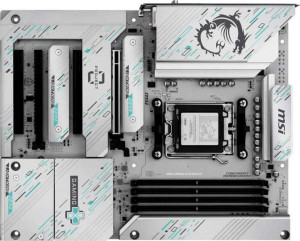
MSI B850 Gaming Plus Wi-Fi PZ
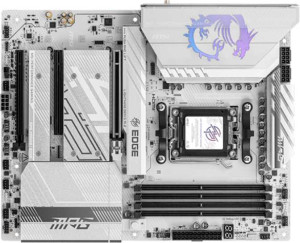
MSI MPG B850 Edge Ti WiFi

MSI B850 Gaming Plus Wi-Fi PZ MSI MPG B850 Edge Ti WiFi

Overview

Choosing between the MSI B850 Gaming Plus Wi-Fi PZ and the MSI MPG B850 Edge Ti WiFi means weighing two AM5 motherboards that share a remarkably solid foundation, including Wi-Fi 7, DDR5 support, and 7.1 audio, yet diverge in meaningful ways across USB connectivity, display outputs, M.2 storage slots, and PCIe expansion. This side-by-side comparison breaks down every key specification so you can identify which board truly fits your build.

Common Features

  • Both products use the AM5 CPU socket.
  • Both products feature the B850 chipset.
  • Both products have an ATX form factor.
  • Wi-Fi is supported on both products, covering Wi-Fi 4, Wi-Fi 5, Wi-Fi 6, Wi-Fi 6E, and Wi-Fi 7.
  • Bluetooth 5.4 is available on both products.
  • Both products support overclocking.
  • Both products support a maximum of 256GB of RAM.
  • Both products support a maximum native RAM speed of 5600 MHz.
  • Both products have 4 memory slots.
  • Both products use DDR5 memory.
  • Both products have 2 memory channels.
  • ECC memory is not supported on either product.
  • Both products have 1 USB 3.2 Gen 1 Type-A port.
  • Neither product has a USB 3.2 Gen 1 Type-C port.
  • Both products have 4 USB 2.0 ports.
  • Neither product has USB 3.2 Gen 2x2, USB 4, Thunderbolt 3, or Thunderbolt 4 ports.
  • Both products provide 4 USB 3.2 Gen 1 ports and 4 USB 2.0 ports through expansion.
  • Both products have 4 SATA 3 connectors and no SATA 2 connectors.
  • A TPM connector is present on both products.
  • Neither product has an mSATA connector or U.2 socket.
  • Both products have 1 PCIe 5.0 x16 slot and no PCIe 3.0 x16, PCIe 2.0 x16, or PCI slots.
  • Both products support 7.1 audio channels with an S/PDIF Out port and 2 audio connectors.
  • Both products support RAID 0, RAID 1, and RAID 10, but not RAID 0+1.

Main Differences

  • Overclocked RAM speed reaches 8200 MHz on MSI B850 Gaming Plus Wi-Fi PZ and 8400 MHz on MSI MPG B850 Edge Ti WiFi.
  • USB 3.2 Gen 2 Type-A ports number 1 on MSI B850 Gaming Plus Wi-Fi PZ and 2 on MSI MPG B850 Edge Ti WiFi.
  • USB 3.2 Gen 2 Type-C ports number 2 on MSI B850 Gaming Plus Wi-Fi PZ and 3 on MSI MPG B850 Edge Ti WiFi.
  • An HDMI output is present on MSI MPG B850 Edge Ti WiFi but not available on MSI B850 Gaming Plus Wi-Fi PZ.
  • MSI B850 Gaming Plus Wi-Fi PZ has 1 DisplayPort output, while MSI MPG B850 Edge Ti WiFi has none.
  • USB 3.2 Gen 2x2 expansion ports number 0 on MSI B850 Gaming Plus Wi-Fi PZ and 1 on MSI MPG B850 Edge Ti WiFi.
  • Fan headers number 6 on MSI B850 Gaming Plus Wi-Fi PZ and 8 on MSI MPG B850 Edge Ti WiFi.
  • M.2 sockets number 3 on MSI B850 Gaming Plus Wi-Fi PZ and 4 on MSI MPG B850 Edge Ti WiFi.
  • MSI B850 Gaming Plus Wi-Fi PZ has no PCIe 4.0 x16 slot, while MSI MPG B850 Edge Ti WiFi has 1.
  • PCIe x1 slots number 2 on MSI B850 Gaming Plus Wi-Fi PZ and 1 on MSI MPG B850 Edge Ti WiFi.
  • MSI B850 Gaming Plus Wi-Fi PZ has 1 PCIe x4 slot, while MSI MPG B850 Edge Ti WiFi has none.
  • RAID 5 support is present on MSI B850 Gaming Plus Wi-Fi PZ but not available on MSI MPG B850 Edge Ti WiFi.
Specs Comparison
MSI B850 Gaming Plus Wi-Fi PZ

MSI B850 Gaming Plus Wi-Fi PZ

MSI MPG B850 Edge Ti WiFi

MSI MPG B850 Edge Ti WiFi

General info:
CPU socket AM5 AM5
chipset B850 B850
form factor ATX ATX
release date June 2025 January 2025
supports Wi-Fi
Wi-Fi version Wi-Fi 4 (802.11n), Wi-Fi 5 (802.11ac), Wi-Fi 6 (802.11ax), Wi-Fi 6E (802.11ax), Wi-Fi 7 (802.11be) Wi-Fi 4 (802.11n), Wi-Fi 5 (802.11ac), Wi-Fi 6 (802.11ax), Wi-Fi 6E (802.11ax), Wi-Fi 7 (802.11be)
Has Bluetooth
Bluetooth version 5.4 5.4
Easy to overclock
has RGB lighting
Easy to reset BIOS
Has dual BIOS
has aptX
CPU sockets 1 1
Has integrated graphics
warranty period 3 years 3 years
height 243.8 mm 243.8 mm
width 304.8 mm 304.8 mm
Has integrated CPU

In terms of general specifications, the MSI B850 Gaming Plus Wi-Fi PZ and the MSI MPG B850 Edge Ti WiFi are virtually identical twins. Both boards are built on the AM5 socket with the B850 chipset, adopt the standard ATX form factor at the same dimensions (243.8 × 304.8 mm), and carry identical wireless credentials — full Wi-Fi 7 (802.11be) support alongside Bluetooth 5.4. Both are overclocking-friendly, feature RGB lighting, offer easy BIOS reset, and come backed by a 3-year warranty. Neither includes a dual BIOS, integrated graphics, or an integrated CPU.

The practical takeaway is that at the platform level, these two boards offer the same fundamental experience: a modern AMD AM5 ecosystem with cutting-edge wireless connectivity. Wi-Fi 7 support is a genuinely meaningful shared advantage, delivering faster throughput, lower latency, and better performance in congested wireless environments compared to prior generations. Bluetooth 5.4 similarly ensures stable, low-energy peripheral connections. The overclocking support on both boards means memory and CPU tuning are accessible to enthusiasts without needing a premium X-series chipset.

Based strictly on the general info specs provided, these two products are in a complete tie — every single value across this group is identical. No advantage can be declared for either board on these criteria alone. A decision between them will need to rest on other specification groups such as power delivery, connectivity, or audio features.
Memory:
maximum memory amount 256GB 256GB
RAM speed (max) 5600 MHz 5600 MHz
overclocked RAM speed 8200 MHz 8400 MHz
memory slots 4 4
DDR memory version 5 5
memory channels 2 2
Supports ECC memory

The memory configurations of both boards share a strong common foundation: DDR5 support across 4 slots in a dual-channel arrangement, a maximum capacity of 256GB, and a native RAM speed ceiling of 5600 MHz. For most users, this shared baseline is more than capable — DDR5 dual-channel at these capacities handles everything from content creation workloads to high-framerate gaming without compromise.

Where the two boards diverge, however, is in overclocked memory headroom. The MPG B850 Edge Ti WiFi tops out at 8400 MHz via overclocking, compared to 8200 MHz on the B850 Gaming Plus Wi-Fi PZ. While a 200 MHz difference may seem marginal, it signals that the Edge Ti WiFi's memory subsystem is validated and tuned to push DDR5 kits slightly further. For enthusiasts chasing peak performance with high-speed memory kits, that extra headroom can translate to tangible gains in memory-bandwidth-sensitive tasks like video encoding, large dataset processing, or competitive gaming at high refresh rates.

The MPG B850 Edge Ti WiFi holds a narrow but clear edge in this category strictly due to its higher overclocked memory ceiling. Neither board supports ECC memory, so workstation or server use cases are off the table for both. If memory overclocking is a priority in your build, the Edge Ti WiFi is the more capable platform of the two.

Ports:
USB 3.2 Gen 2 ports (USB-A) 1 2
USB 3.2 Gen 1 ports (USB-A) 1 1
USB 3.2 Gen 2 ports (USB-C) 2 3
USB 3.2 Gen 1 ports (USB-C) 0 0
USB 2.0 ports 4 4
USB 3.2 Gen 2x2 ports 0 0
USB 4 40Gbps ports 0 0
USB 4 20Gbps ports 0 0
Thunderbolt 4 ports 0 0
Thunderbolt 3 ports 0 0
has an HDMI output
DisplayPort outputs 1 0
RJ45 ports 1 1
Has USB Type-C
eSATA ports 0 0
DVI outputs 0 0
has a VGA connector
PS/2 ports 0 0

Rear I/O is where these two boards start to show more meaningful personality differences. Both share a common base of 4 USB 2.0 ports, a single USB 3.2 Gen 1 Type-A, and one RJ45 ethernet jack — but the MPG B850 Edge Ti WiFi pulls ahead on high-speed USB density, offering 2 USB 3.2 Gen 2 Type-A and 3 USB 3.2 Gen 2 Type-C ports, versus 1 Type-A and 2 Type-C Gen 2 on the B850 Gaming Plus Wi-Fi PZ. In practice, that extra Gen 2 port on each connector type means more simultaneous high-bandwidth device connections — useful for fast external SSDs, modern peripherals, or rapid device charging without needing a hub.

The display output situation is a straightforward trade-off rather than a clear hierarchy. The Gaming Plus Wi-Fi PZ provides a DisplayPort output, while the Edge Ti WiFi opts for HDMI. Neither supports both. For users leveraging AMD's integrated graphics-capable APUs — or simply needing a secondary display connection — the ″right″ choice here comes down entirely to which standard their monitor speaks. DisplayPort is generally preferred for high-refresh-rate monitors, while HDMI has broader compatibility with TVs and consumer displays.

Overall, the MPG B850 Edge Ti WiFi holds a tangible edge in this category. Its higher count of USB 3.2 Gen 2 ports across both Type-A and Type-C gives it more practical flexibility for bandwidth-hungry peripherals, and that advantage compounds for users with multiple fast external devices. The display output difference is a wash — context-dependent rather than a win for either side.

Connectors:
USB 3.2 Gen 1 ports (through expansion) 4 4
USB 3.2 Gen 2x2 ports (through expansion) 0 1
USB 2.0 ports (through expansion) 4 4
SATA 3 connectors 4 4
fan headers 6 8
USB 3.0 ports (through expansion) 4 4
M.2 sockets 3 4
Has TPM connector
U.2 sockets 0 0
Has mSATA connector
SATA 2 connectors 0 0

Digging into internal connectors, the two boards share a solid common foundation — 4 SATA 3 ports, identical USB expansion headers, and a TPM connector on both. For the average builder, these shared specs cover all the essentials without compromise. The divergence, however, lies in three areas that matter increasingly as a build grows in complexity.

Most notable is the M.2 socket count: the MPG B850 Edge Ti WiFi offers 4 M.2 slots versus 3 on the B850 Gaming Plus Wi-Fi PZ. In an era where NVMe SSDs are the default storage choice, that fourth slot is a genuine asset — whether for a dedicated OS drive, a scratch disk for creative workflows, or future storage expansion without displacing existing drives. The Edge Ti WiFi also adds a USB 3.2 Gen 2x2 front-panel header (absent on the Gaming Plus), enabling 20Gbps internal connectivity for compatible cases with high-speed front USB-C ports. Rounding out its internal advantages, the Edge Ti WiFi provides 8 fan headers compared to 6 on the Gaming Plus — a meaningful difference for builders running dense cooling setups with multiple radiator fans, case fans, and pump headers simultaneously.

The MPG B850 Edge Ti WiFi wins this category clearly. More M.2 slots, a faster USB expansion header, and greater fan control capacity all point to a board that scales better with ambitious builds. The Gaming Plus Wi-Fi PZ covers typical use cases comfortably, but enthusiasts or those planning storage-heavy or thermally complex systems will find the Edge Ti WiFi's internal connector suite meaningfully more capable.

Expansion slots:
PCIe 4.0 x16 slots 0 1
PCIe 5.0 x16 slots 1 1
PCIe 3.0 x16 slots 0 0
PCIe x1 slots 2 1
PCI slots 0 0
PCIe 2.0 x16 slots 0 0
PCIe x4 slots 1 0
PCIe x8 slots 0 0

Both boards anchor their expansion slot layout around a single PCIe 5.0 x16 slot — the primary GPU lane — which is the expected standard for a current-generation B850 platform and ensures full bandwidth compatibility with today's and near-future discrete graphics cards. That shared foundation means neither board compromises on the most performance-critical slot.

Beyond that primary slot, the two boards take noticeably different approaches. The MPG B850 Edge Ti WiFi adds a PCIe 4.0 x16 slot as its secondary expansion option, which is a significant asset: a full-size x16 physical slot running at PCIe 4.0 speeds can comfortably host a second high-bandwidth card — think a dedicated capture card, a high-performance NVMe expansion card, or even a secondary GPU — without the bandwidth constraints of a smaller slot. The B850 Gaming Plus Wi-Fi PZ, by contrast, skips a secondary x16 slot entirely and instead provides a PCIe x4 slot alongside two PCIe x1 slots, which better serves users adding multiple lower-bandwidth cards like sound cards, network adapters, or USB expansion controllers simultaneously.

The verdict here depends on use case. For builders who want a second high-bandwidth expansion card, the MPG B850 Edge Ti WiFi has a clear advantage with its PCIe 4.0 x16 secondary slot. Those needing to populate several smaller expansion cards at once may actually find the Gaming Plus Wi-Fi PZ's broader mix of smaller slots more practical. On balance, however, the Edge Ti WiFi's secondary x16 slot represents the higher-value capability for the majority of enthusiast scenarios.

Audio:
audio channels 7.1 7.1
Has S/PDIF Out port
audio connectors 2 2

On the audio front, these two boards are perfectly matched. Both deliver 7.1-channel surround sound support, include an S/PDIF optical output for connecting to external DACs or AV receivers, and offer 2 rear audio connectors. For most users — whether gaming with a headset, running a 2.1 desktop speaker setup, or routing audio through a dedicated external audio system — this configuration covers all common scenarios without gaps.

The S/PDIF output is worth highlighting as a shared strength: it allows lossless digital audio passthrough to higher-quality external hardware, bypassing the onboard codec entirely for users who prioritize audio fidelity. The 7.1-channel capability, meanwhile, ensures compatibility with surround sound headsets and multi-speaker setups alike. Neither board lists aptX support — as established in the general specs — so wireless high-fidelity audio over Bluetooth is equally limited on both.

This category is a complete tie. Every audio specification is identical across the B850 Gaming Plus Wi-Fi PZ and the MPG B850 Edge Ti WiFi, and neither holds any measurable advantage here. Users with more demanding onboard audio requirements — such as a higher connector count for full analog surround setups — would find both boards equally limited, and equally adequate for typical use cases.

Storage:
Supports RAID 1
Supports RAID 10 (1+0)
Supports RAID 5
Supports RAID 0
Supports RAID 0+1

RAID support is an area where both boards cover the consumer essentials confidently — RAID 0 (striping for maximum performance), RAID 1 (mirroring for redundancy), and RAID 10 (a combined striping and mirroring configuration) are available on both the B850 Gaming Plus Wi-Fi PZ and the MPG B850 Edge Ti WiFi. For the vast majority of users who ever engage with RAID at all, these three modes cover every practical use case from speed-optimized game storage arrays to basic data protection setups.

The single point of divergence is RAID 5 support, which is present on the B850 Gaming Plus Wi-Fi PZ but absent on the MPG B850 Edge Ti WiFi. RAID 5 distributes parity data across three or more drives, offering a balance of redundancy, storage efficiency, and read performance that makes it popular in small NAS-style or workstation environments. Its omission on the Edge Ti WiFi is a notable gap for any user planning a multi-drive array where storage efficiency and fault tolerance need to coexist without the capacity overhead of pure mirroring.

For this specific category, the B850 Gaming Plus Wi-Fi PZ holds a narrow but genuine edge by virtue of its RAID 5 support. That said, this advantage is only meaningful for a relatively niche audience — users building multi-drive redundant arrays on a consumer desktop platform. For gaming or general workstation builds where RAID 5 is irrelevant, both boards are effectively equal in storage configuration flexibility.

Comparison Summary & Verdict

The MSI B850 Gaming Plus Wi-Fi PZ and MSI MPG B850 Edge Ti WiFi share a strong common platform with AM5, Wi-Fi 7, DDR5 with up to 256 GB of RAM, and solid audio support, making either a competent foundation for a modern build. However, the MSI MPG B850 Edge Ti WiFi pulls ahead for connectivity-hungry users, delivering more USB 3.2 Gen 2 ports, an extra Type-C port, an HDMI output, 8 fan headers, a fourth M.2 slot, a PCIe 4.0 x16 slot, and a higher overclocked RAM ceiling of 8400 MHz. On the other hand, the MSI B850 Gaming Plus Wi-Fi PZ holds its own for builders who depend on RAID 5 storage, prefer a dedicated DisplayPort output, or require a PCIe x4 slot for specific expansion cards. Neither board is a universal winner; your decision should be driven by whether expanded connectivity and storage slots or RAID 5 support and DisplayPort output matter more to your specific use case.

MSI B850 Gaming Plus Wi-Fi PZ
Buy MSI B850 Gaming Plus Wi-Fi PZ if...

Buy the MSI B850 Gaming Plus Wi-Fi PZ if you require RAID 5 storage support, need a DisplayPort output, or want a PCIe x4 slot for specific expansion cards in your build.

MSI MPG B850 Edge Ti WiFi
Buy MSI MPG B850 Edge Ti WiFi if...

Choose the MSI MPG B850 Edge Ti WiFi if you want more USB ports, an HDMI output, 8 fan headers, a fourth M.2 slot, a PCIe 4.0 x16 slot, and the highest possible overclocked RAM speed for a fully loaded, connectivity-rich system.