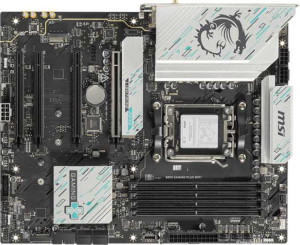
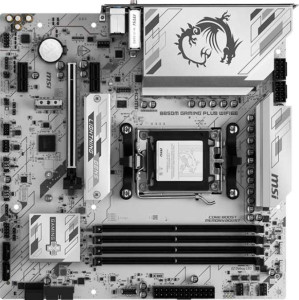
Both boards share a strong common foundation: the AM5 socket with a B850 chipset, support for overclocking, dual BIOS, RGB lighting, and a 3-year warranty. Neither includes integrated graphics or a built-in CPU, so both target users pairing the board with a discrete AMD Ryzen processor and GPU. For connectivity, both offer Bluetooth and Wi-Fi as standard, which is a meaningful inclusion at this price tier.
The most impactful difference lies in form factor and Wi-Fi generation. The B850 Gaming Plus WiFi uses a full ATX layout (304.8 × 243.8 mm), offering more physical space for additional PCIe slots, M.2 slots, and better thermal headroom across VRM and storage zones. The B850M Gaming Plus Wi-Fi6E is Micro-ATX (243.8 × 243.8 mm), making it a better fit for compact builds where case size is a constraint. On wireless, the ATX model supports up to Wi-Fi 7 (802.11be), while the Micro-ATX tops out at Wi-Fi 6E (802.11ax) — a real-world distinction since Wi-Fi 7 delivers significantly higher throughput and lower latency on compatible routers. The ATX model also edges ahead with Bluetooth 5.4 versus 5.3, a minor but measurable improvement in connection stability and range.
The B850 Gaming Plus WiFi (ATX) holds a clear advantage for users who want future-proof wireless with Wi-Fi 7 and have a standard mid-tower or full-tower case. The B850M Gaming Plus Wi-Fi6E is the rational pick for small form factor builds where board footprint is the primary constraint, accepting the trade-off of a slightly older wireless stack.