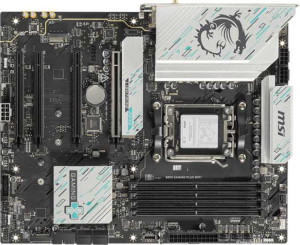
MSI B850 Gaming Plus WiFi
MSI MAG B850 Tomahawk Max WiFi

MSI B850 Gaming Plus WiFi MSI MAG B850 Tomahawk Max WiFi

Overview

When choosing between the MSI B850 Gaming Plus WiFi and the MSI MAG B850 Tomahawk Max WiFi, builders will find two compelling AM5 motherboards sharing the same B850 chipset and ATX form factor, yet differing in meaningful ways. This comparison dives into the key battlegrounds: connectivity and port counts, storage expansion, fan header availability, and display output options — helping you identify which board best matches your build goals.

Common Features

  • Both products use the AM5 CPU socket.
  • Both products feature the B850 chipset.
  • Both products use the ATX form factor.
  • Wi-Fi is supported on both products, covering Wi-Fi 4, Wi-Fi 5, Wi-Fi 6, Wi-Fi 6E, and Wi-Fi 7.
  • Bluetooth 5.4 is available on both products.
  • Both products support overclocking.
  • Both products support a maximum of 256GB of RAM.
  • Both products support a maximum native RAM speed of 5600 MHz.
  • Both products have 4 memory slots.
  • Both products use DDR5 memory.
  • Both products have 2 memory channels.
  • ECC memory is not supported on either product.
  • Both products include 1 USB 3.2 Gen 1 Type-A port.
  • Neither product includes a USB 3.2 Gen 1 Type-C port.
  • Both products include 4 USB 2.0 ports.
  • Neither product includes USB 3.2 Gen 2x2, USB 4, Thunderbolt 3, or Thunderbolt 4 ports.
  • Both products provide 4 USB 3.2 Gen 1 ports and 4 USB 2.0 ports through expansion.
  • Both products include 4 SATA 3 connectors and no SATA 2 connectors.
  • A TPM connector is present on both products.
  • Neither product includes an mSATA connector or U.2 sockets.
  • Both products feature 1 PCIe 5.0 x16 slot and 1 PCIe 4.0 x16 slot.
  • Neither product includes PCIe 3.0, PCIe 2.0, PCIe x4, PCIe x8, or PCI slots.
  • Both products support 7.1 audio channels with 2 audio connectors.
  • An S/PDIF Out port is available on both products.
  • Both products support RAID 0 and RAID 1, but neither supports RAID 5 or RAID 0+1.

Main Differences

  • Overclocked RAM speed is 8200 MHz on MSI B850 Gaming Plus WiFi and 8400 MHz on MSI MAG B850 Tomahawk Max WiFi.
  • USB 3.2 Gen 2 Type-A ports number 1 on MSI B850 Gaming Plus WiFi and 2 on MSI MAG B850 Tomahawk Max WiFi.
  • USB 3.2 Gen 2 Type-C ports number 2 on MSI B850 Gaming Plus WiFi and 3 on MSI MAG B850 Tomahawk Max WiFi.
  • An HDMI output is present on MSI MAG B850 Tomahawk Max WiFi but not available on MSI B850 Gaming Plus WiFi.
  • MSI B850 Gaming Plus WiFi includes 1 DisplayPort output, while MSI MAG B850 Tomahawk Max WiFi has none.
  • Fan headers number 6 on MSI B850 Gaming Plus WiFi and 8 on MSI MAG B850 Tomahawk Max WiFi.
  • M.2 sockets number 3 on MSI B850 Gaming Plus WiFi and 4 on MSI MAG B850 Tomahawk Max WiFi.
  • PCIe x1 slots number 2 on MSI B850 Gaming Plus WiFi and 1 on MSI MAG B850 Tomahawk Max WiFi.
  • RAID 10 (1+0) support is present on MSI MAG B850 Tomahawk Max WiFi but not available on MSI B850 Gaming Plus WiFi.
Specs Comparison
MSI B850 Gaming Plus WiFi

MSI B850 Gaming Plus WiFi

MSI MAG B850 Tomahawk Max WiFi

MSI MAG B850 Tomahawk Max WiFi

General info:
CPU socket AM5 AM5
chipset B850 B850
form factor ATX ATX
release date January 2025 January 2025
supports Wi-Fi
Wi-Fi version Wi-Fi 4 (802.11n), Wi-Fi 5 (802.11ac), Wi-Fi 6 (802.11ax), Wi-Fi 6E (802.11ax), Wi-Fi 7 (802.11be) Wi-Fi 4 (802.11n), Wi-Fi 5 (802.11ac), Wi-Fi 6 (802.11ax), Wi-Fi 6E (802.11ax), Wi-Fi 7 (802.11be)
Has Bluetooth
Bluetooth version 5.4 5.4
Easy to overclock
has RGB lighting
Easy to reset BIOS
Has dual BIOS
has aptX
CPU sockets 1 1
Has integrated graphics
warranty period 3 years 3 years
height 243.8 mm 243.8 mm
width 304.8 mm 304.8 mm
Has integrated CPU

In terms of general specifications, the MSI B850 Gaming Plus WiFi and the MSI MAG B850 Tomahawk Max WiFi are virtually identical twins. Both boards are built on the AM5 socket with the B850 chipset, adopt the standard ATX form factor (304.8 × 243.8 mm), and share the same wireless stack: Wi-Fi 7 (802.11be) with backward compatibility down to Wi-Fi 4, paired with Bluetooth 5.4. In practice, this means both boards are future-proofed for next-generation wireless speeds and low-latency Bluetooth peripherals equally well.

Feature parity extends across every quality-of-life checkbox: both offer dual BIOS for recovery resilience, easy BIOS reset, straightforward overclocking support, and RGB lighting. Neither board carries integrated graphics or an integrated CPU, and both carry the same 3-year warranty. The absence of aptX on both is a minor note for audiophiles using Bluetooth audio, but it affects neither board's advantage.

Based strictly on the general-info specs provided, these two motherboards are completely tied — there is not a single differentiating data point in this category. A buyer choosing between them on general specs alone has no objective basis to prefer one over the other; the decision will hinge entirely on specs from other groups such as power delivery, expansion slots, or connectivity.

Memory:
maximum memory amount 256GB 256GB
RAM speed (max) 5600 MHz 5600 MHz
overclocked RAM speed 8200 MHz 8400 MHz
memory slots 4 4
DDR memory version 5 5
memory channels 2 2
Supports ECC memory

The MSI B850 Gaming Plus WiFi and MSI MAG B850 Tomahawk Max WiFi offer similar memory specifications, with both supporting a maximum memory amount of 256GB and featuring 4 memory slots. Both motherboards also use DDR5 memory, with 2 memory channels available on each. Neither of these models supports ECC memory.

Where they differ is in their overclocked RAM speeds. The MSI B850 Gaming Plus WiFi supports overclocked RAM speeds up to 8200 MHz, while the MSI MAG B850 Tomahawk Max WiFi supports slightly higher overclocked RAM speeds of up to 8400 MHz. The maximum RAM speed for both products is identical, rated at 5600 MHz.

Overall, the memory specifications for both products are very similar, with the only significant difference being the overclocked RAM speed, which is slightly higher on the Tomahawk Max WiFi.

Ports:
USB 3.2 Gen 2 ports (USB-A) 1 2
USB 3.2 Gen 1 ports (USB-A) 1 1
USB 3.2 Gen 2 ports (USB-C) 2 3
USB 3.2 Gen 1 ports (USB-C) 0 0
USB 2.0 ports 4 4
USB 3.2 Gen 2x2 ports 0 0
USB 4 40Gbps ports 0 0
USB 4 20Gbps ports 0 0
Thunderbolt 4 ports 0 0
Thunderbolt 3 ports 0 0
has an HDMI output
DisplayPort outputs 1 0
RJ45 ports 1 1
Has USB Type-C
eSATA ports 0 0
DVI outputs 0 0
has a VGA connector
PS/2 ports 0 0

The MSI B850 Gaming Plus WiFi and MSI MAG B850 Tomahawk Max WiFi offer a variety of similar ports, but there are some notable differences. Both motherboards feature USB 3.2 Gen 1 and Gen 2 ports (USB-A), with the Gaming Plus WiFi having 1 Gen 2 port and 1 Gen 1 port, while the Tomahawk Max WiFi offers 2 Gen 2 ports and 1 Gen 1 port. Additionally, the Gaming Plus WiFi has 2 USB 3.2 Gen 2 (USB-C) ports, while the Tomahawk Max WiFi has 3 USB 3.2 Gen 2 (USB-C) ports.

Both motherboards come with 4 USB 2.0 ports and have no USB 3.2 Gen 2x2, USB 4, Thunderbolt 4, or Thunderbolt 3 ports. The Gaming Plus WiFi features a DisplayPort output, while the Tomahawk Max WiFi includes an HDMI output instead. Neither motherboard includes a VGA connector, PS/2 ports, or eSATA ports, and both have an RJ45 Ethernet port for network connectivity.

In summary, the main differences between the two models in this category are the additional USB 3.2 Gen 2 (USB-C) port and the HDMI output found on the Tomahawk Max WiFi, compared to the DisplayPort on the Gaming Plus WiFi.

Connectors:
USB 3.2 Gen 1 ports (through expansion) 4 4
USB 2.0 ports (through expansion) 4 4
SATA 3 connectors 4 4
fan headers 6 8
USB 3.0 ports (through expansion) 4 4
M.2 sockets 3 4
Has TPM connector
U.2 sockets 0 0
Has mSATA connector
SATA 2 connectors 0 0

The MSI B850 Gaming Plus WiFi and MSI MAG B850 Tomahawk Max WiFi offer similar connectors, with both models featuring 4 USB 3.2 Gen 1 ports and 4 USB 2.0 ports through expansion, as well as 4 SATA 3 connectors. They also both provide 4 USB 3.0 ports through expansion and include a TPM connector. Neither product includes SATA 2 connectors, U.2 sockets, or mSATA connectors.

Where they differ is in the number of fan headers and M.2 sockets. The Gaming Plus WiFi has 6 fan headers and 3 M.2 sockets, while the Tomahawk Max WiFi has 8 fan headers and 4 M.2 sockets. This gives the Tomahawk Max WiFi more flexibility in terms of cooling and storage expansion options.

In summary, the main differences between the two models in this group are the higher number of fan headers and M.2 sockets on the Tomahawk Max WiFi, providing potentially more expansion and cooling capabilities.

Expansion slots:
PCIe 4.0 x16 slots 1 1
PCIe 5.0 x16 slots 1 1
PCIe 3.0 x16 slots 0 0
PCIe x1 slots 2 1
PCI slots 0 0
PCIe 2.0 x16 slots 0 0
PCIe x4 slots 0 0
PCIe x8 slots 0 0

Both the MSI B850 Gaming Plus WiFi and MSI MAG B850 Tomahawk Max WiFi feature one PCIe 4.0 x16 slot and one PCIe 5.0 x16 slot, which provides high bandwidth for graphics cards and other expansion cards. Neither motherboard includes a PCIe 3.0 x16 slot, PCIe 2.0 x16 slot, PCIe x4 slot, or PCIe x8 slot, limiting the expansion options for certain specialized cards.

In terms of PCIe x1 slots, the Gaming Plus WiFi offers 2, while the Tomahawk Max WiFi has only 1. Both motherboards do not include any PCI slots.

In summary, the primary difference between the two models is the number of PCIe x1 slots, with the Gaming Plus WiFi offering one more slot than the Tomahawk Max WiFi.

Audio:
audio channels 7.1 7.1
Has S/PDIF Out port
audio connectors 2 2

Both the MSI B850 Gaming Plus WiFi and MSI MAG B850 Tomahawk Max WiFi offer the same audio specifications. Both motherboards support 7.1 audio channels, have an S/PDIF Out port, and include 2 audio connectors. These features ensure high-quality audio output and connectivity options for users.

There are no differences between the two products in this category, as all audio-related specifications match exactly.

In summary, the audio features of the Gaming Plus WiFi and Tomahawk Max WiFi are identical, offering the same capabilities for audio output and connectivity.

Storage:
Supports RAID 1
Supports RAID 10 (1+0)
Supports RAID 5
Supports RAID 0
Supports RAID 0+1

Both the MSI B850 Gaming Plus WiFi and MSI MAG B850 Tomahawk Max WiFi support RAID 1 and RAID 0, allowing users to configure their storage for redundancy or performance. However, they differ in RAID 10 (1+0) support. The Gaming Plus WiFi does not support RAID 10, while the Tomahawk Max WiFi does. Neither motherboard supports RAID 5 or RAID 0+1 configurations.

In summary, the key difference in storage configurations between these two models is that the Tomahawk Max WiFi offers RAID 10 support, while the Gaming Plus WiFi does not.

Overall, the storage options are similar, but the additional RAID 10 support on the Tomahawk Max WiFi may be beneficial for users looking for more advanced storage configurations.

Comparison Summary & Verdict

Both the MSI B850 Gaming Plus WiFi and the MSI MAG B850 Tomahawk Max WiFi deliver a strong foundation with shared Wi-Fi 7, Bluetooth 5.4, DDR5 support up to 256GB, and dual PCIe 5.0 and 4.0 x16 slots. However, the differences are meaningful. The MSI MAG B850 Tomahawk Max WiFi edges ahead for power users who need more: an extra M.2 slot (4 vs 3), two additional fan headers (8 vs 6), more USB 3.2 Gen 2 ports, HDMI output, and RAID 10 support. The MSI B850 Gaming Plus WiFi, on the other hand, offers a slightly higher PCIe x1 slot count and a DisplayPort output, making it a solid, leaner choice for builders who do not need the extra expansion headroom. Choose the Tomahawk Max WiFi for a feature-rich, future-proof build; opt for the Gaming Plus WiFi if a more streamlined setup suits your needs.

MSI B850 Gaming Plus WiFi
Buy MSI B850 Gaming Plus WiFi if...

Buy the MSI B850 Gaming Plus WiFi if you prefer a DisplayPort output over HDMI and do not need the extra M.2 slot or additional fan headers offered by the Tomahawk Max WiFi.

MSI MAG B850 Tomahawk Max WiFi
Buy MSI MAG B850 Tomahawk Max WiFi if...

Buy the MSI MAG B850 Tomahawk Max WiFi if you want maximum expansion with an extra M.2 socket, more fan headers, additional USB 3.2 Gen 2 ports, HDMI output, and RAID 10 storage support.