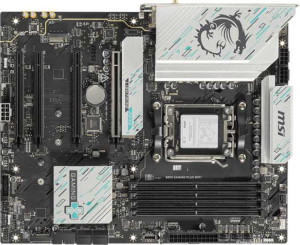
MSI B850 Gaming Plus WiFi
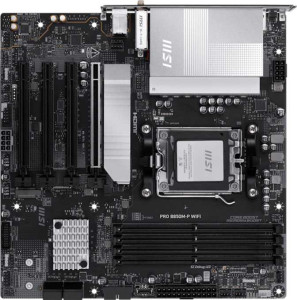
MSI Pro B850M-P Wi-Fi

MSI B850 Gaming Plus WiFi MSI Pro B850M-P Wi-Fi

Overview

Welcome to our in-depth specification comparison between the MSI B850 Gaming Plus WiFi and the MSI Pro B850M-P Wi-Fi — two AM5 motherboards built on the B850 chipset that share a strong foundation yet diverge in meaningful ways. Both boards bring Wi-Fi 7, DDR5 support, and overclocking capability to the table, but key battlegrounds emerge around form factor and physical size, expansion slot configurations, port selection, and storage flexibility. Read on to discover which board is the right fit for your next build.

Common Features

  • Both boards use the AM5 CPU socket.
  • Both boards use the B850 chipset.
  • Wi-Fi is supported on both boards, covering Wi-Fi 4, Wi-Fi 5, Wi-Fi 6, Wi-Fi 6E, and Wi-Fi 7.
  • Bluetooth 5.4 is available on both boards.
  • Both boards support overclocking.
  • RGB lighting is present on both boards.
  • Both boards support a maximum of 256 GB of RAM.
  • The maximum standard RAM speed is 5600 MHz on both boards.
  • The maximum overclocked RAM speed is 8200 MHz on both boards.
  • Both boards have 4 memory slots.
  • Both boards use DDR5 memory.
  • Both boards support dual-channel memory.
  • ECC memory is not supported on either board.
  • Both boards have 1 USB 3.2 Gen 2 Type-A port.
  • Neither board has a USB 3.2 Gen 1 Type-C port.
  • Both boards have 4 USB 2.0 ports.
  • Neither board has a USB 3.2 Gen 2x2 port, USB 4 40 Gbps port, USB 4 20 Gbps port, Thunderbolt 4 port, or Thunderbolt 3 port.
  • Both boards provide 4 USB 3.2 Gen 1 ports and 4 USB 2.0 ports through expansion.
  • Both boards have 4 SATA 3 connectors and no SATA 2 connectors.
  • Both boards have 3 M.2 sockets.
  • A TPM connector is present on both boards.
  • Neither board has an mSATA connector.
  • Both boards have 1 PCIe 5.0 x16 slot and no PCIe 3.0 x16, PCIe 2.0 x16, PCI, PCIe x4, or PCIe x8 slots.
  • Both boards support 7.1 audio channels.
  • Both boards support RAID 0 and RAID 1, but neither supports RAID 0+1.

Main Differences

  • The form factor is ATX on MSI B850 Gaming Plus WiFi and Micro-ATX on MSI Pro B850M-P Wi-Fi.
  • The board width is 304.8 mm on MSI B850 Gaming Plus WiFi and 243.8 mm on MSI Pro B850M-P Wi-Fi.
  • USB 3.2 Gen 1 Type-A ports number 1 on MSI B850 Gaming Plus WiFi and 2 on MSI Pro B850M-P Wi-Fi.
  • USB 3.2 Gen 2 Type-C ports number 2 on MSI B850 Gaming Plus WiFi and 1 on MSI Pro B850M-P Wi-Fi.
  • An HDMI output is present on MSI Pro B850M-P Wi-Fi but not available on MSI B850 Gaming Plus WiFi.
  • Fan headers number 6 on MSI B850 Gaming Plus WiFi and 5 on MSI Pro B850M-P Wi-Fi.
  • A PCIe 4.0 x16 slot is present on MSI B850 Gaming Plus WiFi but not available on MSI Pro B850M-P Wi-Fi.
  • PCIe x1 slots number 2 on MSI B850 Gaming Plus WiFi and 3 on MSI Pro B850M-P Wi-Fi.
  • An S/PDIF Out port is present on MSI B850 Gaming Plus WiFi but not available on MSI Pro B850M-P Wi-Fi.
  • Audio connectors number 2 on MSI B850 Gaming Plus WiFi and 3 on MSI Pro B850M-P Wi-Fi.
  • RAID 10 support is present on MSI Pro B850M-P Wi-Fi but not available on MSI B850 Gaming Plus WiFi.
  • RAID 5 support is present on MSI Pro B850M-P Wi-Fi but not available on MSI B850 Gaming Plus WiFi.
Specs Comparison
MSI B850 Gaming Plus WiFi

MSI B850 Gaming Plus WiFi

MSI Pro B850M-P Wi-Fi

MSI Pro B850M-P Wi-Fi

General info:
CPU socket AM5 AM5
chipset B850 B850
form factor ATX Micro-ATX
release date January 2025 January 2025
supports Wi-Fi
Wi-Fi version Wi-Fi 4 (802.11n), Wi-Fi 5 (802.11ac), Wi-Fi 6 (802.11ax), Wi-Fi 6E (802.11ax), Wi-Fi 7 (802.11be) Wi-Fi 4 (802.11n), Wi-Fi 5 (802.11ac), Wi-Fi 6 (802.11ax), Wi-Fi 6E (802.11ax), Wi-Fi 7 (802.11be)
Has Bluetooth
Bluetooth version 5.4 5.4
Easy to overclock
has RGB lighting
Easy to reset BIOS
Has dual BIOS
has aptX
CPU sockets 1 1
Has integrated graphics
warranty period 3 years 3 years
height 243.8 mm 243.8 mm
width 304.8 mm 243.8 mm
Has integrated CPU

Both the MSI B850 Gaming Plus WiFi and the MSI Pro B850M-P Wi-Fi share the same AM5 socket and B850 chipset, meaning they target the same generation of AMD processors with identical platform capabilities. They also match on wireless connectivity — both support Wi-Fi 7 and Bluetooth 5.4 — and share the same feature checklist: RGB lighting, dual BIOS, easy BIOS reset, and overclocking support. Neither board includes integrated graphics or an integrated CPU, which is standard for this class.

The single most meaningful differentiator in this group is form factor. The Gaming Plus WiFi is a full-size ATX board (304.8 × 243.8 mm), while the Pro B850M-P Wi-Fi is a Micro-ATX design (243.8 × 243.8 mm). The ATX format gives the Gaming Plus WiFi more physical real estate, which typically translates to more expansion slots, better component spacing, and greater cooling headroom — though those details fall outside this spec group. The Micro-ATX Pro B850M-P Wi-Fi, being square and more compact, is better suited to smaller cases and space-constrained builds.

For this general info group, the two boards are essentially tied on features and platform support. The deciding factor here is purely physical: if you are building in a standard mid-tower and want maximum expandability potential, the Gaming Plus WiFi has the edge by virtue of its larger ATX footprint. If your build demands a smaller chassis, the Pro B850M-P Wi-Fi is the logical choice without sacrificing any of the core feature parity.
Memory:
maximum memory amount 256GB 256GB
RAM speed (max) 5600 MHz 5600 MHz
overclocked RAM speed 8200 MHz 8200 MHz
memory slots 4 4
DDR memory version 5 5
memory channels 2 2
Supports ECC memory

Both the MSI B850 Gaming Plus WiFi and MSI Pro B850M-P Wi-Fi motherboards share the same memory specifications, offering identical performance capabilities. Both models support a maximum memory amount of 256GB, with DDR5 memory and a maximum RAM speed of 5600 MHz. Additionally, both motherboards allow for overclocked RAM speeds up to 8200 MHz, providing ample headroom for performance tuning. Each motherboard includes 4 memory slots and operates with 2 memory channels, ensuring solid memory bandwidth and flexibility for multi-tasking or high-performance applications.

Neither motherboard supports ECC memory, making them more suitable for consumer or gaming setups rather than enterprise-grade reliability. These memory specifications are exactly the same across both models, ensuring parity in memory performance and capacity between the two boards.

In summary, there is no difference in the memory specifications between the MSI B850 Gaming Plus WiFi and the MSI Pro B850M-P Wi-Fi. Both boards offer the same memory support, with equivalent speed, capacity, and configuration options.

Ports:
USB 3.2 Gen 2 ports (USB-A) 1 1
USB 3.2 Gen 1 ports (USB-A) 1 2
USB 3.2 Gen 2 ports (USB-C) 2 1
USB 3.2 Gen 1 ports (USB-C) 0 0
USB 2.0 ports 4 4
USB 3.2 Gen 2x2 ports 0 0
USB 4 40Gbps ports 0 0
USB 4 20Gbps ports 0 0
Thunderbolt 4 ports 0 0
Thunderbolt 3 ports 0 0
has an HDMI output
DisplayPort outputs 1 1
RJ45 ports 1 1
Has USB Type-C
eSATA ports 0 0
DVI outputs 0 0
has a VGA connector
PS/2 ports 0 0

The MSI B850 Gaming Plus WiFi and MSI Pro B850M-P Wi-Fi motherboards offer similar port selections, though there are a few differences. Both models feature USB 3.2 Gen 2 (USB-A) ports with 1 port on each, along with USB 3.2 Gen 1 (USB-A) ports, where the Gaming Plus WiFi has 1 and the Pro B850M-P Wi-Fi has 2. For USB 3.2 Gen 2 (USB-C) ports, the Gaming Plus WiFi has 2, while the Pro B850M-P Wi-Fi has 1. Both models offer 4 USB 2.0 ports, with no USB 3.2 Gen 2x2 or USB 4 ports available on either board.

Both motherboards include a DisplayPort output and a single RJ45 port for network connectivity. However, the MSI B850 Gaming Plus WiFi does not have an HDMI output, while the MSI Pro B850M-P Wi-Fi includes 1 HDMI output, providing more flexibility for video output on that model.

Both motherboards also have USB Type-C support, but neither includes Thunderbolt 3 or Thunderbolt 4 ports. Additionally, neither board offers eSATA or VGA connectors, and both lack PS/2 ports, ensuring a modern connection standard across both models.

Connectors:
USB 3.2 Gen 1 ports (through expansion) 4 4
USB 2.0 ports (through expansion) 4 4
SATA 3 connectors 4 4
fan headers 6 5
USB 3.0 ports (through expansion) 4 4
M.2 sockets 3 3
Has TPM connector
Has mSATA connector
SATA 2 connectors 0 0

The MSI B850 Gaming Plus WiFi and MSI Pro B850M-P Wi-Fi both feature similar connector setups, with a few key differences. Both motherboards provide 4 USB 3.2 Gen 1 ports, 4 USB 2.0 ports, and 4 USB 3.0 ports through expansion, ensuring ample connectivity options. They also both include 4 SATA 3 connectors and 3 M.2 sockets, offering flexibility for storage and expansion. Neither motherboard has SATA 2 connectors or an mSATA connector, keeping the focus on more modern storage options.

One difference between the two models is in the number of fan headers. The MSI B850 Gaming Plus WiFi has 6 fan headers, while the MSI Pro B850M-P Wi-Fi has 5, providing slightly more fan control on the Gaming Plus WiFi model. Both motherboards include a TPM connector for enhanced security, ensuring similar support for trusted platform modules across both models.

Overall, the connector configurations of both motherboards are quite similar, with the main distinction being the number of fan headers. Both models provide robust expansion options with a focus on modern connectivity and storage.

Expansion slots:
PCIe 4.0 x16 slots 1 0
PCIe 5.0 x16 slots 1 1
PCIe 3.0 x16 slots 0 0
PCIe x1 slots 2 3
PCI slots 0 0
PCIe 2.0 x16 slots 0 0
PCIe x4 slots 0 0
PCIe x8 slots 0 0

The MSI B850 Gaming Plus WiFi and MSI Pro B850M-P Wi-Fi motherboards have notable differences in their expansion slot configurations. The Gaming Plus WiFi offers 1 PCIe 4.0 x16 slot and 1 PCIe 5.0 x16 slot, providing support for high-speed graphics and expansion cards. In contrast, the Pro B850M-P Wi-Fi features only 1 PCIe 5.0 x16 slot, with no PCIe 4.0 x16 slot available, focusing on next-gen PCIe standards. Both motherboards do not include PCIe 3.0 x16 slots, PCIe 2.0 x16 slots, or PCIe x4/x8 slots.

Both motherboards offer PCIe x1 slots for additional expansions, but the MSI B850 Gaming Plus WiFi has 2 such slots, while the MSI Pro B850M-P Wi-Fi provides 3, offering a bit more flexibility for additional cards. Neither board includes any PCI slots, keeping the expansion options focused on modern PCIe standards.

In summary, the primary difference between the two models in this group is the number of PCIe 4.0 x16 slots, with the Gaming Plus WiFi offering one, while the Pro B850M-P Wi-Fi lacks this slot but provides one more PCIe x1 slot. Both motherboards are equipped with the latest PCIe 5.0 x16 slot, ensuring future-proof expansion capabilities.

Audio:
audio channels 7.1 7.1
Has S/PDIF Out port
audio connectors 2 3

Both the MSI B850 Gaming Plus WiFi and MSI Pro B850M-P Wi-Fi motherboards offer 7.1 audio channels, providing immersive audio support for a range of applications. However, there are some key differences in their audio features. The Gaming Plus WiFi model includes an S/PDIF Out port, which allows for high-quality digital audio output to compatible devices, while the Pro B850M-P Wi-Fi does not have this port. On the other hand, the Pro B850M-P Wi-Fi offers 3 audio connectors, compared to the 2 connectors available on the Gaming Plus WiFi.

In summary, both motherboards provide similar audio channel support, but the MSI B850 Gaming Plus WiFi has the added advantage of an S/PDIF Out port, while the MSI Pro B850M-P Wi-Fi compensates with an additional audio connector. These differences give each board a slight edge depending on the user's needs for audio connectivity.

Storage:
Supports RAID 1
Supports RAID 10 (1+0)
Supports RAID 5
Supports RAID 0
Supports RAID 0+1

Both the MSI B850 Gaming Plus WiFi and MSI Pro B850M-P Wi-Fi motherboards support RAID 1 and RAID 0, allowing for basic mirroring and striping configurations. However, they differ in their RAID 10, RAID 5, and RAID 0+1 support. The Gaming Plus WiFi does not support RAID 10, RAID 5, or RAID 0+1, whereas the Pro B850M-P Wi-Fi supports RAID 10 and RAID 5 in addition to RAID 1 and RAID 0, offering more flexible storage configurations.

Neither motherboard supports RAID 0+1, which combines features of both RAID 0 and RAID 1. The Gaming Plus WiFi’s RAID capabilities are more limited compared to the Pro B850M-P Wi-Fi, which provides additional RAID configurations for more advanced storage setups.

In summary, while both motherboards offer RAID 1 and RAID 0 support, the MSI Pro B850M-P Wi-Fi has broader RAID support, including RAID 10 and RAID 5, making it more versatile for users looking for advanced RAID options.

Comparison Summary & Verdict

After examining every specification, it is clear that both boards are capable AM5 platforms with DDR5, Wi-Fi 7, and overclocking support — but they are aimed at different builders. The MSI B850 Gaming Plus WiFi stands out for enthusiasts who want a full ATX form factor, an extra PCIe 4.0 x16 slot for additional expansion, more fan headers for complex cooling setups, and an S/PDIF Out port for digital audio. The MSI Pro B850M-P Wi-Fi appeals to those prioritizing a compact Micro-ATX build, who benefit from its HDMI output for direct display connectivity, broader RAID support including RAID 5 and RAID 10, and a slightly higher physical audio connector count. In short, choose the Gaming Plus WiFi for a feature-rich full-size build, and opt for the Pro B850M-P Wi-Fi when space efficiency and versatile storage configurations matter most.

MSI B850 Gaming Plus WiFi
Buy MSI B850 Gaming Plus WiFi if...

Buy the MSI B850 Gaming Plus WiFi if you want a full ATX board with an extra PCIe 4.0 x16 slot, more fan headers for advanced cooling, and S/PDIF Out for digital audio connectivity.

MSI Pro B850M-P Wi-Fi
Buy MSI Pro B850M-P Wi-Fi if...

Buy the MSI Pro B850M-P Wi-Fi if you are building in a compact Micro-ATX case and need a built-in HDMI output, plus broader RAID support with RAID 5 and RAID 10 options.