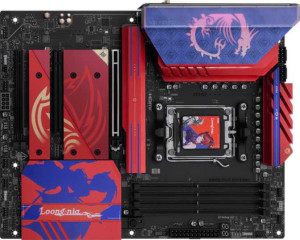
MSI B850 MLG Edition
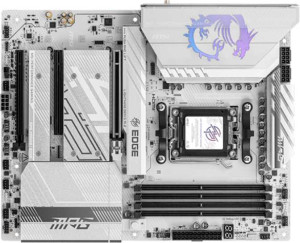
MSI MPG B850 Edge Ti WiFi

MSI B850 MLG Edition MSI MPG B850 Edge Ti WiFi

Overview

Welcome to our detailed spec comparison between the MSI B850 MLG Edition and the MSI MPG B850 Edge Ti WiFi — two AMD AM5 motherboards built on the B850 chipset. While these boards share a strong common foundation, they diverge in areas like rear USB connectivity and PCIe expansion slot configuration, making the choice between them more nuanced than it first appears. Read on to find out which board fits your build.

Common Features

  • Both boards use the AM5 CPU socket.
  • Both boards feature the B850 chipset.
  • Both boards use the ATX form factor.
  • Wi-Fi connectivity is available on both products, supporting Wi-Fi 4 (802.11n), Wi-Fi 5 (802.11ac), Wi-Fi 6 (802.11ax), Wi-Fi 6E (802.11ax), and Wi-Fi 7 (802.11be).
  • Bluetooth 5.4 is present on both products.
  • Both boards include an HDMI 2.1 port.
  • Both boards support a maximum memory amount of 256GB.
  • Both boards support overclocked RAM speeds of up to 8400 MHz.
  • Both boards have 4 memory slots and support DDR5 memory across 2 channels.
  • ECC memory support is not available on either product.
  • Both boards offer 2 USB 3.2 Gen 2 Type-A ports and 3 USB 3.2 Gen 2 Type-C ports on the rear panel.
  • Both boards provide 4 USB 2.0 rear panel ports.
  • USB 3.2 Gen 2x2, USB 4 (40Gbps and 20Gbps), and Thunderbolt 4 ports are not available on either product.
  • Both boards have 4 SATA 3 connectors and 4 M.2 sockets.
  • Both boards include 8 fan headers.
  • A TPM connector is present on both products.
  • Both boards feature 1 PCIe 5.0 x16 slot and 1 PCIe x1 slot.
  • PCIe 3.0 x16, PCIe 2.0 x16, PCIe x8, and PCI slots are not available on either product.
  • Both boards deliver a 120 dB signal-to-noise ratio on the DAC, 7.1 audio channels, an S/PDIF Out port, and 2 audio connectors.
  • Both boards support RAID 0, RAID 1, and RAID 10, while RAID 5 and RAID 0+1 are not supported on either product.

Main Differences

  • USB 3.2 Gen 1 Type-A rear panel ports number 4 on the MSI B850 MLG Edition but only 1 on the MSI MPG B850 Edge Ti WiFi.
  • A PCIe 4.0 x16 slot is present on the MSI MPG B850 Edge Ti WiFi but not available on the MSI B850 MLG Edition.
  • A PCIe x4 slot is present on the MSI B850 MLG Edition but not available on the MSI MPG B850 Edge Ti WiFi.
Specs Comparison
MSI B850 MLG Edition

MSI B850 MLG Edition

MSI MPG B850 Edge Ti WiFi

MSI MPG B850 Edge Ti WiFi

General info:
CPU socket AM5 AM5
chipset B850 B850
form factor ATX ATX
release date August 2025 January 2025
supports Wi-Fi
Wi-Fi version Wi-Fi 4 (802.11n), Wi-Fi 5 (802.11ac), Wi-Fi 6 (802.11ax), Wi-Fi 6E (802.11ax), Wi-Fi 7 (802.11be) Wi-Fi 4 (802.11n), Wi-Fi 5 (802.11ac), Wi-Fi 6 (802.11ax), Wi-Fi 6E (802.11ax), Wi-Fi 7 (802.11be)
Has Bluetooth
Bluetooth version 5.4 5.4
HDMI version HDMI 2.1 HDMI 2.1
Easy to overclock
has RGB lighting
Easy to reset BIOS
Has dual BIOS
has aptX
CPU sockets 1 1
Has integrated graphics
warranty period 3 years 3 years
height 243.8 mm 243.8 mm
width 304.8 mm 304.8 mm
Has integrated CPU

In terms of general specifications, the MSI B850 MLG Edition and the MSI MPG B850 Edge Ti WiFi are remarkably alike. Both boards share the same AM5 socket and B850 chipset, target the same processor ecosystem, and adopt the standard ATX form factor with identical dimensions of 304.8 × 243.8 mm. Their wireless capabilities are also carbon copies of each other: both support the full Wi-Fi 7 (802.11be) stack down through Wi-Fi 4, pair with Bluetooth 5.4, and output video via HDMI 2.1. Practically speaking, neither board gives you a connectivity edge over the other out of the box.

The quality-of-life features are equally mirrored. Both offer easy overclocking and easy BIOS reset, RGB lighting, and a 3-year warranty — while both omit dual BIOS and aptX audio. The absence of dual BIOS on either board is worth noting for overclockers: there is no automatic fallback if a BIOS flash goes wrong, which is a shared limitation rather than a differentiator.

Based strictly on the general-info specs provided, these two motherboards are in a complete tie. Every measurable attribute in this category — chipset, socket, form factor, wireless stack, Bluetooth version, dimensions, and warranty — is identical. A buyer cannot distinguish between the two boards on general specifications alone; the decision will need to rest on other spec groups such as power delivery, connectivity ports, or aesthetics and branding.

Memory:
maximum memory amount 256GB 256GB
overclocked RAM speed 8400 MHz 8400 MHz
memory slots 4 4
DDR memory version 5 5
memory channels 2 2
Supports ECC memory

The memory configurations on both boards are a mirror image of each other. Both the MSI B850 MLG Edition and the MSI MPG B850 Edge Ti WiFi feature 4 DDR5 slots across a dual-channel architecture, with a ceiling of 256GB of total RAM. That capacity is well beyond what gaming or typical creative workloads demand today, leaving plenty of headroom for future upgrades without ever hitting a ceiling.

The more practically interesting shared figure is the overclocked RAM speed support of 8400 MHz. On a B850 platform, this is a strong ceiling — enthusiast-grade memory kits pushing those frequencies will be fully accommodated without needing a higher-end X870 board. Meanwhile, the lack of ECC memory support on both boards confirms they are squarely aimed at consumer use cases; ECC is a workstation and server requirement, so its absence is an expected and inconsequential limitation for the target audience.

Much like the general-info category, memory specs result in a complete tie. There is no differentiation whatsoever between the two boards here — same slot count, same maximum capacity, same DDR version, same overclock headroom, same dual-channel setup. Shoppers comparing these two models will need to look beyond memory specifications entirely to find a meaningful distinction.

Ports:
USB 3.2 Gen 2 ports (USB-A) 2 2
USB 3.2 Gen 1 ports (USB-A) 4 1
USB 3.2 Gen 2 ports (USB-C) 3 3
USB 3.2 Gen 1 ports (USB-C) 0 0
USB 2.0 ports 4 4
USB 3.2 Gen 2x2 ports 0 0
USB 4 40Gbps ports 0 0
USB 4 20Gbps ports 0 0
Thunderbolt 4 ports 0 0
Thunderbolt 3 ports 0 0
has an HDMI output
DisplayPort outputs 0 0
RJ45 ports 1 1
Has USB Type-C
eSATA ports 0 0
DVI outputs 0 0
has a VGA connector
PS/2 ports 0 0

For the most part, the rear I/O port layouts of the MSI B850 MLG Edition and the MSI MPG B850 Edge Ti WiFi are nearly identical — both offer 2 USB 3.2 Gen 2 Type-A ports, 3 USB 3.2 Gen 2 Type-C ports, 4 USB 2.0 ports, a single RJ45 ethernet jack, and HDMI 2.1 for display output. The three Gen 2 Type-C ports are a highlight worth noting: at 10Gbps each, they comfortably handle fast external SSDs, modern peripherals, and high-speed data transfers without bottlenecking.

The one concrete differentiator sits with the USB 3.2 Gen 1 Type-A count. The B850 MLG Edition provides 4 ports of this type, while the MPG B850 Edge Ti WiFi offers just 1. Gen 1 Type-A runs at 5Gbps — sufficient for mice, keyboards, headsets, USB hubs, and most everyday peripherals. Having four of them versus one is a meaningful practical advantage, reducing dependence on USB hubs for users with multiple wired devices.

The B850 MLG Edition takes a clear edge in this category. The tripled Gen 1 Type-A port count gives it noticeably greater plug-in flexibility for day-to-day use, particularly for users with crowded desks or multi-peripheral setups. The MPG B850 Edge Ti WiFi's single Gen 1 Type-A port could become a friction point without an external hub.

Connectors:
USB 3.2 Gen 1 ports (through expansion) 4 4
USB 2.0 ports (through expansion) 4 4
SATA 3 connectors 4 4
fan headers 8 8
USB 3.0 ports (through expansion) 4 4
M.2 sockets 4 4
Has TPM connector
U.2 sockets 0 0
Has mSATA connector
SATA 2 connectors 0 0

Strip away the branding and the internal connector layouts of the MSI B850 MLG Edition and the MSI MPG B850 Edge Ti WiFi are indistinguishable. Both boards provide 4 M.2 sockets — a generous allocation that allows a full NVMe storage array without sacrificing any SATA ports, which also number 4 on each board. That combination comfortably supports mixed storage builds pairing fast NVMe drives with larger SATA-based storage.

Thermal management headroom is equally matched, with both offering 8 fan headers. That count is well suited to elaborate cooling setups — multiple case fans, a CPU cooler, and AIO pump headers can all be managed natively without splitters. The shared TPM connector is a quiet but meaningful inclusion, ensuring Windows 11 compliance and supporting hardware-level security features relevant to enterprise-adjacent users. Expansion USB connectivity through headers is also identical on both sides, at 4 Gen 1 and 4 USB 2.0 ports.

This category is a complete tie. Every internal connector — M.2 count, SATA ports, fan headers, expansion USB, and TPM — is identical between the two boards. Neither product offers a storage, cooling, or connectivity advantage at the internal level, and buyers should weigh other specification groups to differentiate the two.

Expansion slots:
PCIe 4.0 x16 slots 0 1
PCIe 5.0 x16 slots 1 1
PCIe 3.0 x16 slots 0 0
PCIe x1 slots 1 1
PCI slots 0 0
PCIe 2.0 x16 slots 0 0
PCIe x4 slots 1 0
PCIe x8 slots 0 0

Both boards anchor their expansion layouts with a single PCIe 5.0 x16 slot — the primary GPU slot — which is the current gold standard for discrete graphics cards and ensures full bandwidth compatibility with present and next-generation GPUs. A shared PCIe x1 slot rounds out the common ground, useful for add-in cards like capture cards or network adapters. The real divergence lies in what each board offers as a secondary full-length slot.

The MSI MPG B850 Edge Ti WiFi adds a PCIe 4.0 x16 slot as its secondary expansion option. While this slot likely runs at x4 electrical bandwidth in practice on a B850 chipset, its physical x16 connector accommodates a wider range of expansion cards. The MSI B850 MLG Edition, by contrast, replaces this with a PCIe x4 slot — more honest in its physical sizing but functionally narrower in terms of card compatibility, as some longer add-in cards simply will not fit mechanically.

The MPG B850 Edge Ti WiFi holds a modest edge here. The physical x16 connector on its secondary slot is more versatile for users who plan to install a second discrete card, a high-end capture card, or other full-length PCIe devices. For the majority of single-GPU builds the difference is academic, but for users who anticipate secondary slot usage, the Edge Ti WiFi's layout is the more accommodating of the two.

Audio:
Signal-to-Noise ratio (DAC) 120 dB 120 dB
audio channels 7.1 7.1
Has S/PDIF Out port
audio connectors 2 2

Audio is another category where the two boards converge entirely. Both the MSI B850 MLG Edition and the MSI MPG B850 Edge Ti WiFi deliver a 120 dB signal-to-noise ratio from their onboard DAC — a figure that sits comfortably in the upper tier for integrated motherboard audio, minimizing audible hiss and interference even when driving higher-impedance headphones or studio monitors directly from the rear panel.

The 7.1 channel surround support makes both boards viable for immersive home theater or gaming audio setups without an add-in sound card, and the presence of an S/PDIF optical output on each provides a clean, interference-free digital path to external receivers or DACs for users who prefer to handle audio processing externally. Both boards also offer the same number of analog audio connectors, so rear-panel audio flexibility is identical.

Unsurprisingly, this category is a complete tie. Every measurable audio specification — SNR, channel count, digital output, and connector count — is shared between the two boards. Users prioritizing onboard audio quality will find no reason to choose one over the other on this basis alone.

Storage:
Supports RAID 1
Supports RAID 10 (1+0)
Supports RAID 5
Supports RAID 0
Supports RAID 0+1

RAID support on both the MSI B850 MLG Edition and the MSI MPG B850 Edge Ti WiFi follows the same pattern: RAID 0, 1, and 10 are supported, while RAID 5 and RAID 0+1 are not. For the consumer audience these boards target, that is a practical and well-calibrated set of options. RAID 0 delivers striped performance gains across multiple drives, RAID 1 provides straightforward mirroring for redundancy, and RAID 10 combines both — offering a meaningful safety net without the parity calculation overhead that RAID 5 requires.

The absence of RAID 5 is consistent with B850 chipset positioning and is unlikely to affect the vast majority of users. RAID 5 is predominantly a NAS and enterprise concern, and its omission here is a shared limitation rather than a differentiator. What matters more for most buyers is that both boards offer enough RAID flexibility to build a resilient or high-performance multi-drive array using the 4 SATA connectors and 4 M.2 sockets confirmed in the connectors category.

Storage configuration capabilities result in yet another complete tie. The supported RAID modes are identical across both boards, and neither holds any advantage for users planning redundant or performance-optimized storage setups. This category will not move the needle in a buying decision between the two.

Comparison Summary & Verdict

Both the MSI B850 MLG Edition and the MSI MPG B850 Edge Ti WiFi deliver an impressive shared foundation: Wi-Fi 7, Bluetooth 5.4, DDR5 support up to 8400 MHz, four M.2 sockets, and a robust USB port selection. However, the differences tell an important story. The MLG Edition stands out with four USB 3.2 Gen 1 Type-A ports and a PCIe x4 slot, making it the stronger pick for users who need more legacy USB bandwidth or an additional x4 expansion device. The MPG B850 Edge Ti WiFi counters with a PCIe 4.0 x16 slot, offering greater GPU or high-speed card flexibility for builders who want that extra full-bandwidth lane. Neither board is a clear overall winner — your decision should hinge on whether dense USB-A connectivity or broader PCIe 4.0 expansion matters most to your specific build.

MSI B850 MLG Edition
Buy MSI B850 MLG Edition if...

Buy the MSI B850 MLG Edition if you need more USB 3.2 Gen 1 Type-A rear ports or require a PCIe x4 expansion slot for additional devices in your build.

MSI MPG B850 Edge Ti WiFi
Buy MSI MPG B850 Edge Ti WiFi if...

Buy the MSI MPG B850 Edge Ti WiFi if having a PCIe 4.0 x16 slot for a second GPU or high-bandwidth expansion card is a priority for your system.