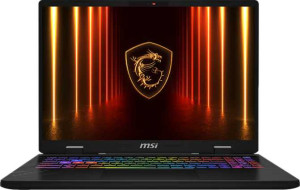
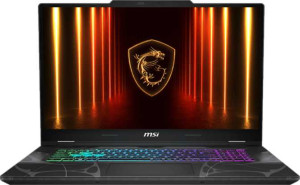
Digging into the GPU internals reveals just how wide the discrete graphics gap truly is. The Crosshair A16's GPU counts 4,608 shading units, 144 TMUs, and 48 ROPs against the Cyborg A15's 2,560 shaders, 80 TMUs, and 32 ROPs — roughly 80% more compute resources across the board. This is further reinforced by the memory subsystem: the Crosshair's effective memory speed of 25,400 MHz and maximum bandwidth of 405.8 GB/s dwarf the Cyborg's 14,000 MHz and 224 GB/s. Higher bandwidth means the GPU is less likely to stall waiting for data, which sustains frame rates in GPU-limited scenarios. Both share the same Blackwell architecture, 128-bit memory bus, and 50W TDP, confirming these are architecturally related but binned at very different performance levels.
The CPU-side cache hierarchy also favors the Crosshair significantly. With 64 MB of L3 cache — four times the Cyborg's 16 MB — and double the L1 capacity, the Crosshair's processor can hold far more working data close to its cores, reducing latency in cache-sensitive workloads like gaming engines and simulation software. One notable edge for the Cyborg, however, is its support for RAM speeds up to 7,500 MHz versus the Crosshair's 5,200 MHz ceiling, giving it more headroom for memory overclocking or future high-speed kit compatibility. Additionally, only the Crosshair features an unlocked clock multiplier, making it the only one of the two that can be CPU-overclocked — a meaningful perk for enthusiasts who want to push the hardware beyond factory settings.
The Cyborg's higher RAM speed ceiling is a genuine but narrow counterpoint. Taken as a whole, the Crosshair A16 dominates this category through massively superior GPU compute resources, faster and wider memory bandwidth, a far deeper cache hierarchy, and overclocking flexibility that the Cyborg simply does not offer.