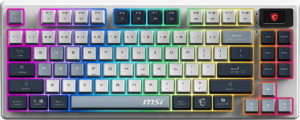
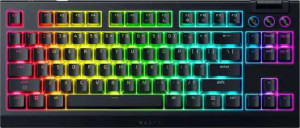
Shared ground between these two keyboards in the features category is limited to N-Key Rollover (NKRO), which ensures every simultaneous keypress is registered independently — a baseline expectation for any serious gaming keyboard. Beyond that, the MSI Forge GK600 TKL distinguishes itself with capabilities the Razer simply does not offer.
Most notably, the MSI supports analog input and adjustable actuation. Analog input means individual keys can report a continuous range of values rather than a binary on/off signal, enabling nuanced control in compatible games — similar to how an analog joystick behaves. Paired with adjustable actuation, users can fine-tune the exact depth at which each keypress registers, tailoring the feel and responsiveness to their preference or game genre. The Razer BlackWidow V4 TKL HyperSpeed offers neither, making it a purely traditional digital input device in comparison.
The MSI also includes an on-board display, which typically surfaces real-time status information — such as active profiles, connectivity mode, or battery level — without needing companion software. The Razer has no equivalent. Neither keyboard supports open firmware standards like QMK, ZMK, or VIA, so deep low-level remapping is off the table for both. Still, the MSI's analog capability, adjustable actuation, and built-in display collectively represent a meaningful feature advantage in this group, making it the stronger choice for users who want more control and on-device feedback.