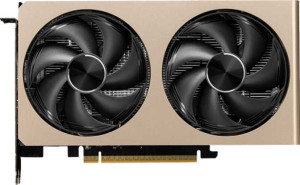
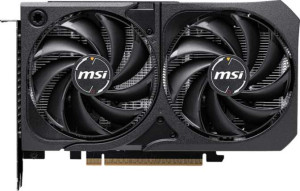
At the architectural level, the MSI RTX 5060 Inspire 2X and the MSI RTX 5060 Shadow 2X OC are built on identical silicon: the same 3840 shading units, 120 TMUs, 48 ROPs, and 1750 MHz memory speed. This means the two cards process geometry, textures, and pixels through exactly the same pipeline — any performance difference between them comes down entirely to clock speed headroom.
That difference is narrow but consistent. Both cards share a 2280 MHz base clock, but the Shadow 2X OC's factory overclock pushes its turbo to 2527 MHz versus the Inspire 2X's 2497 MHz — a 30 MHz gap, or roughly 1.2%. This modest uplift flows directly into every throughput metric: the Shadow 2X OC edges ahead with 19.41 TFLOPS of floating-point performance versus 19.18 TFLOPS, a 303.2 GTexels/s texture rate versus 299.6, and a 121.3 GPixel/s pixel rate versus 119.9. In isolation, a ~1–1.5% advantage is rarely perceptible in real workloads, sitting well within frame-to-frame variance in most games and GPU-accelerated tasks.
The Shadow 2X OC holds a technical edge in this group, but it is slim. Both cards support Double Precision Floating Point, making neither distinctly better for GPGPU or professional compute workloads. For pure gaming or content creation, the Inspire 2X and the Shadow 2X OC will perform virtually identically in practice; the OC variant is the rational pick only if it carries no meaningful price premium, since its advantage will not be discernible without benchmarking tools.