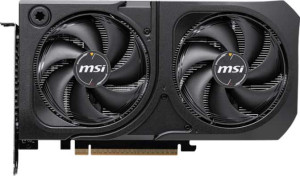
At first glance, these two cards look remarkably similar on paper: both carry 16GB of GDDR7 VRAM, run at the same effective memory speed of 28000 MHz, and both support ECC memory for error-corrected compute workloads. For many buyers, the identical VRAM capacity will be the headline — and it does mean neither card has a practical advantage in terms of how large a scene, texture set, or model can fit into GPU memory.
Where the memory subsystems diverge sharply is the bus width. The RTX 5060 Ti Shadow 2X Plus uses a 128-bit memory interface, while the RTX 5070 Ti Shadow 3X doubles that to 256-bit. Since both cards use the same memory chips at the same speed, that wider bus is the sole reason the 5070 Ti achieves 896 GB/s of peak bandwidth against the 5060 Ti's 448 GB/s — exactly twice as much. Memory bandwidth is the pipeline that feeds the GPU's shaders with data; starve that pipeline and even the fastest execution units sit idle. At high resolutions, with large textures, or under demanding ray-tracing workloads, the 5070 Ti's headroom here directly sustains its higher frame rates rather than allowing them to be bottlenecked by memory throughput.
The RTX 5070 Ti Shadow 3X holds a clear memory bandwidth advantage, and it is a structurally important one — not a marginal difference. The equal VRAM capacity means the 5060 Ti is not left behind for everyday gaming at 1440p, but users targeting 4K or memory-intensive compute tasks will feel the 5070 Ti's 2× bandwidth lead in sustained, real-world performance.