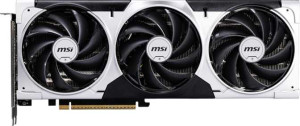
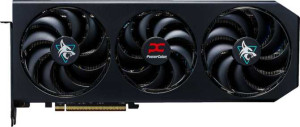
Both cards ship with 16GB of VRAM, which is a meaningful point of parity — at this tier, 16GB provides comfortable headroom for high-resolution textures, modding, and memory-hungry workloads without either card being disadvantaged on capacity alone. The more interesting story lies in how each card's memory subsystem is architected to deliver that bandwidth to the GPU.
The RTX 5060 Ti takes a modern, efficiency-focused approach: GDDR7 memory running at an effective 28,000 MHz over a 128-bit bus. GDDR7 is the newer standard, offering significantly higher per-pin data rates than GDDR6, which is precisely how NVIDIA compensates for the narrower bus. The RX 9070 XT, by contrast, uses GDDR6 at 20,000 MHz but pairs it with a much wider 256-bit bus. This wider bus is the key: it allows more data to flow in parallel each clock cycle, and the result is a maximum memory bandwidth of 644.6 GB/s — versus 448 GB/s on the RTX 5060 Ti. That is a roughly 44% bandwidth advantage for the RX 9070 XT, despite using an older memory generation.
In practice, memory bandwidth is one of the most direct predictors of GPU performance at high resolutions, where the framebuffer grows large and the GPU must constantly stream texture and geometry data. The RX 9070 XT's bandwidth advantage reinforces its broader performance lead and reduces the likelihood of memory bottlenecks in demanding scenarios. The RTX 5060 Ti's adoption of GDDR7 is a forward-looking architectural choice, but within the constraints of a 128-bit bus, it cannot close the bandwidth gap. Both cards support ECC memory, though this is primarily relevant for professional and compute use cases rather than gaming. On memory subsystem strength, the RX 9070 XT holds a clear and consequential edge.