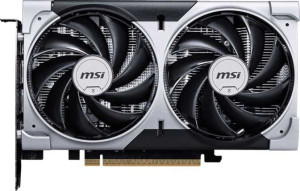
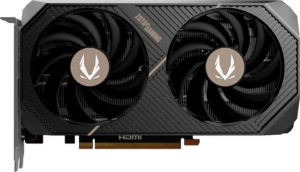
At their core, both the MSI Ventus 2X and the Zotac AMP share identical silicon foundations: the same 3840 shading units, 120 TMUs, 48 ROPs, and a matching base clock of 2280 MHz with memory running at 1750 MHz. This means the two cards are built on the exact same GPU architecture and, under everyday workloads, will behave virtually identically.
The real differentiation lies in the boost clock. The Zotac AMP reaches a turbo of 2550 MHz versus the MSI Ventus 2X's 2497 MHz — a gap of 53 MHz, or roughly 2.1%. This translates directly into the derived throughput figures: the Zotac edges ahead with 19.58 TFLOPS of floating-point performance and a texture rate of 306 GTexels/s, compared to 19.18 TFLOPS and 299.6 GTexels/s for the MSI. In practical terms, a ~2% compute advantage is unlikely to produce a measurable framerate difference in gaming, though it could offer a slight edge in sustained GPU-compute workloads like AI inferencing or creative rendering over long sessions.
On balance, the Zotac AMP holds a narrow but real performance edge in this group, courtesy of its higher factory boost clock. Both cards support Double Precision Floating Point, so neither has an architectural advantage there. For users focused purely on out-of-box performance headroom, the Zotac's higher turbo gives it the win — though the margin is slim enough that real-world gaming results will fall within the noise floor for most titles.