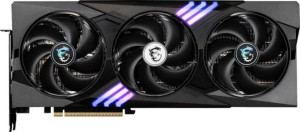
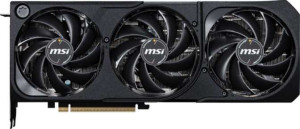
At first glance, the clock speed story favors the MSI GeForce RTX 5070 Gaming Trio OC: its base clock of 2325 MHz and turbo of 2610 MHz both outpace the RTX 5070 Ti Shadow 3X OC's 2295 MHz base and 2482 MHz turbo. However, raw clock frequency is only one part of the GPU performance equation — and in this case, it is the less important part.
What truly separates these two cards is the scale of their underlying silicon. The Shadow 3X OC fields 8,960 shading units, 280 TMUs, and 96 ROPs against the Gaming Trio OC's 6,144 shaders, 192 TMUs, and 80 ROPs — roughly a 46% wider compute engine. This architectural gap is why the Shadow 3X OC delivers 44.48 TFLOPS of floating-point throughput versus 32.07 TFLOPS, and a texture fill rate of 695 GTexels/s versus 501.1 GTexels/s. In practice, more shaders and TMUs mean the GPU can process more geometry, lighting calculations, and shader workloads per clock cycle — directly translating to higher average frame rates and better headroom at demanding resolutions and settings. The higher ROP count on the Shadow 3X OC also gives it a pixel fill rate advantage (238.3 GPixel/s vs 208.8 GPixel/s), which benefits anti-aliasing and high-resolution rendering. Memory speed is identical at 1750 MHz for both, and both support double-precision floating point — a niche but useful feature for compute workloads.
The RTX 5070 Ti Shadow 3X OC holds a clear and substantial performance advantage in this group. Despite running at modestly lower clocks, its far larger shader array produces roughly 38% more raw compute throughput, making it the stronger card for GPU-intensive workloads across gaming and content creation alike. The Gaming Trio OC's clock speed lead is real but insufficient to close that gap.