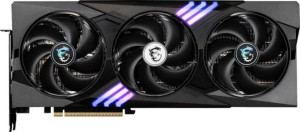
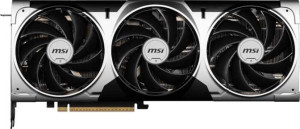
At first glance, the MSI RTX 5070 Gaming Trio OC appears competitive thanks to its higher base and turbo clock speeds — 2325 MHz / 2610 MHz versus 2295 MHz / 2482 MHz on the MSI RTX 5070 Ti Ventus 3X OC. A faster clock means each execution cycle completes more quickly, which can benefit latency-sensitive workloads. However, raw clock speed is only one part of the GPU performance equation, and in this case, it tells only a small fraction of the story.
The far more consequential differentiator is the scale of the compute hardware itself. The RTX 5070 Ti Ventus carries 8,960 shading units and 280 TMUs against the Gaming Trio OC's 6,144 shading units and 192 TMUs — roughly a 46% advantage in raw parallelism. This directly translates into the floating-point performance gap: 44.48 TFLOPS on the 5070 Ti versus 32.07 TFLOPS on the 5070 — a difference that matters enormously in GPU-accelerated rendering, AI inference, and compute-heavy games. The 5070 Ti also edges ahead on pixel output with 96 ROPs versus 80, yielding a higher pixel fill rate (238.3 GPixel/s vs. 208.8 GPixel/s), which benefits high-resolution and high-framerate scenarios. Memory speed is identical at 1750 MHz on both cards, and both support Double Precision Floating Point, making that a non-factor in the comparison.
The RTX 5070 Ti Ventus 3X OC holds a clear and substantial performance advantage in this group. Its clock speed deficit is modest and is entirely overwhelmed by its much larger shader array and compute throughput. For users prioritizing raw GPU horsepower — whether for gaming at 4K, content creation, or AI workloads — the 5070 Ti is the stronger performer based purely on these specs.