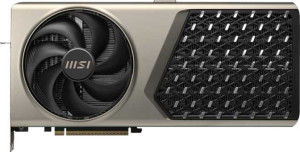
Both the MSI RTX 5070 Ti Expert and the MSI RTX 5080 Expert share an identical base clock of 2295 MHz, meaning neither card has an architectural edge at idle or low-load scenarios. The real divergence begins at boost: the RTX 5080 Expert reaches a turbo of 2617 MHz versus 2452 MHz on the 5070 Ti Expert — a roughly 7% higher peak frequency that compounds across every sustained workload like gaming, rendering, or inference.
The more decisive gap, however, comes from raw silicon width. The RTX 5080 Expert fields 10,752 shading units, 336 TMUs, and 112 ROPs against the 5070 Ti Expert's 8,960 / 280 / 96 respectively — approximately a 20% wider execution engine across the board. Combined with its faster memory speed of 1875 MHz versus 1750 MHz, this translates into a floating-point throughput of 56.28 TFLOPS on the 5080 Expert compared to 43.94 TFLOPS on the 5070 Ti Expert — a ~28% computational advantage. In practice, this margin is felt most acutely in 4K rasterization, ray tracing workloads, and GPU-accelerated compute tasks where shader and memory bandwidth saturation become the bottleneck. Both cards support Double Precision Floating Point, so neither has an exclusive edge for mixed-precision professional workloads.
The MSI RTX 5080 Expert holds a clear and consistent performance advantage in this group. The lead is not marginal — nearly 30% more compute throughput, higher turbo clocks, faster memory, and wider raster and texture pipelines collectively point to a meaningfully faster card under real-world demanding loads. The 5070 Ti Expert is competitive at its tier, but the 5080 Expert outclasses it on every measurable performance dimension provided here.