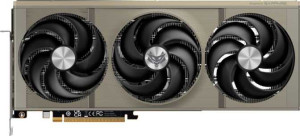
MSI GeForce RTX 5070 Ti Expert
Sapphire Nitro+ Radeon RX 9070 XT

MSI GeForce RTX 5070 Ti Expert Sapphire Nitro+ Radeon RX 9070 XT

Overview

In this head-to-head comparison between the MSI GeForce RTX 5070 Ti Expert and the Sapphire Nitro+ Radeon RX 9070 XT, we put two of the most compelling modern GPUs side by side to examine their key battlegrounds: raw compute performance, memory subsystem capabilities, feature sets, and physical design. Both cards share a strong foundation, yet they take distinctly different architectural approaches that could make one a far better fit for your specific needs than the other.

Common Features

  • Both cards support Double Precision Floating Point (DPFP).
  • Both cards come with 16GB of VRAM.
  • Both cards use a 256-bit memory bus width.
  • ECC memory support is available on both products.
  • Both cards support DirectX 12 Ultimate.
  • Both cards support OpenGL version 4.6.
  • Multi-display technology is supported on both products.
  • Ray tracing support is available on both products.
  • 3D support is available on both products.
  • XeSS (XMX) support is not available on either product.
  • LHR is not present on either product.
  • Both cards support up to 4 displays.
  • Both cards have an HDMI output with HDMI version 2.1b.
  • Neither card has any USB-C ports.
  • Neither card has any DVI outputs.
  • Neither card has any mini DisplayPort outputs.
  • Both cards use PCI Express (PCIe) version 5.
  • Air-water cooling is not available on either product.

Main Differences

  • GPU base clock speed is 2295 MHz on MSI GeForce RTX 5070 Ti Expert and 1660 MHz on Sapphire Nitro+ Radeon RX 9070 XT.
  • GPU turbo clock speed is 2452 MHz on MSI GeForce RTX 5070 Ti Expert and 3060 MHz on Sapphire Nitro+ Radeon RX 9070 XT.
  • Pixel rate is 235.4 GPixel/s on MSI GeForce RTX 5070 Ti Expert and 391.7 GPixel/s on Sapphire Nitro+ Radeon RX 9070 XT.
  • Floating-point performance is 43.94 TFLOPS on MSI GeForce RTX 5070 Ti Expert and 50.14 TFLOPS on Sapphire Nitro+ Radeon RX 9070 XT.
  • Texture rate is 686.6 GTexels/s on MSI GeForce RTX 5070 Ti Expert and 783.4 GTexels/s on Sapphire Nitro+ Radeon RX 9070 XT.
  • GPU memory speed is 1750 MHz on MSI GeForce RTX 5070 Ti Expert and 2518 MHz on Sapphire Nitro+ Radeon RX 9070 XT.
  • Shading units count is 8960 on MSI GeForce RTX 5070 Ti Expert and 4096 on Sapphire Nitro+ Radeon RX 9070 XT.
  • Texture mapping units (TMUs) number 280 on MSI GeForce RTX 5070 Ti Expert and 256 on Sapphire Nitro+ Radeon RX 9070 XT.
  • Render output units (ROPs) total 96 on MSI GeForce RTX 5070 Ti Expert and 128 on Sapphire Nitro+ Radeon RX 9070 XT.
  • Effective memory speed is 28000 MHz on MSI GeForce RTX 5070 Ti Expert and 20000 MHz on Sapphire Nitro+ Radeon RX 9070 XT.
  • Maximum memory bandwidth is 896 GB/s on MSI GeForce RTX 5070 Ti Expert and 644.6 GB/s on Sapphire Nitro+ Radeon RX 9070 XT.
  • MSI GeForce RTX 5070 Ti Expert uses GDDR7 memory, while Sapphire Nitro+ Radeon RX 9070 XT uses GDDR6.
  • OpenCL version is 3 on MSI GeForce RTX 5070 Ti Expert and 2.2 on Sapphire Nitro+ Radeon RX 9070 XT.
  • DLSS support is present on MSI GeForce RTX 5070 Ti Expert but not available on Sapphire Nitro+ Radeon RX 9070 XT.
  • MSI GeForce RTX 5070 Ti Expert uses Intel Resizable BAR, while Sapphire Nitro+ Radeon RX 9070 XT uses AMD SAM.
  • RGB lighting is present on Sapphire Nitro+ Radeon RX 9070 XT but not available on MSI GeForce RTX 5070 Ti Expert.
  • HDMI port count is 1 on MSI GeForce RTX 5070 Ti Expert and 2 on Sapphire Nitro+ Radeon RX 9070 XT.
  • DisplayPort outputs number 3 on MSI GeForce RTX 5070 Ti Expert and 2 on Sapphire Nitro+ Radeon RX 9070 XT.
  • GPU architecture is Blackwell on MSI GeForce RTX 5070 Ti Expert and RDNA 4.0 on Sapphire Nitro+ Radeon RX 9070 XT.
  • Thermal Design Power (TDP) is 300W on MSI GeForce RTX 5070 Ti Expert and 330W on Sapphire Nitro+ Radeon RX 9070 XT.
  • Semiconductor size is 5 nm on MSI GeForce RTX 5070 Ti Expert and 4 nm on Sapphire Nitro+ Radeon RX 9070 XT.
  • Transistor count is 45600 million on MSI GeForce RTX 5070 Ti Expert and 53900 million on Sapphire Nitro+ Radeon RX 9070 XT.
  • Card width is 319 mm on MSI GeForce RTX 5070 Ti Expert and 330.8 mm on Sapphire Nitro+ Radeon RX 9070 XT.
  • Card height is 150 mm on MSI GeForce RTX 5070 Ti Expert and 128.5 mm on Sapphire Nitro+ Radeon RX 9070 XT.
Specs Comparison
MSI GeForce RTX 5070 Ti Expert

MSI GeForce RTX 5070 Ti Expert

Sapphire Nitro+ Radeon RX 9070 XT

Sapphire Nitro+ Radeon RX 9070 XT

Performance:
GPU clock speed 2295 MHz 1660 MHz
GPU turbo 2452 MHz 3060 MHz
pixel rate 235.4 GPixel/s 391.7 GPixel/s
floating-point performance 43.94 TFLOPS 50.14 TFLOPS
texture rate 686.6 GTexels/s 783.4 GTexels/s
GPU memory speed 1750 MHz 2518 MHz
shading units 8960 4096
texture mapping units (TMUs) 280 256
render output units (ROPs) 96 128
Has Double Precision Floating Point (DPFP)

At first glance, the raw unit counts favor the MSI RTX 5070 Ti Expert: it fields a substantially larger shader array with 8960 shading units and 280 TMUs versus the Sapphire Nitro+ RX 9070 XT's 4096 shading units and 256 TMUs. However, clock speed is the great equalizer here. The RX 9070 XT boosts to a striking 3060 MHz turbo — more than 600 MHz higher than the RTX 5070 Ti's 2452 MHz peak — and that frequency advantage more than compensates for the shader count deficit when it comes to real throughput numbers.

The throughput metrics tell the decisive story. The RX 9070 XT delivers 50.14 TFLOPS of floating-point performance against the RTX 5070 Ti's 43.94 TFLOPS, a roughly 14% lead. Its pixel rate of 391.7 GPixel/s dwarfs the RTX 5070 Ti's 235.4 GPixel/s — a gap driven both by higher clocks and by the RX 9070 XT's larger ROP count (128 ROPs vs. 96), which directly determines how fast the GPU can write finished pixels to the framebuffer. Higher pixel fill rate matters most at high resolutions and with anti-aliasing enabled. Memory bandwidth potential also skews toward the RX 9070 XT, whose GDDR6 runs at 2518 MHz versus 1750 MHz on the RTX 5070 Ti.

On paper, the Sapphire Nitro+ RX 9070 XT holds a clear performance edge within this spec group across virtually every throughput metric — TFLOPS, pixel rate, texture rate, and memory speed — despite the MSI card's larger shader array. The RTX 5070 Ti's advantage in shading unit and TMU count does not translate into a lead in any of the computed performance figures provided. Both cards support Double Precision Floating Point, so that is a wash. For workloads that map closely to these throughput figures, the RX 9070 XT is the stronger performer based strictly on the data here.

Memory:
effective memory speed 28000 MHz 20000 MHz
maximum memory bandwidth 896 GB/s 644.6 GB/s
VRAM 16GB 16GB
GDDR version GDDR7 GDDR6
memory bus width 256-bit 256-bit
Supports ECC memory

Both cards ship with 16GB of VRAM on a 256-bit memory bus, and both support ECC memory — so capacity and bus width are a dead heat. The real separation comes from the memory technology underneath. The RTX 5070 Ti Expert uses GDDR7, while the RX 9070 XT relies on GDDR6, and that generational gap produces a substantial bandwidth difference that shows up directly in the effective speed figures.

The RTX 5070 Ti's GDDR7 achieves an effective speed of 28000 MHz, yielding a peak bandwidth of 896 GB/s. The RX 9070 XT's GDDR6 tops out at 20000 MHz effective, translating to 644.6 GB/s — roughly 28% less throughput across the same 256-bit bus. Memory bandwidth acts as a pipeline: the wider and faster it is, the more data the GPU can feed its compute units per second. At high resolutions, with large textures, or in memory-intensive workloads like raytracing and AI inference, a starved memory bus becomes a bottleneck regardless of how powerful the shader array is. The RTX 5070 Ti's bandwidth advantage gives it considerably more headroom before hitting that ceiling.

In the memory category, the MSI RTX 5070 Ti Expert holds a clear and meaningful edge. Identical capacity and bus width mean neither card has a raw storage advantage, but the RTX 5070 Ti's GDDR7 subsystem delivers bandwidth that the GDDR6-equipped RX 9070 XT simply cannot match — and in demanding, high-resolution scenarios, that gap will be felt.

Features:
DirectX version DirectX 12 Ultimate DirectX 12 Ultimate
OpenGL version 4.6 4.6
OpenCL version 3 2.2
Supports multi-display technology
supports ray tracing
Supports 3D
supports DLSS
has XeSS (XMX)
AMD SAM / Intel Resizable BAR Intel Resizable BAR AMD SAM
has LHR
has RGB lighting
supported displays 4 4

The foundational feature set is largely shared: both cards run DirectX 12 Ultimate, OpenGL 4.6, support ray tracing, multi-display output across up to 4 displays, and carry no LHR restrictions. Where they diverge is in the features that define each vendor's ecosystem. The RTX 5070 Ti Expert supports DLSS — Nvidia's AI-driven upscaling and frame generation technology — which has become one of the most widely adopted performance-boosting features in modern PC gaming, with broad support across hundreds of titles. The RX 9070 XT does not support DLSS, nor does either card support XeSS.

The OpenCL version gap is minor but worth noting: the RTX 5070 Ti supports OpenCL 3 versus the RX 9070 XT's OpenCL 2.2, which could matter for certain compute or creative workloads that target the newer standard. On the memory access side, the RTX 5070 Ti uses Intel Resizable BAR while the RX 9070 XT uses AMD SAM — both are implementations of the same underlying PCIe feature that allows the CPU to access the full GPU memory pool, improving performance in supported games. In practice, the functional benefit is equivalent between the two implementations. The RX 9070 XT does add RGB lighting, which the RTX 5070 Ti lacks — a purely aesthetic differentiator.

For the features category, the MSI RTX 5070 Ti Expert holds the more impactful advantage. DLSS support is a significant real-world differentiator — it provides meaningful frame rate uplift and image quality options in a large and growing library of games, a capability the RX 9070 XT cannot access. The remaining differences are either minor or equivalent in effect.

Ports:
has an HDMI output
HDMI ports 1 2
HDMI version HDMI 2.1b HDMI 2.1b
DisplayPort outputs 3 2
USB-C ports 0 0
DVI outputs 0 0
mini DisplayPort outputs 0 0

Both cards share the same total port count of four outputs and the same HDMI 2.1b standard, which supports 4K at high refresh rates and 8K output. The only meaningful difference lies in how that total is distributed. The RTX 5070 Ti Expert opts for 1 HDMI + 3 DisplayPort, while the RX 9070 XT flips the balance to 2 HDMI + 2 DisplayPort.

In practice, this split matters depending on your display setup. Users running multiple monitors that connect via DisplayPort — common among PC enthusiasts and productivity users — will find the RTX 5070 Ti's three DisplayPort outputs more convenient, avoiding the need for adapters. Conversely, the RX 9070 XT's two HDMI ports are a tangible advantage for anyone connecting a mix of HDMI-native devices such as a TV alongside a primary monitor, or pairing the card with a console-style display arrangement — all without reaching for a cable adapter.

This category is essentially a tie in capability, with the edge going to whichever card matches the user's specific display ecosystem. Neither card offers USB-C or DVI outputs, so there are no surprises on those fronts. If your setup is DisplayPort-heavy, the RTX 5070 Ti Expert is the more convenient choice; if HDMI devices dominate your desk, the Sapphire RX 9070 XT serves you better.

General info:
GPU architecture Blackwell RDNA 4.0
release date August 2025 March 2025
Thermal Design Power (TDP) 300W 330W
PCI Express (PCIe) version 5 5
semiconductor size 5 nm 4 nm
number of transistors 45600 million 53900 million
Has air-water cooling
width 319 mm 330.8 mm
height 150 mm 128.5 mm

Manufactured on different process nodes, these two cards reveal an interesting efficiency story. The RX 9070 XT is built on a 4 nm process and packs 53,900 million transistors, compared to the RTX 5070 Ti's 5 nm die with 45,600 million transistors. A smaller node generally allows more transistors in the same die area with improved power characteristics — and yet the RX 9070 XT draws a higher 330W TDP versus the RTX 5070 Ti's 300W. That 30W difference suggests AMD has used the denser node to prioritize transistor count and raw compute headroom rather than power reduction, while Nvidia's Blackwell architecture achieves its output at a notably lower thermal envelope.

From a physical standpoint, the two cards are close in size but differ in shape. The RTX 5070 Ti Expert measures 319 × 150 mm, while the RX 9070 XT is slightly longer and shorter at 330.8 × 128.5 mm. The height difference is the more practically relevant dimension — a taller card at 150 mm may conflict with certain motherboard heatsinks or RAM clearance in tighter cases, whereas the RX 9070 XT's slimmer 128.5 mm profile could be the deciding factor in compact or mid-tower builds with limited vertical GPU clearance. Both cards use PCIe 5.0 and air cooling only.

On the whole, this group does not produce a single clear winner — each card holds a different kind of advantage. The RTX 5070 Ti Expert has the edge in power efficiency, drawing 30W less for a competitive workload. The RX 9070 XT counters with a more advanced process node, a higher transistor count, and a lower-profile form factor that may fit more easily into space-constrained cases. The right choice here depends on whether your priority is system power draw or physical compatibility.

Comparison Summary & Verdict

After a thorough review of the specifications, both cards prove to be highly capable, but they cater to different priorities. The MSI GeForce RTX 5070 Ti Expert stands out with its significantly higher memory bandwidth of 896 GB/s, faster GDDR7 memory, a larger shading unit count of 8960, and exclusive DLSS support, making it the stronger choice for workflows and games that leverage NVIDIA’s AI-upscaling ecosystem. On the other hand, the Sapphire Nitro+ Radeon RX 9070 XT counters with a higher boost clock of 3060 MHz, superior pixel rate and texture rate, a newer 4 nm process node, and a higher floating-point score of 50.14 TFLOPS, giving it an edge in raw rasterization throughput. It also adds RGB lighting and a second HDMI port for connectivity flexibility. Neither card is an outright winner; your ideal choice hinges on whether you value NVIDIA’s feature ecosystem or AMD’s raw clock-speed performance.

MSI GeForce RTX 5070 Ti Expert
Buy MSI GeForce RTX 5070 Ti Expert if...

Buy the MSI GeForce RTX 5070 Ti Expert if you want faster memory bandwidth, GDDR7 memory, and access to DLSS for AI-powered upscaling in supported games and applications.

Sapphire Nitro+ Radeon RX 9070 XT
Buy Sapphire Nitro+ Radeon RX 9070 XT if...

Buy the Sapphire Nitro+ Radeon RX 9070 XT if you prioritize a higher boost clock speed, superior pixel rate, greater floating-point performance, and a more feature-rich connectivity setup with dual HDMI ports.