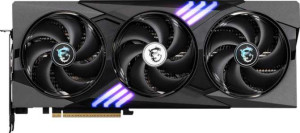
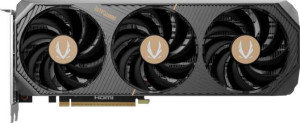
At their core, both the MSI GeForce RTX 5070 Ti Gaming Trio OC Plus and the Zotac Gaming GeForce RTX 5070 Ti Solid SFF OC share the same fundamental GPU silicon: identical base clocks of 2295 MHz, the same 8960 shading units, 280 TMUs, 96 ROPs, and 1750 MHz memory speed. This means their theoretical compute ceiling and memory bandwidth characteristics start from the exact same foundation.
The real differentiator in this group is the GPU boost clock. The MSI card boosts to 2572 MHz, while the Zotac reaches only 2482 MHz — a gap of 90 MHz, or roughly 3.6%. That difference cascades directly into every throughput metric: the MSI delivers 46.09 TFLOPS of floating-point performance versus 44.48 TFLOPS for the Zotac, a 720.2 GTexels/s texture fill rate against 695 GTexels/s, and a pixel rate of 246.9 GPixel/s compared to 238.3 GPixel/s. In practice, a ~3–4% clock advantage translates to a modest but measurable edge in GPU-bound workloads — think slightly higher sustained frame rates in demanding games or marginally faster inference times in compute tasks.
The MSI Gaming Trio OC Plus holds a clear, if narrow, performance edge in this group. Its higher factory overclock means it extracts more throughput from the same GPU architecture without any user intervention. The Zotac Solid SFF OC, by contrast, appears to trade a small amount of peak clock headroom — likely in exchange for its smaller form factor and tighter thermal constraints. For users prioritizing raw GPU performance, the MSI is the stronger choice here; for those where size is the priority, the Zotac's slightly lower clocks are the expected cost of its compact design.