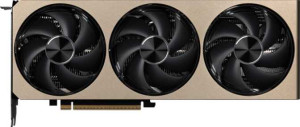
MSI GeForce RTX 5070 Ti Inspire 3X OC Plus
MSI GeForce RTX 5070 Ti Inspire 3X Plus

MSI GeForce RTX 5070 Ti Inspire 3X OC Plus MSI GeForce RTX 5070 Ti Inspire 3X Plus

Overview

Welcome to our in-depth specification comparison between the MSI GeForce RTX 5070 Ti Inspire 3X OC Plus and the MSI GeForce RTX 5070 Ti Inspire 3X Plus. Both cards share the same Blackwell architecture, 16GB of GDDR7 memory, and a 300W TDP, yet they differ in key clock speed and throughput metrics that could matter to demanding users. Read on to see exactly where each card stands.

Common Features

  • Both cards share a base GPU clock speed of 2295 MHz.
  • Both cards have a GPU memory speed of 1750 MHz.
  • Both cards feature 8960 shading units.
  • Both cards have 280 texture mapping units (TMUs).
  • Both cards have 96 render output units (ROPs).
  • Double Precision Floating Point (DPFP) is supported on both cards.
  • Both cards have an effective memory speed of 28000 MHz.
  • Both cards offer a maximum memory bandwidth of 896 GB/s.
  • Both cards come with 16GB of VRAM.
  • Both cards use GDDR7 memory.
  • Both cards have a 256-bit memory bus width.
  • ECC memory is supported on both cards.
  • Both cards support DirectX 12 Ultimate.
  • Both cards support OpenGL version 4.6.
  • Both cards support OpenCL version 3.
  • Multi-display technology is supported on both cards.
  • Ray tracing is supported on both cards.
  • DLSS is supported on both cards.
  • 3D support is available on both cards.
  • XeSS (XMX) is not available on either card.
  • Both cards have one HDMI 2.1b port and three DisplayPort outputs.
  • Neither card has USB-C or DVI outputs.
  • Both cards are built on the Blackwell GPU architecture.
  • Both cards have a Thermal Design Power (TDP) of 300W.
  • Both cards use PCIe version 5.
  • Both cards are manufactured on a 5 nm semiconductor process.
  • Both cards contain 45600 million transistors.
  • Air-water cooling is not available on either card.
  • Both cards share the same dimensions of 288 mm width and 112 mm height.

Main Differences

  • GPU turbo clock speed is 2482 MHz on MSI GeForce RTX 5070 Ti Inspire 3X OC Plus and 2452 MHz on MSI GeForce RTX 5070 Ti Inspire 3X Plus.
  • Pixel rate is 238.3 GPixel/s on MSI GeForce RTX 5070 Ti Inspire 3X OC Plus and 235.4 GPixel/s on MSI GeForce RTX 5070 Ti Inspire 3X Plus.
  • Floating-point performance is 44.48 TFLOPS on MSI GeForce RTX 5070 Ti Inspire 3X OC Plus and 43.94 TFLOPS on MSI GeForce RTX 5070 Ti Inspire 3X Plus.
  • Texture rate is 695 GTexels/s on MSI GeForce RTX 5070 Ti Inspire 3X OC Plus and 686.6 GTexels/s on MSI GeForce RTX 5070 Ti Inspire 3X Plus.
Specs Comparison
MSI GeForce RTX 5070 Ti Inspire 3X OC Plus

MSI GeForce RTX 5070 Ti Inspire 3X OC Plus

MSI GeForce RTX 5070 Ti Inspire 3X Plus

MSI GeForce RTX 5070 Ti Inspire 3X Plus

Performance:
GPU clock speed 2295 MHz 2295 MHz
GPU turbo 2482 MHz 2452 MHz
pixel rate 238.3 GPixel/s 235.4 GPixel/s
floating-point performance 44.48 TFLOPS 43.94 TFLOPS
texture rate 695 GTexels/s 686.6 GTexels/s
GPU memory speed 1750 MHz 1750 MHz
shading units 8960 8960
texture mapping units (TMUs) 280 280
render output units (ROPs) 96 96
Has Double Precision Floating Point (DPFP)

At their core, both the MSI RTX 5070 Ti Inspire 3X OC Plus and the Inspire 3X Plus share an identical silicon foundation: the same 8960 shading units, 280 TMUs, 96 ROPs, and 1750 MHz memory speed. Both also support Double Precision Floating Point, confirming the same GPU die with no hardware cuts between the two models. The base clock of 2295 MHz is likewise identical, meaning out-of-the-box, non-boosted workloads will behave the same on either card.

The meaningful split comes down to one number: the GPU turbo (boost) clock. The OC Plus reaches 2482 MHz versus 2452 MHz on the standard Plus — a 30 MHz difference. That gap ripples directly into every derived throughput metric. The OC Plus delivers 44.48 TFLOPS of floating-point performance against 43.94 TFLOPS, a 695 GTexels/s texture rate versus 686.6 GTexels/s, and a pixel rate of 238.3 GPixel/s versus 235.4 GPixel/s. In percentage terms, the OC Plus is roughly 1.2% faster across all of these metrics — a modest but consistent lead.

In real-world gaming or rendering, a ~1.2% throughput advantage is unlikely to translate into a perceptible frame-rate difference on its own. However, the OC Plus does hold a measurable, across-the-board edge in this group purely due to its higher factory boost clock. If peak theoretical throughput is the deciding factor, the OC Plus wins this category — narrowly but unambiguously.

Memory:
effective memory speed 28000 MHz 28000 MHz
maximum memory bandwidth 896 GB/s 896 GB/s
VRAM 16GB 16GB
GDDR version GDDR7 GDDR7
memory bus width 256-bit 256-bit
Supports ECC memory

When it comes to memory, both cards are completely identical — there is not a single differentiating figure between them. Both feature 16GB of GDDR7 VRAM across a 256-bit bus, running at an effective speed of 28000 MHz for a peak bandwidth of 896 GB/s. ECC memory support is also present on both, which adds a layer of data integrity useful in precision compute workloads.

The real-world significance of these shared specs is worth unpacking. 896 GB/s of memory bandwidth is substantial, enabling the GPU to feed its shader array with texture and geometry data at high resolution without bottlenecking — particularly relevant at 4K or when working with large assets in creative applications. The 16GB VRAM capacity is also generous enough to handle high-resolution textures, complex ray-traced scenes, and AI-assisted rendering tasks comfortably.

This group is a clear and complete tie. No matter which of the two cards a buyer chooses, the memory subsystem — its capacity, speed, bus width, and feature set — is exactly the same. Any purchase decision should rest entirely on other specification groups.

Features:
DirectX version DirectX 12 Ultimate DirectX 12 Ultimate
OpenGL version 4.6 4.6
OpenCL version 3 3
Supports multi-display technology
supports ray tracing
Supports 3D
supports DLSS
has XeSS (XMX)
AMD SAM / Intel Resizable BAR Intel Resizable BAR Intel Resizable BAR
has LHR
has RGB lighting
supported displays 4 4

Feature parity between these two cards is total. Both support DirectX 12 Ultimate — the highest current DirectX tier, unlocking hardware ray tracing, mesh shaders, and variable rate shading in compatible titles — alongside OpenGL 4.6 and OpenCL 3, covering the full spectrum from gaming to GPU-accelerated compute workloads. Neither card carries LHR restrictions, meaning full, unthrottled GPU utilization is available across all use cases.

On the display and rendering side, both support up to 4 simultaneous displays and include DLSS, NVIDIA's AI-driven upscaling technology that can significantly boost frame rates with minimal visual quality trade-off. Ray tracing support is present on both as well. Notably, neither card supports AMD SAM but both do support Intel Resizable BAR, which allows the CPU to access the full GPU frame buffer at once — a feature that can yield modest performance gains in supported games and systems.

This group is another unambiguous tie. Every feature flag, API version, and capability is mirrored exactly across the OC Plus and the standard Plus. Buyers comparing these two cards on features alone have no basis for differentiation here.

Ports:
has an HDMI output
HDMI ports 1 1
HDMI version HDMI 2.1b HDMI 2.1b
DisplayPort outputs 3 3
USB-C ports 0 0
DVI outputs 0 0
mini DisplayPort outputs 0 0

The port layout on both cards is identical: 3 DisplayPort outputs and 1 HDMI 2.1b port, totaling four display connections — which aligns with the four-display limit noted in the Features group. There are no USB-C, DVI, or mini DisplayPort outputs on either card.

The quality of those connections matters as much as the count. HDMI 2.1b is the latest HDMI revision, supporting up to 4K at high refresh rates and 8K output, making it well-suited for modern TVs and high-end monitors. The three DisplayPort outputs, meanwhile, give multi-monitor desktop users and sim-racing or productivity setups the flexibility to drive several high-resolution panels simultaneously without adapters.

Predictably, this group is a dead tie. The connector selection, port count, and HDMI version are a perfect match across both the OC Plus and the standard Plus. Connectivity requirements should play no role in choosing between these two cards.

General info:
GPU architecture Blackwell Blackwell
release date February 2025 February 2025
Thermal Design Power (TDP) 300W 300W
PCI Express (PCIe) version 5 5
semiconductor size 5 nm 5 nm
number of transistors 45600 million 45600 million
Has air-water cooling
width 288 mm 288 mm
height 112 mm 112 mm

Underneath the cooler shroud, both cards are built on exactly the same silicon: NVIDIA's Blackwell architecture, manufactured on a 5nm process with 45.6 billion transistors. That transistor count reflects a dense, modern GPU die, and the 5nm node helps balance high compute density with manageable heat output. PCIe 5.0 support is present on both, ensuring neither card will face any interface-level bandwidth constraints on current or near-future platforms.

Power draw and physical footprint are also a match. Both cards carry a 300W TDP, so system builders should plan for the same PSU headroom and case airflow requirements regardless of which model they choose. Dimensionally, the cards are identical at 288 mm wide and 112 mm tall, meaning case compatibility and cooler clearance are non-issues when comparing the two.

This group offers no basis for differentiation whatsoever. From architecture and process node down to physical dimensions and thermal envelope, the OC Plus and the standard Plus are indistinguishable. As has been the pattern across most groups in this comparison, the only meaningful delta between these two cards remains the factory boost clock advantage held by the OC Plus.

Comparison Summary & Verdict

After a thorough comparison, it is clear that the MSI GeForce RTX 5070 Ti Inspire 3X OC Plus and the MSI GeForce RTX 5070 Ti Inspire 3X Plus are nearly identical cards sharing the same memory subsystem, feature set, port layout, and physical dimensions. The only meaningful separators are the OC Plus model's higher GPU turbo clock of 2482 MHz, its slightly elevated floating-point performance of 44.48 TFLOPS, and its marginally better texture rate of 695 GTexels/s and pixel rate of 238.3 GPixel/s. For enthusiasts who want every last frame and are willing to pay a premium for factory-overclocked headroom, the OC Plus is the natural choice. For those seeking outstanding Blackwell-generation performance at what is typically a lower price point, the standard Plus delivers nearly identical real-world output with the same 16GB GDDR7 memory and full feature parity.

MSI GeForce RTX 5070 Ti Inspire 3X OC Plus
Buy MSI GeForce RTX 5070 Ti Inspire 3X OC Plus if...

Buy the MSI GeForce RTX 5070 Ti Inspire 3X OC Plus if you want the highest factory-overclocked GPU turbo clock, pixel rate, texture rate, and floating-point performance available between these two cards.

MSI GeForce RTX 5070 Ti Inspire 3X Plus
Buy MSI GeForce RTX 5070 Ti Inspire 3X Plus if...

Buy the MSI GeForce RTX 5070 Ti Inspire 3X Plus if you are happy to trade a small reduction in GPU turbo clock speed and throughput figures for what is otherwise an identical card in terms of memory, features, ports, and build.