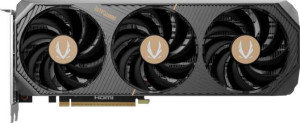
Both the MSI RTX 5070 Ti Inspire 3X OC Plus and the Zotac RTX 5070 Ti Solid SFF OC carry an identical memory configuration built around GDDR7 — the latest generation of graphics memory. Running at an effective speed of 28000 MHz across a 256-bit bus, this combination yields 896 GB/s of peak memory bandwidth. To put that in perspective, this bandwidth figure comfortably outpaces previous-generation GDDR6X implementations on higher-tier cards, meaning texture streaming, large asset loading, and high-resolution framebuffer operations are handled with significant headroom on both cards.
The 16 GB of VRAM is another shared highlight worth contextualizing. At this capacity, both cards are well-positioned for 4K gaming with high-resolution texture packs, as well as emerging AI-assisted rendering workloads like DLSS frame generation that increasingly benefit from larger frame buffers. ECC memory support is also present on both, a feature typically associated with professional GPU workloads — it adds error-correcting capability that protects data integrity under sustained compute tasks, though it has negligible relevance for pure gaming use.
As with the Performance group, this is an unambiguous tie. Every memory specification — capacity, speed, bandwidth, bus width, and feature support — is identical across both cards. Buyers should look elsewhere in the spec sheet, such as cooling design or physical dimensions, to differentiate between them.