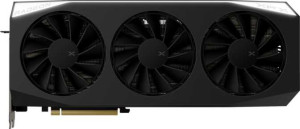
The performance picture here is more nuanced than a simple spec-count comparison suggests. The MSI RTX 5070 Ti leads in raw shader muscle with 8,960 shading units versus the XFX RX 9070 XT's 4,096 — more than double — along with a higher TMU count (280 vs. 256). However, the RTX 5070 Ti's advantage in unit count is largely offset by the RX 9070 XT's dramatically higher turbo clock: 2,970 MHz versus just 2,452 MHz. That ~21% clock speed gap at peak allows the AMD card to push more work through fewer units, closing — and in some throughput metrics, reversing — what looks like an overwhelming NVIDIA lead on paper.
When examining actual computed throughput, the RX 9070 XT comes out ahead across the board. Its floating-point performance of 48.66 TFLOPS beats the RTX 5070 Ti's 43.94 TFLOPS, and its texture rate of 760.3 GTexels/s surpasses the 686.6 GTexels/s of its rival. Most notably, the RX 9070 XT's pixel rate of 380.2 GPixel/s is dramatically higher than the 235.4 GPixel/s on the MSI card — a difference driven by both its higher ROP count (128 vs. 96) and superior turbo frequency. Higher pixel fill rate translates directly to better performance at high resolutions and in scenarios involving heavy anti-aliasing or complex framebuffer operations. The XFX card also benefits from faster memory at 2,518 MHz vs. 1,750 MHz, which helps feed its GPU with data at a higher sustained rate.
Overall, the XFX RX 9070 XT holds a clear edge in computed throughput across every key performance metric in this group — TFLOPS, texture rate, pixel rate, and memory speed — despite its lower shading unit count. The RTX 5070 Ti's larger shader array does not translate into superior throughput at these clock speeds, making the AMD card the stronger performer on paper based strictly on the provided data. Both cards support Double Precision Floating Point, so neither has an exclusive advantage there.