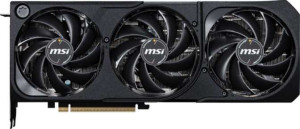
At the architectural level, both GPUs are built on identical silicon: the same 8960 shading units, 280 TMUs, and 96 ROPs, with memory running at 1750 MHz on both cards. This means any performance delta between them comes purely from clock speed tuning, not from hardware differences. Both also support Double Precision Floating Point, which is relevant for compute workloads but a wash here since neither has an advantage.
The key differentiator is how the MSI Shadow 3X OC's factory overclock shifts the performance balance. While Nvidia's Founders Edition holds a negligible edge in base clock (2300 MHz vs. 2295 MHz), the MSI card pulls ahead decisively under boost, hitting 2482 MHz versus the reference 2450 MHz — a 32 MHz advantage where it counts most. That higher sustained boost directly inflates all throughput metrics: the MSI delivers 44.48 TFLOPS of floating-point performance against 43.94 TFLOPS, a 695 GTexels/s texture rate versus 686.6 GTexels/s, and a 238.3 GPixel/s pixel rate compared to 235.2 GPixel/s. These are roughly 1–1.2% gains across the board.
In real-world terms, a ~1% performance lead is imperceptible in gaming frame rates and unlikely to be felt in most workloads. However, the MSI Shadow 3X OC holds the edge in this group by every throughput metric — a direct result of its factory overclock. Users who want to extract the maximum out of the RTX 5070 Ti GPU without manual overclocking will find the MSI marginally ahead, though the gap is too small to be a decisive factor on its own.