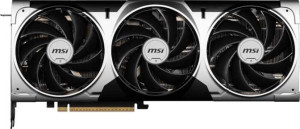
MSI GeForce RTX 5070 Ti Shadow 3X
MSI GeForce RTX 5070 Ti Ventus 3X OC

MSI GeForce RTX 5070 Ti Shadow 3X MSI GeForce RTX 5070 Ti Ventus 3X OC

Overview

Welcome to our in-depth specification comparison between the MSI GeForce RTX 5070 Ti Shadow 3X and the MSI GeForce RTX 5070 Ti Ventus 3X OC. Both cards are built on the same Blackwell architecture with identical memory configurations, port layouts, and feature sets, making this a fascinating head-to-head. The real question comes down to GPU turbo clock speeds and the raw throughput metrics that flow from them. Read on to find out which card edges ahead where it counts.

Common Features

  • Both cards share a base GPU clock speed of 2295 MHz.
  • Both cards have a GPU memory speed of 1750 MHz.
  • Both cards feature 8960 shading units.
  • Both cards include 280 texture mapping units (TMUs).
  • Both cards have 96 render output units (ROPs).
  • Double Precision Floating Point (DPFP) is supported on both cards.
  • Both cards have an effective memory speed of 28000 MHz.
  • Both cards offer a maximum memory bandwidth of 896 GB/s.
  • Both cards come with 16GB of VRAM.
  • Both cards use GDDR7 memory.
  • Both cards have a 256-bit memory bus width.
  • ECC memory is supported on both cards.
  • Both cards support DirectX 12 Ultimate.
  • Both cards support OpenGL version 4.6.
  • Both cards support OpenCL version 3.
  • Multi-display technology is supported on both cards.
  • Ray tracing is supported on both cards.
  • DLSS is supported on both cards.
  • XeSS (XMX) is not available on either card.
  • Both cards have one HDMI 2.1b output and three DisplayPort outputs, with no USB-C or DVI outputs.
  • Both cards are built on the Blackwell GPU architecture.
  • Both cards have a Thermal Design Power (TDP) of 300W.
  • Both cards use PCIe version 5.
  • Both cards are manufactured on a 5 nm semiconductor process.
  • Both cards contain 45600 million transistors.
  • Air-water cooling is not available on either card.
  • Both cards share the same dimensions of 303 mm width and 121 mm height.

Main Differences

  • GPU turbo clock speed is 2452 MHz on the MSI GeForce RTX 5070 Ti Shadow 3X and 2482 MHz on the MSI GeForce RTX 5070 Ti Ventus 3X OC.
  • Pixel rate is 235.4 GPixel/s on the MSI GeForce RTX 5070 Ti Shadow 3X and 238.3 GPixel/s on the MSI GeForce RTX 5070 Ti Ventus 3X OC.
  • Floating-point performance is 43.94 TFLOPS on the MSI GeForce RTX 5070 Ti Shadow 3X and 44.48 TFLOPS on the MSI GeForce RTX 5070 Ti Ventus 3X OC.
  • Texture rate is 686.6 GTexels/s on the MSI GeForce RTX 5070 Ti Shadow 3X and 695 GTexels/s on the MSI GeForce RTX 5070 Ti Ventus 3X OC.
Specs Comparison
MSI GeForce RTX 5070 Ti Shadow 3X

MSI GeForce RTX 5070 Ti Shadow 3X

MSI GeForce RTX 5070 Ti Ventus 3X OC

MSI GeForce RTX 5070 Ti Ventus 3X OC

Performance:
GPU clock speed 2295 MHz 2295 MHz
GPU turbo 2452 MHz 2482 MHz
pixel rate 235.4 GPixel/s 238.3 GPixel/s
floating-point performance 43.94 TFLOPS 44.48 TFLOPS
texture rate 686.6 GTexels/s 695 GTexels/s
GPU memory speed 1750 MHz 1750 MHz
shading units 8960 8960
texture mapping units (TMUs) 280 280
render output units (ROPs) 96 96
Has Double Precision Floating Point (DPFP)

At their core, both cards share identical silicon configurations: 8960 shading units, 280 TMUs, 96 ROPs, and a base clock of 2295 MHz — meaning the underlying GPU architecture and its theoretical ceiling are the same. The real divergence lies in the boost clock, where the Ventus 3X OC edges ahead at 2482 MHz versus the Shadow 3X's 2452 MHz, a 30 MHz advantage that cascades directly into every performance metric derived from it.

That clock gap translates to the Ventus 3X OC posting a higher floating-point throughput of 44.48 TFLOPS versus 43.94 TFLOPS, a higher pixel fill rate of 238.3 GPixel/s versus 235.4, and a texture rate of 695 GTexels/s versus 686.6. In practice, these are roughly 1.2–1.5% differences — negligible in any real-world gaming or rendering workload. No benchmark would reliably distinguish them frame-to-frame, and the gap would fall well within run-to-run variance.

The Ventus 3X OC holds a narrow but technically measurable performance edge in this group, purely by virtue of its higher factory boost clock. However, given that the margin is under 2% across all derived metrics and both cards share the same memory speed and compute architecture, this advantage is effectively a tie for practical purposes. A buyer choosing between them on performance alone would gain nothing meaningful from the OC model — the decision is better made on cooling, acoustics, or price.

Memory:
effective memory speed 28000 MHz 28000 MHz
maximum memory bandwidth 896 GB/s 896 GB/s
VRAM 16GB 16GB
GDDR version GDDR7 GDDR7
memory bus width 256-bit 256-bit
Supports ECC memory

Memory is where these two cards are truly indistinguishable — every single specification is identical. Both carry 16GB of GDDR7 VRAM across a 256-bit bus, running at an effective speed of 28000 MHz and delivering a peak bandwidth of 896 GB/s. That bandwidth figure is particularly significant: it positions both cards well above what most gaming workloads demand today, and provides meaningful headroom for memory-intensive tasks like 4K texture streaming, ray tracing, and AI-accelerated rendering.

The GDDR7 standard itself is worth noting — it represents a generational leap in memory efficiency and data throughput over GDDR6X, achieving higher bandwidth at lower voltages. Combined with the 256-bit bus, the 896 GB/s ceiling means neither card will encounter a memory bottleneck in any current consumer workload. ECC memory support is also present on both, which reduces the risk of data corruption in professional or compute applications — a minor but welcome feature for creators using these cards beyond gaming.

This group is a complete tie. There is no basis to prefer one card over the other on memory grounds — the subsystem is literally the same hardware. Any performance difference between the two in memory-bound scenarios will be zero.

Features:
DirectX version DirectX 12 Ultimate DirectX 12 Ultimate
OpenGL version 4.6 4.6
OpenCL version 3 3
Supports multi-display technology
supports ray tracing
Supports 3D
supports DLSS
has XeSS (XMX)
AMD SAM / Intel Resizable BAR Intel Resizable BAR Intel Resizable BAR
has LHR
has RGB lighting
supported displays 4 4

Feature parity is total here — both cards expose an identical software and API capability set. The headline items are DirectX 12 Ultimate and ray tracing support, which together unlock the full suite of modern rendering techniques: hardware-accelerated ray tracing, mesh shaders, variable-rate shading, and sampler feedback. For gamers, this means neither card leaves anything on the table when running current and next-generation titles.

DLSS support is present on both, which is arguably the most impactful feature on this list. DLSS allows the GPU to render at a lower internal resolution and reconstruct a higher-quality image using AI, delivering substantial frame rate gains with minimal visual quality loss — particularly valuable at 4K. Both cards also support up to 4 simultaneous displays and Intel Resizable BAR, the latter allowing the CPU to access the full GPU framebuffer at once, which can yield modest performance improvements in supported games and workloads.

With no differentiating feature on either side, this group is an unambiguous tie. A buyer who prioritizes software capabilities — API support, upscaling technology, or multi-monitor flexibility — will find no reason to favor one card over the other. The decision remains entirely in the domain of clock speeds, thermals, and price.

Ports:
has an HDMI output
HDMI ports 1 1
HDMI version HDMI 2.1b HDMI 2.1b
DisplayPort outputs 3 3
USB-C ports 0 0
DVI outputs 0 0
mini DisplayPort outputs 0 0

The port configuration on both cards is identical: 3 DisplayPort outputs and 1 HDMI 2.1b port, totaling four physical display connections — which aligns with the maximum supported display count established in the Features group. This is a practical and well-balanced layout for both gamers and multi-monitor power users.

HDMI 2.1b is the key specification worth unpacking here. It supports up to 10K resolution with high refresh rates, includes enhanced Variable Refresh Rate capabilities, and is backward compatible with older HDMI standards — making it future-proof for high-end TVs and monitors. The three DisplayPort outputs, meanwhile, are well-suited for desktop monitor setups, particularly for users running a triple-display configuration for productivity or sim racing. The absence of USB-C and DVI outputs is standard for modern cards at this tier and carries no practical penalty for the overwhelming majority of users.

No differentiation exists between the two cards on connectivity — this is another clean tie. Whichever card a buyer chooses, they get the same display ecosystem flexibility, the same maximum resolution support, and the same physical port layout.

General info:
GPU architecture Blackwell Blackwell
release date February 2025 February 2025
Thermal Design Power (TDP) 300W 300W
PCI Express (PCIe) version 5 5
semiconductor size 5 nm 5 nm
number of transistors 45600 million 45600 million
Has air-water cooling
width 303 mm 303 mm
height 121 mm 121 mm

Underneath the different cooler designs, both cards are built on exactly the same silicon foundation: NVIDIA's Blackwell architecture, fabbed on a 5nm process with 45.6 billion transistors. That transistor count and process node define the generational leap these cards represent — the 5nm node enables higher transistor density and better power efficiency compared to prior generations, which is part of what allows Blackwell to deliver its performance-per-watt improvements.

Both cards carry a 300W TDP, which sets the expectations for power supply and cooling requirements equally across both models. At 300W, buyers will need a capable PSU — typically 850W or above depending on the rest of the system — and adequate case airflow. The shared PCIe 5.0 interface ensures maximum bandwidth headroom to the CPU, though in practice PCIe 4.0 is rarely a bottleneck at this tier either. Physical dimensions are also locked in at 303mm × 121mm for both, so case compatibility planning applies equally to either card.

General info is a straight tie with no differentiators anywhere in the group. Both cards are the same chip, the same process, the same power envelope, and the same physical footprint. The choice between the Shadow 3X and Ventus 3X OC will ultimately hinge on factors outside this group — namely cooling performance, noise levels, and price.

Comparison Summary & Verdict

After a thorough review of the specifications, it is clear that the MSI GeForce RTX 5070 Ti Shadow 3X and the MSI GeForce RTX 5070 Ti Ventus 3X OC are extremely closely matched cards. Both share identical memory configurations of 16GB GDDR7 at 896 GB/s bandwidth, the same port selection, the same 300W TDP, and the same full feature set including ray tracing and DLSS support. The only meaningful separation lies in the GPU turbo clock, where the Ventus 3X OC reaches 2482 MHz versus 2452 MHz on the Shadow 3X, translating into marginally higher floating-point performance of 44.48 TFLOPS against 43.94 TFLOPS. Choose the Ventus 3X OC if you want every last drop of peak clock headroom, and opt for the Shadow 3X if it comes in at a lower price point for virtually the same real-world experience.

MSI GeForce RTX 5070 Ti Shadow 3X
Buy MSI GeForce RTX 5070 Ti Shadow 3X if...

Buy the MSI GeForce RTX 5070 Ti Shadow 3X if you want the same core Blackwell architecture, 16GB GDDR7 memory, and full feature set at potentially a lower cost, accepting a marginally lower GPU turbo clock of 2452 MHz.

MSI GeForce RTX 5070 Ti Ventus 3X OC
Buy MSI GeForce RTX 5070 Ti Ventus 3X OC if...

Buy the MSI GeForce RTX 5070 Ti Ventus 3X OC if you want the highest available boost clock at 2482 MHz and the slightly higher floating-point performance of 44.48 TFLOPS that comes with it.