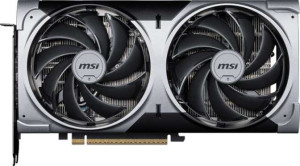
At first glance, the clock speed story favors the MSI GeForce RTX 5070 Ventus 2X OC, which runs a slightly higher base clock of 2325 MHz and boosts to 2542 MHz, compared to the Shadow 3X's 2295 MHz base and 2452 MHz turbo. However, raw clock speed is only one piece of the performance puzzle — and in this case, it is the less important one. The RTX 5070 Ti Shadow 3X fields a dramatically larger GPU die with 8960 shading units and 280 TMUs, versus 6144 shading units and 192 TMUs on the Ventus 2X OC. More execution units at a slightly lower frequency still yields far greater throughput.
This translates directly into the headline compute metrics. The Shadow 3X delivers 43.94 TFLOPS of floating-point performance — roughly 41% more than the Ventus 2X OC's 31.24 TFLOPS. Similarly, its texture fill rate of 686.6 GTexels/s dwarfs the Ventus 2X OC's 488.1 GTexels/s, meaning the Ti variant can process complex, heavily textured scenes with significantly less GPU-bound strain. The pixel rate advantage (235.4 GPixel/s vs 203.4 GPixel/s) further indicates higher sustainable frame output at demanding resolutions. Both cards share an identical 1750 MHz memory speed and both support Double Precision Floating Point, so neither holds an edge there.
The conclusion for this group is clear: the RTX 5070 Ti Shadow 3X holds a decisive and broad performance advantage. The Ventus 2X OC's marginally higher clock speeds are a cosmetic edge that cannot compensate for the Ti's substantially larger shader array and the compute throughput it enables. Users prioritizing peak rendering performance — particularly at higher resolutions or in compute-heavy workloads — will find the Shadow 3X to be the significantly stronger card based on these specs.