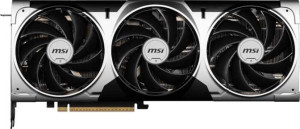
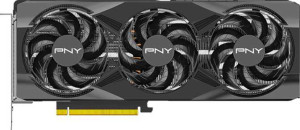
Both cards share an identical foundation: the same 2295 MHz base clock, 8960 shading units, 280 TMUs, 96 ROPs, and 1750 MHz memory speed. This means they are built on the same silicon configuration with no architectural differences — the distinction between them is entirely a matter of factory overclocking.
The meaningful divergence appears at boost: the PNY GeForce RTX 5070 Ti OC Triple Fan reaches a 2572 MHz turbo versus 2482 MHz on the MSI Ventus 3X OC — a 90 MHz gap (~3.6%). That delta flows directly into every throughput metric: the PNY delivers 46.09 TFLOPS of floating-point performance against 44.48 TFLOPS for the MSI, a texture rate of 720.2 GTexels/s versus 695 GTexels/s, and a pixel fill rate of 246.9 GPixel/s versus 238.3 GPixel/s. In practice, a ~3–4% compute advantage rarely produces a dramatic frame-rate gap in GPU-limited scenarios, but it does provide a slight edge in compute-heavy workloads, ray tracing throughput, and situations where the GPU is already running near its boost ceiling.
On performance, the PNY Triple Fan OC holds a clear, if modest, advantage purely by virtue of its higher factory overclock. Both cards support Double Precision Floating Point, so neither has an edge in professional compute tasks that rely on DPFP. If sustained peak throughput is the priority, the PNY's higher boost clock makes it the stronger choice within this spec group; however, the real-world gaming difference will likely be within the margin of run-to-run variance for most titles.