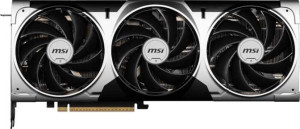
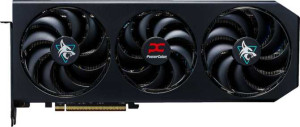
The most striking tension in this performance group is between shading unit count and actual throughput. The MSI RTX 5070 Ti Ventus 3X OC fields a massive 8,960 shading units — more than double the 4,096 in the PowerColor Hellhound RX 9070 XT — yet the AMD card outperforms it on nearly every computed throughput metric. This is a clear architectural story: NVIDIA's Ada/Blackwell-era shader counts don't translate linearly to raw output, whereas AMD's RDNA 4 design extracts significantly more work per clock at higher boost frequencies.
Looking at where it matters most for real workloads: the RX 9070 XT delivers 49.32 TFLOPS of floating-point performance versus 44.48 TFLOPS for the RTX 5070 Ti — an ~11% compute advantage. Its pixel rate of 385.3 GPixel/s (vs. 238.3 on the 5070 Ti) and 128 ROPs (vs. 96) suggest a meaningful edge in fill-rate-bound scenarios such as high-resolution rendering with heavy alpha blending or complex framebuffers. The texture throughput gap is narrower — 770.6 vs. 695 GTexels/s — but still favors the AMD card. Memory speed also leans AMD, with the Hellhound running at 2518 MHz versus 1750 MHz on the MSI, which feeds those compute units more efficiently under sustained load.
The RTX 5070 Ti does hold a notably higher base clock of 2295 MHz, suggesting more consistent floor-level performance and potentially better behavior under power-constrained or thermally throttled conditions, where the RX 9070 XT's 3010 MHz turbo may not always be sustained. Both cards support Double Precision Floating Point, which matters for compute and professional workloads beyond gaming. Overall, on raw paper performance metrics provided here, the PowerColor Hellhound RX 9070 XT holds a clear edge in throughput — compute, pixel, and texture — despite the shader count deficit, making it the stronger performer in this group.