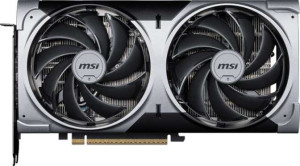
At first glance, the RTX 5070 Ventus 2X OC appears to win on raw clock speeds, with a base of 2325 MHz and a turbo of 2542 MHz versus the 5070 Ti Ventus 3X's 2295 / 2452 MHz. However, clock speed alone is a misleading metric when two GPUs have fundamentally different architectures in terms of execution width. The 5070 Ti carries 8960 shading units versus 6144 on the 5070 OC — a 46% larger shader array — along with 280 TMUs versus 192 and 96 ROPs versus 80. These are not incremental differences; they represent a substantially wider GPU die that can process far more work per clock cycle.
The real-world consequence of that width advantage shows clearly in the compute and throughput figures. The 5070 Ti delivers 43.94 TFLOPS of floating-point performance against the 5070 OC's 31.24 TFLOPS — roughly a 41% lead in raw shader throughput. Similarly, texture fill rate jumps from 488.1 GTexels/s to 686.6 GTexels/s, and pixel fill rate from 203.4 to 235.4 GPixel/s. In practice, this means the 5070 Ti can handle more complex geometry, higher-resolution textures, and denser scenes without the same bottlenecks, translating to better performance in demanding 4K workloads and GPU compute tasks. Memory speed is identical on both at 1750 MHz, and both support Double Precision Floating Point, so neither card holds an advantage in those areas.
The 5070 Ti Ventus 3X holds a decisive performance advantage in this group. The 5070 OC's slightly higher boost clock offers a marginal and largely theoretical edge that is completely overwhelmed by the 5070 Ti's far greater shader, texture, and compute resources. Users prioritizing raw rendering throughput, high-resolution gaming, or GPU-accelerated workloads should consider the 5070 Ti the clear winner here.